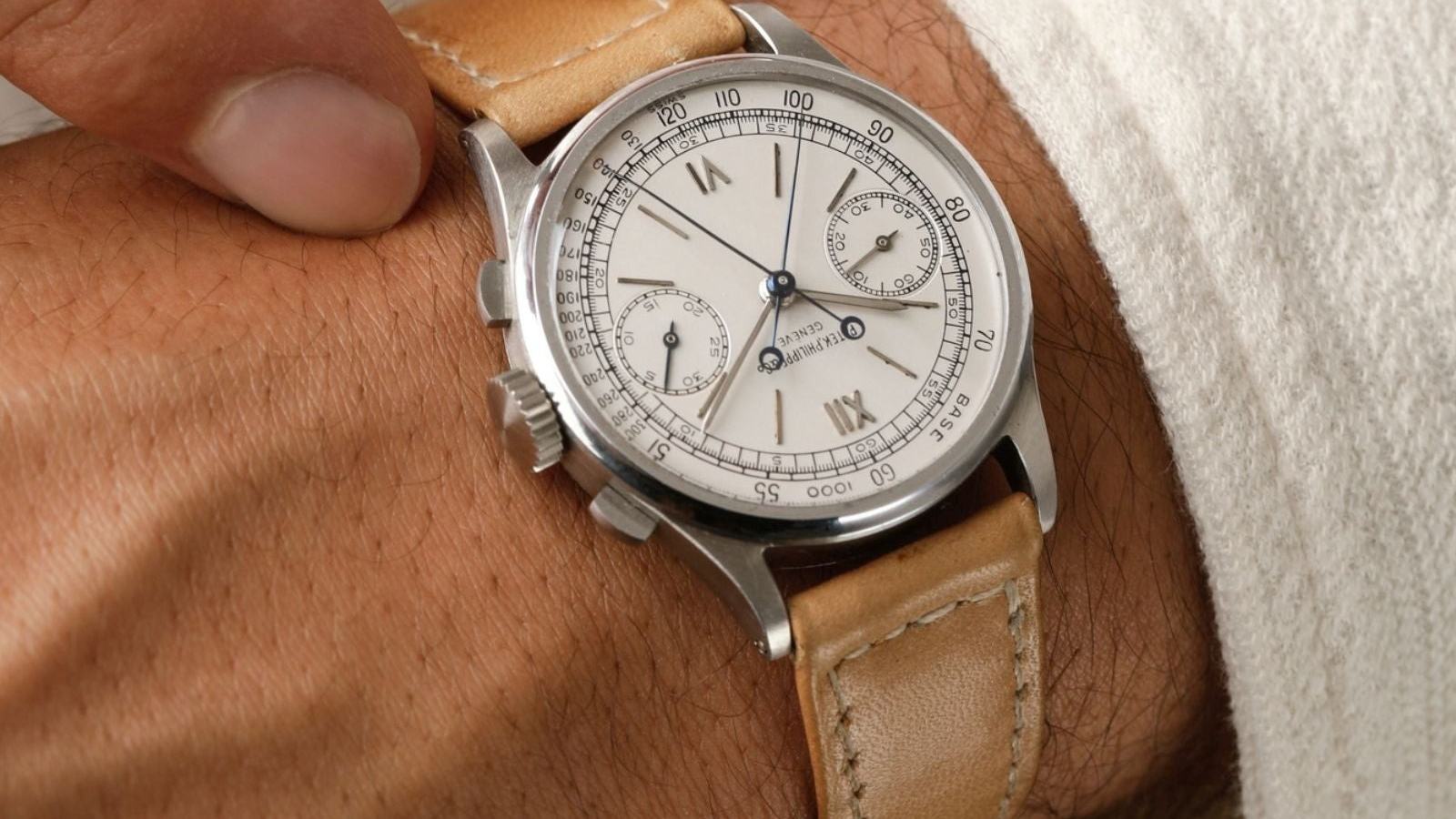
Phillips specialists spotlight a rare 1945 steel Patek Philippe Ref. 1436 split-seconds chronograph with CHF 2m–4m estimate in the November Geneva Watch Auction.
A steel chronograph at the upper end of watch collecting
Phillips has highlighted a 1945 Patek Philippe split-seconds chronograph in stainless steel among the standout lots for its November 2026 Geneva watch auction. Reference 1436 is associated with an advanced mechanical stopwatch function, and examples in steel from this period sit at the most closely studied end of vintage collecting.
The watch is catalogued as lot 95, with a guide of CHF 2 million to CHF 4 million. Those numbers are pre-sale estimates, not realised values, and an interested bidder will also need to consider the auction’s stated premiums and conditions.
Tiffany To and Marcello de Marco, specialists at Phillips, selected it as part of a broader examination of rare watches whose unusual combinations of materials, construction and preservation are not necessarily obvious from a quick glance. Their appraisal emphasises what distinguishes a high-quality example from a superficially similar reference.
Why steel complicates the collecting picture
Stainless steel has often been associated with practical everyday watches, but a highly complicated Patek Philippe from the 1940s can be exceptionally uncommon in that material. Production history, case design and condition all influence how a steel example is evaluated beside pieces made in yellow or pink gold.
The featured watch has a more angular case profile than some yellow-gold examples of reference 1436, with narrower, pointed lugs. Such differences may reflect construction techniques and the separate case makers used during the period, although an attribution should be supported by primary documentation.
An apparently modest material can therefore carry unusually significant historical weight when combined with a demanding movement and a rare surviving configuration. The appeal is not simply that the case is steel, but that it preserves a particular expression of Patek Philippe’s mid-century watchmaking.
A split-seconds mechanism merits careful study
A split-seconds chronograph permits the timing of two overlapping intervals, using a second chronograph hand that can be stopped separately before catching up with the primary hand. The mechanism adds considerable complexity to a conventional stopwatch and requires careful construction and adjustment.
In a mid-century wristwatch, the state of the movement and the originality of its components are critical. Collectors need to understand any service work, replacement parts and refinishing, especially where an apparently minor intervention could alter the rarity or appeal of an individual example.
The reference also invites scrutiny of the dial, hands, case and archival records, with experts seeking consistency across every element. A written condition report is a useful starting point, but specialists routinely recommend a direct examination before a transaction of such magnitude.
How to approach an important November lot
The Geneva Watch Auction XXIV will take place on 7 and 8 November at the Hotel President and includes more than two hundred watches from leading makers. A high estimate may draw attention, but the context of competing lots and the interests of individual collectors can influence how bidding develops.
Buyers should verify whether an advertised estimate is quoted in Swiss francs and understand all applicable taxes, premiums and transport arrangements. Auction catalogue descriptions also deserve close reading for caveats on provenance, component originality and functionality.
For admirers of historic mechanical design, the steel 1436 illustrates why meticulous research matters in collecting. Its true importance lies in the intersection of an uncommon case material, a sophisticated movement and the historical evidence surrounding the watch offered.