Principal Dimensions, Displacement & Hull Geometry
The fundamental dimensions and geometric relationships that define a yacht's displacement, proportions, underwater volume, hull geometry and basic naval architectural platform.
Explore subject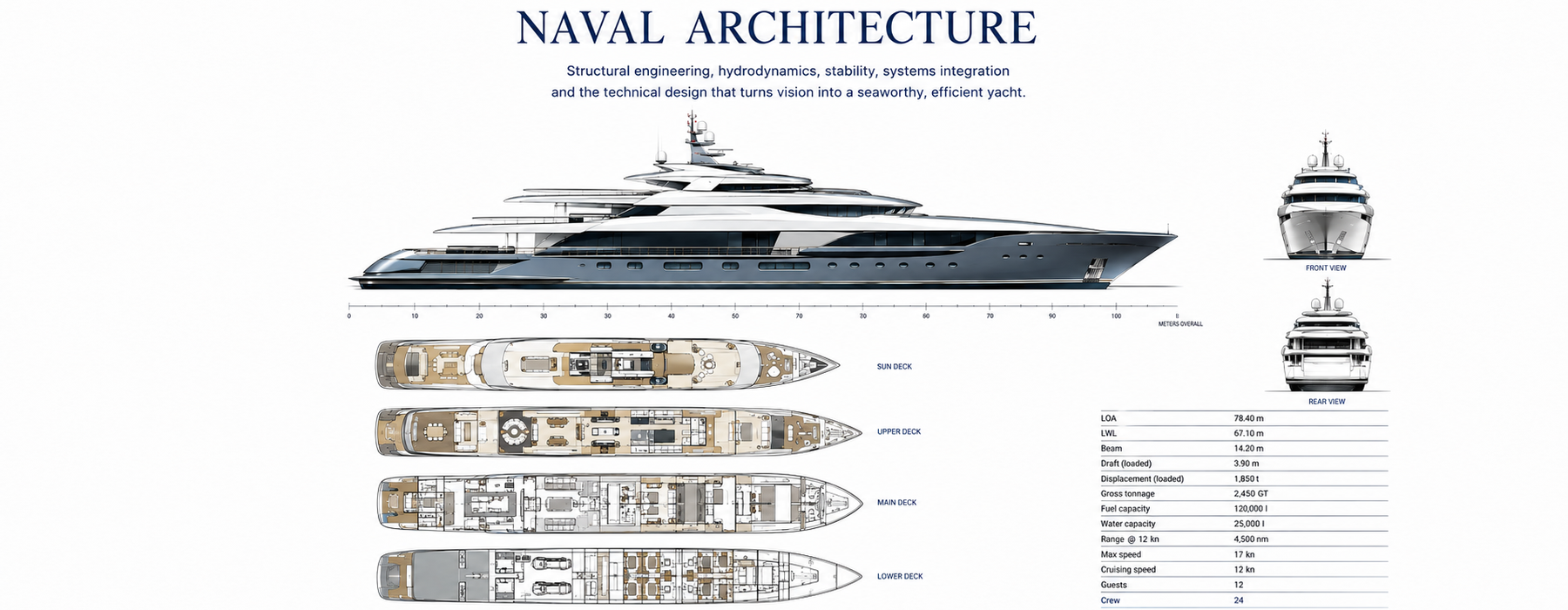
Naval Architecture
Naval Architecture covers hull form, structure, stability, weight, hydrodynamics, watertight integrity and the engineering geometry of the yacht.
Naval Architecture is the specialist discipline covering hull form, hydrostatics, stability, resistance, structures, subdivision, weight control, seakeeping, manoeuvring and the physical vessel geometry on which the yacht depends.
The fundamental dimensions and geometric relationships that define a yacht's displacement, proportions, underwater volume, hull geometry and basic naval architectural platform.
Explore subjectThe characteristics and selection of displacement, semi-displacement, planing and specialist hull forms, and how hull geometry affects performance, volume and operating profile.
Explore subjectHydrostatic behaviour, intact stability and trim, including buoyancy, centres of gravity and flotation, loading effects and the yacht's equilibrium across operating conditions.
Explore subjectHow lightweight estimates, weight growth, load cases and vertical and longitudinal centres of gravity are controlled throughout design, construction, operation and modification.
Explore subjectHow hull resistance, speed requirements, propulsion power and hydrodynamic efficiency are evaluated to support performance, fuel consumption, range and machinery selection.
Explore subjectHow hull geometry, displacement and operating condition influence heave, pitch, roll, accelerations, comfort, operability and the yacht's behaviour in waves.
Explore subjectThe yacht's turning, directional stability and low- and high-speed handling characteristics, including the effects of hull form, appendages, propulsion and steering arrangements.
Explore subjectThe structural engineering of hulls, decks, bulkheads, framing and supporting members, including load paths, strength, stiffness, fatigue considerations and rule-based scantlings.
Explore subjectWatertight boundaries, bulkheads, doors, penetrations and compartment subdivision used to preserve buoyancy and control flooding while accommodating the yacht's arrangement.
Explore subjectAssessment of the yacht's survivability after flooding, including damaged compartments, residual stability, equilibrium, subdivision and the influence of openings and arrangements.
Explore subjectHow freeboard, reserve buoyancy, draft, loading condition and watertight geometry contribute to seaworthiness, operational margins and compliance across the yacht's service profile.
Explore subjectNaval architectural integration of propellers, shafts, pods, waterjets, rudders, stabilisers and other appendages with hull geometry, wake field, resistance and manoeuvring requirements.
Explore subjectSpatial naval architecture of tanks, machinery spaces and major technical zones, balancing capacity, weight distribution, access, structure, hull form and the general arrangement.
Explore subjectEngineering of large hull and superstructure openings, shell doors and movable structures while preserving strength, stiffness, watertight integrity and appropriate load paths.
Explore subjectNaval architectural implications of steel, aluminium, composites and other construction systems, including structural behaviour, weight, fabrication, interfaces and design constraints.
Explore subjectHow classification rules, statutory requirements, design submissions, calculations, plans and approval processes influence naval architecture from concept through construction.
Explore subjectNaval architecture for existing-yacht alteration, including new openings, extensions, added weight, changed loading, structural modifications, stability review and conversion constraints.
Explore subject