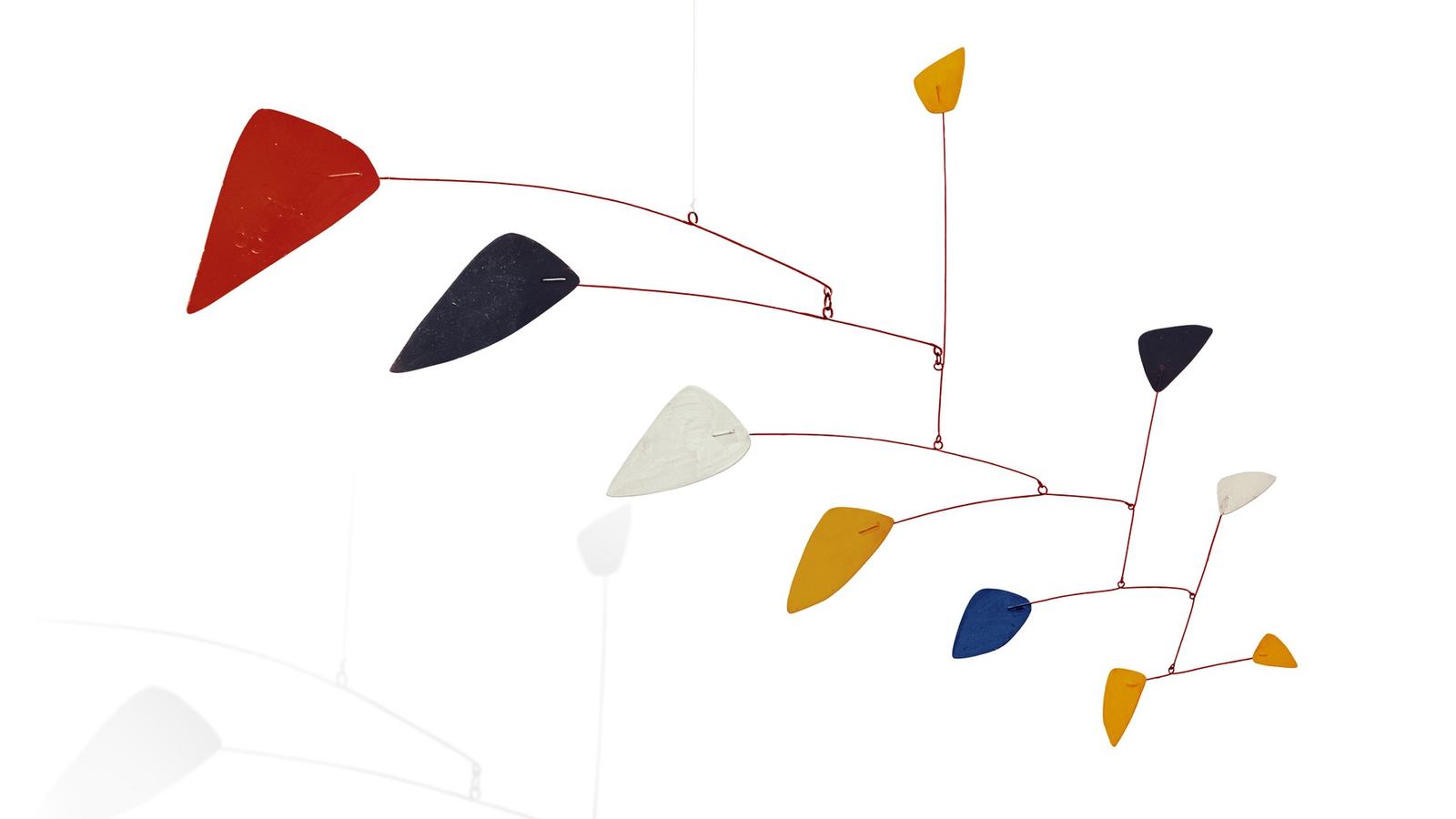
L'Epine Jaune, a 1965 painted-metal and wire sculpture by Alexander Calder, is offered at Sotheby's Paris with a €1.5m–2m estimate.
A sculptural language built on balance
Alexander Calder's L'Epine Jaune, a painted-metal and wire work executed in 1965, is among the sculptures offered in Sotheby's Paris Modernités auction. The piece has an estimate of €1.5 million to €2 million and measures approximately 57 by 90 centimetres. The exact balance of a piece can be difficult to appreciate in a catalogue illustration. Even a seemingly modest metal element may make a decisive contribution to the way the entire sculpture appears from a different viewpoint.
Calder's reputation rests partly on his ability to give simple shapes an unusual sense of energy through their arrangement and balance. Even when an object is relatively small, its relationship to the surrounding air can be central to the way a viewer experiences it.
Colour, line and physical space
The lot combines sheet metal, wire and paint, allowing a small number of carefully chosen elements to define a larger visual space. The title L'Epine Jaune, or The Yellow Thorn, suggests an image without requiring a literal representation of a plant.
Colour provides a point of focus, while the wire introduces lines that can connect elements without concealing the spaces between them. The composition changes when seen from different angles, and a still photograph can capture only one of those possible views.
A documented 1965 provenance
Sotheby's traces the work to Galerie Maeght in Paris and records its purchase by Robert W. Kurtz of Houston in 1965. It subsequently passed through private ownership and Pace Gallery in New York before reaching its present owner in 2011.
That sequence is relevant because a Calder sculpture can involve distinctive construction techniques and surface finishes. Documentation of early ownership helps specialists identify the specific work and examine any changes during its history.
The Calder Foundation record
The catalogue states that the sculpture is registered in the archives of the Calder Foundation in New York under application number A14005. Buyers should distinguish archival registration and catalogue documentation from claims about value, because the latter also depend on condition and market circumstances.
Professional examination can clarify the object's materials, stability and any restoration. A sculpture's apparent simplicity does not mean that modifications to its wire, paint or suspended elements would be inconsequential.
Placement within a private collection
An open composition can be affected by the wall colour, nearby artworks and available sightlines. Display should allow viewers to move around or otherwise see the object from more than one position, without placing vulnerable components in a busy circulation route.
Collectors should discuss handling and mounting with specialists familiar with Calder's work. The costs of appropriate support, insurance and transportation can be significant even when a sculpture is not physically enormous.
Why this lot merits attention
The 1965 date places the work within Calder's mature practice, while its combination of colour and spare metal elements exemplifies qualities that continue to attract collectors. Its history is sufficiently documented to provide a clear starting point for research.
The €1.5m–2m figure is a pre-sale estimate rather than an achieved result. Buyers should understand its aesthetic and physical characteristics before using the market figure to assess whether the work belongs in their collection.