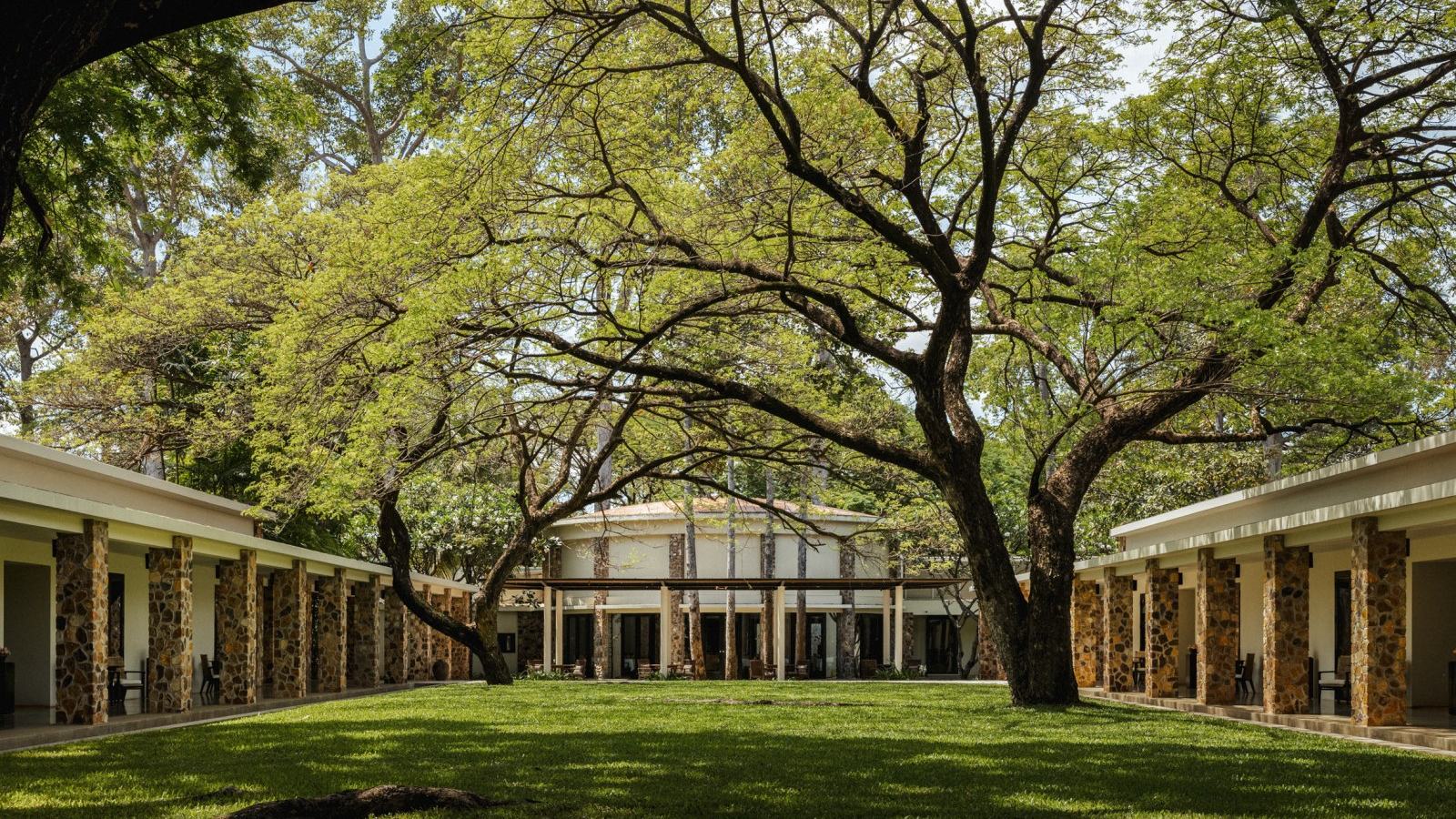
Amansara, once a residence for guests of King Sihanouk, offers 24 suites and a discreet architectural base near Angkor Wat's extraordinary temple landscape.
A remarkable address beside Angkor
Amansara occupies a notable architectural address in Siem Reap, the Cambodian city that acts as the gateway to Angkor's celebrated temple complexes. The resort is close enough to make early excursions practical while preserving the sense of privacy associated with Aman's smaller properties. Rather than copying the appearance of an ancient temple, the building has its own modern Cambodian identity. That distinction matters: visitors encounter two different periods of cultural history, one in the accommodation and another in the monumental landscape beyond it.
The name is associated with an intimate scale, and the property contains 24 suites rather than hundreds of hotel rooms. Its appeal is particularly strong for travellers who want cultural discovery without the busy conventions of a large resort. The nearby temples are an extraordinary draw, but the return journey to a quiet room and courtyard is part of the complete experience. An effective itinerary gives enough time to appreciate both the historic sites and the character of the accommodation.
New Khmer architecture with a royal connection
Aman's official history identifies the property as a former residence for guests of King Sihanouk. Its 1960s New Khmer architectural language reflects a modern period in Cambodia's design history, distinct from the much earlier stone monuments at Angkor. The low profile, composed proportions and restrained details speak to an era that is often overlooked by visitors focused entirely on antiquity. Staying here offers an opportunity to become more attentive to Cambodia's twentieth-century creative heritage.
It is important not to confuse a former royal guest residence with a functioning palace or museum. Amansara operates as hospitality accommodation, and its architectural significance is best understood through the property's documented background. Travellers with a strong interest in design can ask for interpretive information while respecting the privacy of other guests. The building provides a compelling context for conversations about how Cambodian identity has been expressed in very different architectural periods.
Twenty-four suites and a contained world
The accommodation is organised around a relatively intimate resort environment, with suites that favour simple lines and a measured use of space. Some categories include private plunge pools, while others offer a different arrangement of outdoor areas. Guests should examine the precise suite type rather than assume that every room includes identical facilities. In a property of this scale, location within the building and proximity to shared spaces can shape the experience as much as the published dimensions.
For couples travelling privately, the quietness of a courtyard or the possibility of taking an afternoon swim away from a public pool may be the decisive details. For small groups, the relevant questions are whether suites can be allocated near one another and how privacy is preserved during shared meals or excursions. Thoughtful accommodation planning matters when guests return from long days in tropical heat. Comfortable rest is a practical requirement, not merely a luxury adjective.
Cultural excursions require careful pacing
Angkor Wat is the most immediately recognisable landmark in the region, but the wider archaeological landscape contains many distinct sites, each deserving attention. Amansara describes private exploration and culturally focused experiences as important parts of its offering. Guests should discuss interests with the resort team in advance, whether these lie in architecture, history, photography or quieter routes that avoid the busiest periods when possible. A specialist guide can provide essential context that is absent from a rapid photographic visit.
Temple access is governed by local authorities and may involve permits, dress requirements, restricted areas and changing visitor arrangements. A private guide cannot override those rules, and a custom itinerary is not a promise that a major monument will be empty. Heat, distance and walking surfaces should also influence the daily programme. The most satisfying cultural visit is often a focused morning at a few sites, followed by time to absorb what has been seen.
Dining and calm between temple visits
Amansara's circular dining room and landscaped pool areas contribute to the sense of an enclosed retreat. Their restrained design leaves room for conversation after days spent in the field. The hotel can be a comfortable setting for guests who prefer a thoughtful private dinner or time alone rather than an evening of constant entertainment. Dining options and specific menu arrangements should be checked directly before travel, especially where dietary needs or private occasions require advance preparation.
The rhythm of a stay can be more important than the number of tours booked. A visitor might use the coolest part of the morning for the temple complex, return for lunch and rest, then spend a shorter period exploring the city or learning about local traditions. Such a pattern acknowledges Cambodia's climate and the mental concentration that a richly historical destination invites. A hotel that supports periods of calm makes the cultural excursions more enjoyable.
Planning travel to Siem Reap
Amansara is situated near Angkor Wat, but international travellers must still account for airport arrival procedures and the substantial journey from Siem Reap Angkor International Airport. Aman describes a transfer of roughly an hour, a useful planning estimate rather than a guaranteed timetable. Immigration formalities, flight timing and local traffic can alter the final schedule. Guests arranging private flights or onward charter travel should make the necessary airport and ground-handling arrangements directly with qualified providers.
The resort works best when Angkor is treated as the subject of a considered journey, not a short stop squeezed between unrelated destinations. The 24-suite scale, the modern Khmer architecture and the building's unusual history create a coherent base for that approach. For travellers who prize discretion and genuine cultural depth, Amansara offers a distinctive combination: a peaceful twentieth-century residence within reach of one of the world's most significant ancient landscapes.