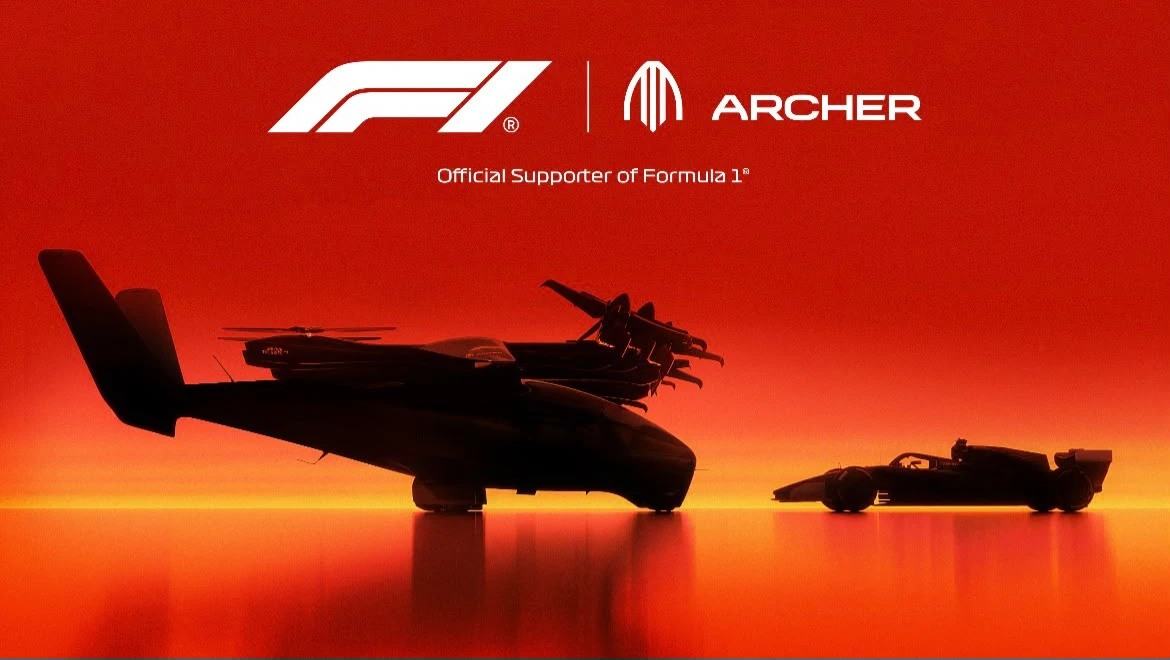
Archer and Formula 1 agree a multi-year partnership to explore future electric air taxi journeys for race guests, subject to regulatory and operating approvals.
Race-weekend transport enters the partnership discussion
Archer Aviation and Formula 1 announced a multi-year partnership on 12 November 2026 under which the electric aircraft company will participate at selected Grand Prix events. The parties also intend to investigate whether an air taxi service could eventually become part of the experience for guests attending races. Their announcement identifies Archer's Midnight aircraft as the proposed platform and relates the initiative to markets in which the company is developing plans for commercial operations.
For a superyacht owner, the idea addresses a familiar problem in high-profile entertainment destinations. Arriving at a marina or international airport can be relatively straightforward, while travelling from there to a crowded venue can consume a disproportionate amount of the day. Air transfer might offer an alternative where suitable infrastructure and airspace arrangements exist. However, the current partnership is not an operating timetable. The companies are exploring potential services; there are no confirmed passenger flights, prices or circuit-to-marina routes in the announcement. Any future service must be evaluated in the context of its actual regulatory status and local operating arrangements.
Why the last part of a journey deserves attention
A race experience often involves several separate movements: a flight to the host city, a transfer to accommodation, travel to the circuit and a return after the event. The final leg of the outward journey may be comparatively short in distance, but special road restrictions and concentrated demand can make its timing difficult. Even an experienced chauffeur cannot remove those constraints. For a client arriving for a scheduled meeting or hospitality programme, uncertainty can be as significant as the time spent travelling.
An alternative aircraft transfer should be compared with that entire sequence rather than simply with the speed of a car on the road. The passenger needs to reach a departure point, complete the operator's boarding process, fly to an approved destination and travel onward to the actual place of attendance. If the landing site is some distance from the venue, the last of those movements may still be substantial. The success of an aviation solution depends on a combination of location, availability and predictable service. Marketing descriptions of very short airborne times should therefore not be treated as guaranteed door-to-door journey times.
Midnight and the short urban aviation mission
Midnight is an electric vertical take-off and landing aircraft being developed for short journeys in and around cities. It approaches the question of personal aviation differently from a conventional business jet, for which an airport and runway are intrinsic parts of the journey. Vertical take-off and landing can provide more options for the location of facilities, while electric propulsion introduces a different set of operational considerations. Archer's announcement presents the aircraft as designed for successive short flights.
It is important not to confuse the intention of a design with a general permission to operate. Electric aircraft are subject to the airworthiness and operational requirements applying in the jurisdictions in which they fly. An approved aircraft configuration and qualified operator are essential, as are acceptable facilities at each end of an intended journey. Weather and airspace restrictions still matter. The technology also has to demonstrate that its charging and maintenance arrangements can support the desired frequency of service. None of these issues is settled merely by associating the aircraft with a major sporting event. Archer's partnership is a possible pathway to an application, not evidence that every part of the application is ready.
Formula 1 hospitality may provide a route to customers
The partners identify possible connections between air taxi journeys and the hospitality or ticketing arrangements associated with Formula 1. In principle, that could allow travel to be considered alongside the experience for which a client is visiting the host city. Rather than contacting unrelated providers and coordinating separate bookings, a guest might be offered a more integrated itinerary. The announcement describes this as something to be explored, without defining a particular product or establishing that transport will be included in any ticket category.
The commercial advantage of an integrated arrangement would depend on its clarity. A client should know which party is responsible for arranging a flight, which operator will conduct it and what happens if timing changes. A race programme can itself be altered, making flexibility in the surrounding transport particularly valuable. The cancellation provisions and ground transport alternatives matter almost as much as the planned airborne service. Wealthy travellers may place a premium on the predictability of a schedule rather than merely exclusivity. A practical premium offering would need to respond to those priorities with reliable operating information rather than rely solely on the association of two recognisable brands.
The markets identified for the relationship
Archer says the partnership corresponds to its intentions to develop air taxi markets in the United States, the Middle East, Asia and Europe. It refers specifically to planned networks in Miami and Texas when discussing the American opportunities. The company also says Midnight was displayed in Austin at the United States Grand Prix, with further displays planned at Las Vegas and Abu Dhabi later this year. These appearances give race spectators an opportunity to encounter the aircraft, but a display should not be mistaken for the opening of a scheduled passenger service.
The relevance of these locations to yachting varies considerably. Some race destinations already form part of well-established private travel itineraries, while others require a significant additional journey from the coast. Each location has its own airspace arrangements, access restrictions and infrastructure options. A service introduced in one city would not automatically be transferable to another. Owners and family offices following the programme should look for specific announcements identifying the operating company, approved network and start date in each market. A general international partnership does not erase the local regulatory and logistical work involved in launching aviation services.
How a yacht might connect to a future network
An owner attending a race while their yacht is in the region needs to coordinate the itinerary with the captain and shore team. If a suitable land-based aviation facility is available near the marina, a proposed air service could begin there rather than requiring a vessel to carry its own helicopter. That would be an interesting alternative for yachts without the arrangements to support permanent aviation equipment, provided the transfer between marina and facility is itself manageable.
No claim is made here that Midnight can operate from a superyacht's landing deck. That is a separate technical and operational question for which the current partnership supplies no evidence. A venue near a marina is not necessarily available for aviation use either. For the yacht operator, the objective would be to make an approved shore-based service fit into the movements of guests, vehicles and crew. Planning would also need to consider where baggage can travel, whether group members can be carried together and how medical or accessibility needs are handled. A genuinely useful transport arrangement should be capable of providing clear answers to those questions.
Passenger experience will depend on professional operations
Private travellers often expect discretion when moving between an aircraft, residence and public event. An air taxi service may differ from traditional dedicated aircraft charter in that facilities could be shared with other passengers and operated to maintain a high frequency of movements. The degree of privacy attainable would depend on booking arrangements, the layout of departure facilities and the procedures of the operator. The current announcement does not specify whether passengers would be able to reserve the whole aircraft or whether services might also be offered seat by seat.
The reliability of any high-frequency aircraft service also depends on decisions made out of public view. Aircraft must be made ready for the next journey, flight crews need to follow appropriate duty and rest arrangements, and local facilities must accommodate changing demand. Engineering and operations are central to the customer experience, even though they are often absent from promotional imagery. Before relying on a service for a time-sensitive event, a private travel manager should establish what the operator has actually demonstrated and what arrangements are still in development. There can be significant differences between an attractive proposed transport concept and a mature service.
The partnership is a development milestone, not a flight launch
Archer's collaboration with Formula 1 creates a platform for presenting electric aircraft to an international audience and discussing potential services linked to individual races. It also acknowledges a tangible need for more flexible transport when large numbers of people attend a venue at the same time. These are reasonable subjects for investigation as the aviation market develops. The future commercial outcome will depend on progress with aircraft approval, operational authorisations, infrastructure and the economics of providing a reliable service at each location.
For now, the announced relationship is best understood as an opportunity to examine a possible solution rather than a reason to change confirmed travel arrangements. Superyacht guests planning to attend a forthcoming Grand Prix should rely on available and properly authorised transport services. If and when approved Midnight routes are offered, those services can be compared with conventional options on their actual terms. The attraction of a shorter transfer is considerable, but the essential measure is professional delivery. Press contacts supplied in the Archer release are Archer@TheBrandAmp.com and f1media@f1.com.
Primary source: Archer Aviation official Business Wire announcement, 12 November 2026.
Archer Aviation — official publicity image from its Formula 1 partnership announcement. Official source.