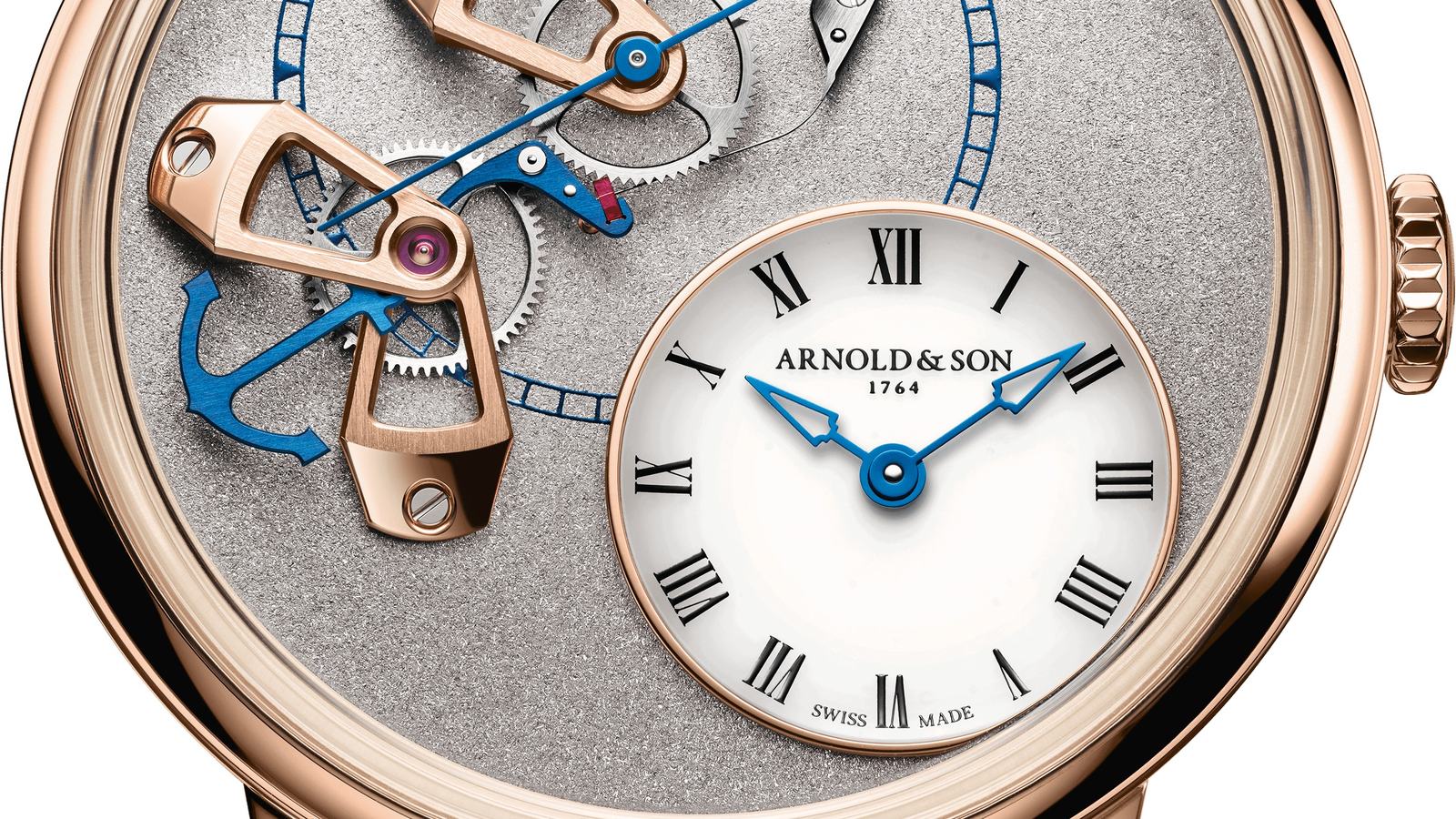
Arnold & Son adds stop-seconds synchronisation to its DSTB true-beat collection, recalling the history of precise maritime navigation.
An instrument inspired by marine navigation
Arnold & Son has introduced a new DSTB Stop-Seconds watch that directly recalls the precision demands of historic seafaring. The latest 42-millimetre interpretation pairs its visible true-beat seconds mechanism with a stop-seconds function, enabling the seconds hand to halt when the crown is pulled out.
The design is available in red gold with a Cliff Grey dial and platinum with a Kingsand dial, each limited to 18 pieces. This is a contemporary collector timepiece, not a navigation instrument recommended for use in place of certified electronic equipment aboard a modern yacht.
The legacy of John Arnold
John Arnold helped advance marine chronometry during the age when accurate time measurement was essential to calculating longitude at sea. The brand continues to use this heritage as a basis for its mechanical watchmaking, particularly in the DSTB collection.
The new stop-seconds feature references the need to synchronise a portable timekeeper with a reliable time signal. It adds a practical setting function to a watch whose visual identity is built around mechanical precision.
What true-beat seconds means
Most modern mechanical watch seconds hands sweep with multiple small movements each second. Arnold & Son's true-beat complication instead causes the hand to advance in precise one-second steps, while the underlying movement operates at a much higher frequency.
A dedicated mechanical system creates this measured indication, and the watch exposes its operation on the dial side. This combination makes the passage of time both legible and visually engaging for enthusiasts of mechanical engineering.
Stopping time to set it precisely
Pulling the crown engages the stop-seconds function, bringing the seconds hand to a halt so the wearer can synchronise the watch with a reference. The ability to restart at an exact moment adds another layer of control to the true-beat display.
The mechanism is inspired by traditional chronometry but has been engineered for a wristwatch. The wearer must still establish an accurate reference time; the function does not independently receive a radio or satellite synchronisation signal.
Two precious-metal editions
The red-gold edition is crafted in 18-carat 5N gold and uses a grained Cliff Grey dial with a white opal subdial. Its platinum counterpart offers another precious-metal interpretation, with both versions limited to just 18 examples.
The restrained palette lets the exposed mechanism and off-centre dial draw attention. Edition numbers and current availability should be confirmed directly with the manufacturer or an authorised retailer.
A purpose-built automatic calibre
The watch uses the Arnold & Son A&S6303 self-winding movement, measuring 36.2 millimetres in diameter and 5.54 millimetres thick. It incorporates 32 jewels, beats at 28,800 vibrations per hour and provides approximately 55 hours of power reserve.
Its movement was developed and produced within the manufacturer's Swiss watchmaking operations. The automatic winding system means ordinary wrist movement contributes energy, but the watch still needs winding if it has been left unworn long enough to stop.
Finishing through a sapphire back
A transparent sapphire caseback reveals a decorated movement with a 22-carat gold oscillating weight. The weight carries the house's anchor emblem, while bridges feature traditional finishing such as Geneva stripes and polished bevels.
Blue screws and finely worked surfaces contribute to the overall presentation. These details are part of the technical and artisanal appeal rather than necessary to understand the displayed hours and minutes.
Case size and everyday considerations
The 42-millimetre case is approximately 12.95 millimetres thick, with domed sapphire glass treated to reduce reflections. The red-gold model is paired with a warm-grey hand-stitched alligator strap and matching precious-metal pin buckle.
Its water resistance is rated to three bar, roughly equivalent to 30 metres under standard test conditions. It should not be described as a professional diving watch merely because its design references marine history.
A maritime story for collectors
The DSTB Stop-Seconds is particularly relevant to collectors interested in the history of navigation and fine mechanical instruments. The visible seconds mechanism turns a complex historical subject into a feature that can be observed each time the wearer consults the dial.
Its significance to yachting lies in the connection to marine chronometers developed for ocean voyages. The new watch offers an aesthetic and historical tribute rather than a yacht-specific onboard timing system.
An exclusive release in 2026
Arnold & Son's official product presentation identifies the limited red-gold and platinum editions and publishes detailed specifications of the new movement. Prices and allocations should be confirmed with authorised retailers, as they can vary by market.
For collectors who value mechanical innovation and nautical heritage, the two 18-piece editions provide a distinctive expression of the brand's chronometric tradition. The important new feature is the combination of dial-side true-beat seconds with a precise stopping function.