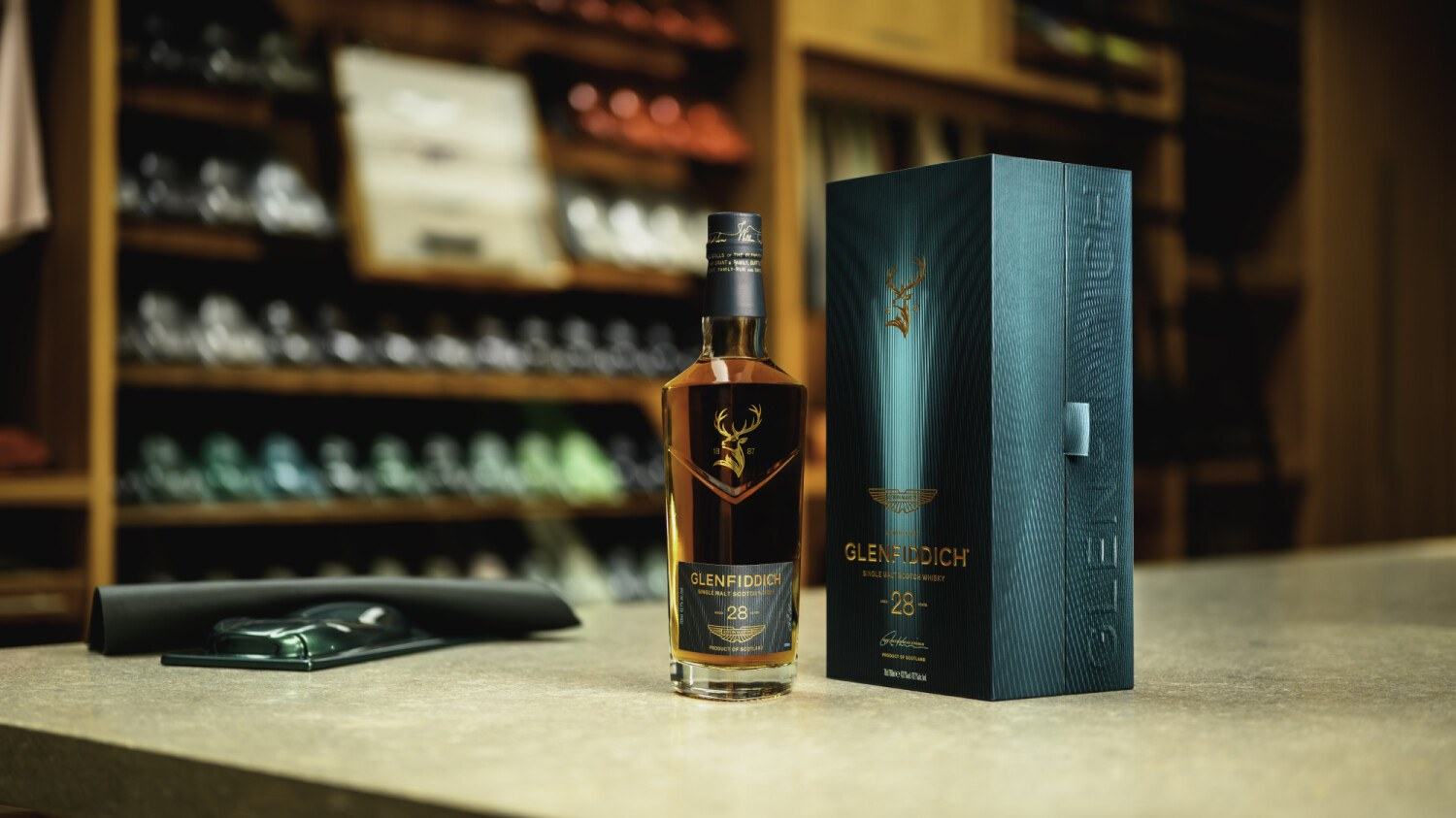
Aston Martin and Glenfiddich have unveiled a 28-year-old limited-edition Scotch whisky combining different oak influences with collector packaging developed alongside the carmaker's design team.
An unusual meeting of craftsmanship
Aston Martin and Glenfiddich have introduced a 28-year-old single malt Scotch whisky that places craftsmanship and design at the centre of a new collaboration. Announced on 4 November 2026, the limited release will become available in January 2027 through the United States and selected global travel-retail outlets. It brings together a luxury sports-car maker and a distillery whose shared message concerns long-term refinement rather than a conventional vehicle launch.
The partnership is presented through both the spirit and its packaging, developed with Aston Martin's design team. Such collaborations can easily rely on a famous badge, but the more interesting question is whether the liquid and the presentation justify attention independently of the names involved. Glenfiddich has provided specific information about maturation, offering enthusiasts a starting point for evaluating the release beyond its visual identity. This is a product announcement rather than an independent evaluation, so the distinction between brand positioning and measurable specifications is important. Glenfiddich states the age, planned markets and maturation approach, but the release does not establish how the bottle compares with similarly mature single malts in blind tasting or value for money.
What twenty-eight years can mean
An age statement on a Scotch whisky identifies the minimum age of the whisky used in its composition. It is not a guarantee of flavour, but it does describe a considerable commitment to maturation. Glenfiddich's announcement emphasises the handling of several cask influences and the expertise of Malt Master Brian Kinsman. The release is designed to combine depth with the orchard-fruit character traditionally associated with the distillery.
The distillery describes a marriage of American and European oak, including a particular contribution from virgin American oak. Whisky initially matured in American oak receives secondary maturation in virgin oak, intended to bring deeper spice and vanilla. That approach illustrates why age alone cannot explain a mature whisky's character. The selection and sequence of casks can be as influential as the years spent waiting. Lengthy maturation also involves considerable uncertainty for a distillery. The final character cannot be predicted solely by waiting a fixed number of years, because cask history and storage conditions influence the result. That helps explain why skilled selection remains central even when a whisky carries a precise and impressive age statement.
A layered oak composition
European oak Oloroso sherry-seasoned hogsheads contribute another dimension, described by the distillery as a source of texture, depth and sherried character. Traditional ex-bourbon casks also appear in the blend and are associated in the release with brighter fruit notes. These are the producer's descriptions of its intended flavour profile; they should not be mistaken for findings from an independent tasting of a bottle.
Combining such elements asks a master blender to maintain a recognisable house style while introducing stronger influences from more active wood. Too much oak can dominate fruit and freshness; too little contribution from the special casks might leave the result feeling ordinary. The value of the release will ultimately rest on balance, integration and how it performs in the glass, not the complexity of its recipe alone. The combination of woods demonstrates a common tension in mature spirits. Consumers may welcome pronounced oak influence but still expect the distillery's fruit-led signature to remain recognisable. How those elements are balanced is therefore a more informative question than how many unusual casks are included in the promotional description.
A design language borrowed from Aston Martin
The accompanying box uses flowing forms that Aston Martin says were inspired by movement and performance. Its design team worked on the packaging, bringing an automotive language to an object usually presented through distillery imagery. Layered detailing, light and surface treatment are intended to echo the whisky's maturation. The company also identifies Podium Green and copper finishes as part of the limited-edition presentation.
Aston Martin's connection to the spirit is therefore primarily an exercise in physical and visual design. The whisky does not come from the automotive world, nor is its production described as depending on car technology. It is useful to keep those distinctions clear. A collector may value the collaboration's look and story, while another buyer may be interested principally in the cask composition and tasting experience. Packaging matters most when it protects and communicates the bottle without obscuring what is being sold. Collectors may appreciate unusual forms, but authenticity, batch identification and the condition of the original presentation are also practical concerns. Those factors should be confirmed through the seller rather than inferred from photographs of the launch set.
A link to the late 1990s
Glenfiddich connects the spirit's original maturation period with an important phase in Aston Martin's history. In the late 1990s, the carmaker developed the Project Vantage concept that helped shape the later Vanquish. The V12-powered DB7 Vantage was another marker of that era. The comparison is thematic rather than technical: cars were being developed while the whisky entered decades of maturation.
Historical references can enrich a collector edition when they are accurate and relevant, but they should not be confused with provenance of individual casks. The announcement does not identify an automobile that carried the whisky or a special distillation method connected to a particular model. The connection is about two timelines and two forms of craftsmanship. That provides context without requiring an invented link between distilling and engineering. The historic analogy is most convincing when treated as a parallel between two established manufacturers, not a suggestion of shared engineering. A whisky maturing for decades and a car undergoing iterative design both require patient decisions, but their production techniques and quality tests are completely different. That separation makes the collaboration's story clearer.
Who this release is intended for
The limited-edition positioning makes the expression relevant to whisky collectors, design enthusiasts and customers already interested in the two brands. Travel retail will be an important sales channel, according to Aston Martin. That does not establish unlimited availability at every airport, and the announcement does not provide a universal retail price. Buyers should verify distribution and exact terms through official channels when the January launch arrives.
Presentation and scarcity can affect the desirability of a collector bottle, but neither guarantees investment performance. Whisky prices and resale markets can change, and condition, authenticity and storage history matter to collectors. The most defensible reason to acquire a premium release is an appreciation of its composition or design rather than an assumption that its market value will rise. A public announcement alone cannot support a promised return. Buyers should also distinguish a limited-edition description from a disclosed bottle count. The official announcement does not establish the exact allocation to every retailer or guarantee access at a given airport. It is sensible to verify the edition details and local taxes before comparing offers across different sales channels.
A place in luxury travel and hospitality
Premium spirits are often associated with hotels, clubs and private gatherings, which may make the collaboration interesting to the wider luxury-travel audience. There is no announcement of a specific yacht partnership or onboard distribution arrangement, however. Any connection with the superyacht lifestyle is an editorial observation about the intended audience rather than a claim made by the manufacturer about maritime availability.
Responsible service and moderation matter wherever alcohol is offered, whether at a private residence or during hospitality ashore. Aston Martin and Glenfiddich specifically emphasise that no one should drink and drive. The distinction deserves mention in an automotive partnership, because the design association should not be interpreted as encouragement to combine drinking and motoring. Appreciation of a mature whisky and enjoyment of a car belong to separate occasions. For hospitality professionals, the whisky's age and visual presentation might provide a conversation starter, but competent service remains essential. Glassware, serving temperature and the setting all influence how guests experience aromas, while the spirit's profile should be appreciated without excessive consumption. None of these considerations depends on an association with motoring.
What to watch as January approaches
The official release sets out its maturation strategy, design direction and broad availability from January 2027, but important commercial details remain for later confirmation. Prospective purchasers will want to know the market price, allocation, bottle presentation and any restrictions applying to individual retailers. Independent tasting assessments will also provide perspective on how the different casks combine in practice.
Ultimately, Glenfiddich 28 Years Old will be judged on more than its premium age statement or Aston Martin connection. Its appeal depends on whether careful blending and a distinctive physical design result in an experience worthy of the attention. The collaboration has a credible story of separate crafts working together. That story now needs to be supported by the quality of the finished expression. January 2027 will offer an opportunity to move beyond the manufacturer narrative towards actual commercial details and independent assessments. The most useful reports will distinguish stated tasting notes from reviewers' own observations and will identify retail pricing where verified. Those are the details that can support an informed purchase rather than speculation about collector demand.
Editorial source: Aston Martin Media. This original lifestyle feature is based on information from the named source; check current local navigation requirements and the equipment manufacturer before departure.
Source
Aston Martin Media