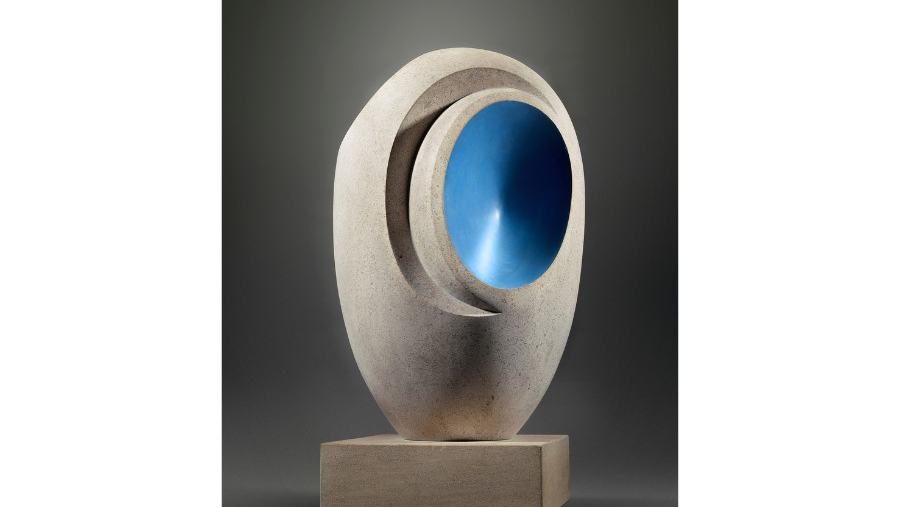
Barbara Hepworth’s Sculpture with Colour (Eos), carved and painted in 1946, will lead Christie’s 21 October London sale with an estimate of £5 million–£8 million.
A post-war Hepworth work returns to auction
Christie’s will offer Barbara Hepworth’s Sculpture with Colour (Eos) as a leading lot in its Modern British and Irish Art Evening Sale in London on 21 October 2026. The carved and painted work dates from 1946 and carries an estimate of £5 million to £8 million, placing it among the most significant pieces in this autumn’s British modern art offering.
Hepworth’s sculpture emerged at an important point in her development, when the experience of the Second World War was giving way to renewed exploration of material, light and spatial relationships. The work’s title refers to the dawn, a fitting association for an artist concerned with how colour and form can create a sense of renewal.
Colour and carved space work together
Eos incorporates three hollowed forms coloured in blue, grey and white, making the interior of the sculpture as visually active as its exterior surface. The use of paint changes the way the carving receives light, allowing different tones and shadows to interact as the viewer moves around it.
Unlike a flat painted image, a carved work needs to be considered in three dimensions, with lighting, height and surrounding architecture affecting the experience. That is relevant for any prospective collector assessing whether the sculpture will be best appreciated in a carefully controlled gallery space or a private interior.
Christie’s has emphasised that the work belongs to a pivotal stage in Hepworth’s career. Its historical position is reinforced by early exhibition activity and the fact that the sculpture has continued to feature in major presentations about the artist’s techniques.
From Lee Miller’s photographs to the Courtauld
Shortly after Hepworth completed the piece, photographer Lee Miller documented the artist in her studio for Vogue, with the sculpture visible beside her. Such images are valuable research references because they can help establish how an artwork was displayed and understood close to the time of its creation.
The piece was associated with the Lefevre Gallery in 1946 and more recently featured in Hepworth in Colour at London’s Courtauld Gallery. That exhibition ran from June to September 2026, giving modern audiences an opportunity to see how coloured surfaces operated across the sculptor’s wider practice.
An exhibition record does not guarantee an auction result, but it can help collectors trace a work through time and assess its importance within an artist’s output. Buyers should also request the full condition report and review the details of any past conservation treatment.
A London auction with international appeal
The sculpture is being presented in the 21 October sale, following public viewings during London’s autumn auction season. Christie’s has noted additional opportunities to see the work during the Modern British and Irish Art exhibition immediately before the sale.
For international collectors, the £5 million to £8 million estimate provides a price indication but does not include buyer’s premium or any additional transport, import or insurance costs. The amount realised at auction may be higher or lower depending on bidding and the final sale terms.
Eos is a compelling example of why collectors can value an artwork for more than fame or rarity. Its importance lies in the conjunction of artistic experiment, documentation, exhibition history and the visual experience of the object itself, each of which deserves independent examination before a purchase.
Source
Christie’s