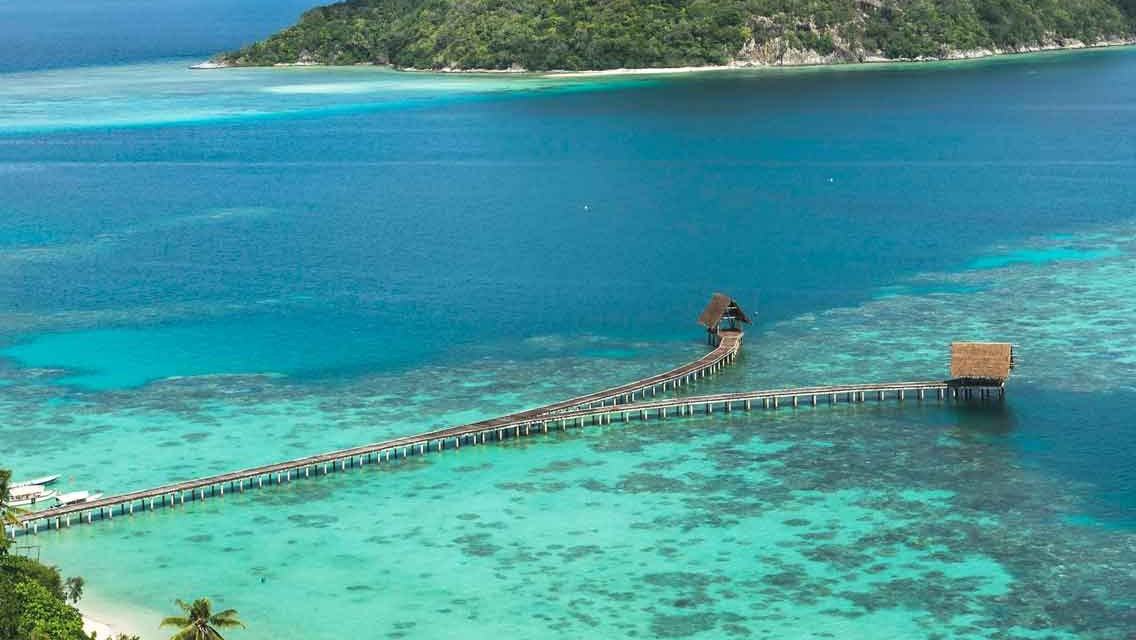
Bawah Reserve spreads across six islands in the Anambas Archipelago and describes sustainability as a foundational design principle. Its low-key, marine-focused approach sets a distinctive tone.
A different definition of exclusivity
Bawah Reserve in Indonesia's Anambas Archipelago presents private-island luxury as the opportunity to step away from crowds and pay closer attention to an intact natural setting. Its six-island location creates a striking geographical proposition, with beaches, rainforest and water acting as much more than scenery outside a suite. The resort places ecological stewardship prominently in the story it tells prospective guests.
The official website describes thirty-six tented suites, overwater bungalows and pool villas across the reserve. It also refers to a surrounding marine conservation area, with seaplane travel forming part of the recognised route from the Singapore region. That description is a reason to plan transfers carefully rather than assume that a private vessel can simply arrive and anchor wherever its owner chooses.
Building around what was already there
The resort says its infrastructure was designed with minimal clearing along the shore, using natural materials sourced as locally as practical and construction approaches that reduced the need for heavy machinery. It highlights the use of recycled copper in fittings and the careful assembly of paths and foundations. These details invite scrutiny of how an island retreat can offer high-end comfort without reshaping every part of its environment.
Perhaps the most memorable design example is the jetty, which Bawah describes as deliberately asymmetrical to avoid damage to coral reef between lagoons. For a superyacht traveller accustomed to elegant waterfront engineering, that is a useful reversal of priorities: the geometry of an arrival point follows the habitat. Its appearance becomes a record of a constraint accepted during design, not merely a visual flourish.
An unusually visible approach to energy
Bawah says it operates solar panels floating in the lagoon, combining electricity generation with an initiative intended to reduce environmental impact. This is an unusual feature to see associated with a resort rather than a utility-scale energy project. The operator also discusses water management, including rainwater collection and a desalination plant, as part of making a remote island property function.
These systems should not be romanticised as proof of zero impact or complete self-sufficiency. Desalination, transport, electricity and waste handling all carry operational costs, even when technologies are chosen to reduce them. The relevance of Bawah's account is that it makes those often-invisible parts of luxury hospitality explicit, offering guests an opportunity to understand the infrastructure behind their comfort.
Conservation beyond the guest villas
The reserve describes coral reefs and mangroves as important nursery habitats for marine life, with programmes focused on research, reef restoration and the care of nesting turtles. Its published sustainability account includes relocation of vulnerable turtle nests and eggs where necessary. These are claims made by the operator about its programmes, and interested visitors should seek current updates on the work being carried out.
The broader ambition includes relationships with neighbouring island communities, not only the plants and animals encountered on a guest excursion. Bawah says it aims to support villages around the reserve through engagement and partnerships. A responsible visitor should see the local community as a stakeholder in conservation, rather than regard the surrounding islands as scenery reserved for a private holiday.
An island day should have room to breathe
The resort's collection of restaurants, spa experiences and outdoor activities can support an extended stay, but the setting itself deserves unstructured time. Guests might spend a morning watching the light change over a sheltered lagoon, then take a guided activity that helps explain its ecology. Such experiences are more persuasive when adapted to the weather and to responsible access than when pursued as a checklist.
Because water is central to the property, sea conditions should influence plans for swimming, snorkelling and transfers. There is no reason to make a promise about a particular wildlife encounter or reef visit before the resort confirms what is appropriate on that day. Discretion and careful planning are as valuable here as an ambitious excursion schedule.
Luxury with questions worth asking
Travellers choosing Bawah should ask about the differences among tented suites, bungalows and villas, and how location affects access, views and privacy. They may also wish to understand the seasonal character of the Anambas waters and the logistics of arriving with a sizeable family group. The six-island setting offers variety, but it does not remove the need for thoughtful practical arrangements.
Bawah's strongest proposition may be that the resort openly connects its architecture and operation to the natural world it occupies. No luxury hotel can make its environmental footprint disappear. The interesting question is whether its choices give guests a more respectful, informed and memorable encounter with a rare island environment.
There is also value in asking how conservation programmes are monitored over time. A resort can describe a promising initiative, but a discerning traveller may want published results, the involvement of local expertise and an honest account of challenges that remain. Those questions are entirely compatible with enjoying a beautiful holiday.
For current accommodation choices and arrangements, consult the official Bawah Reserve — Sustainability information. The hero photograph is supplied by Bawah Reserve, official aerial jetty photography.