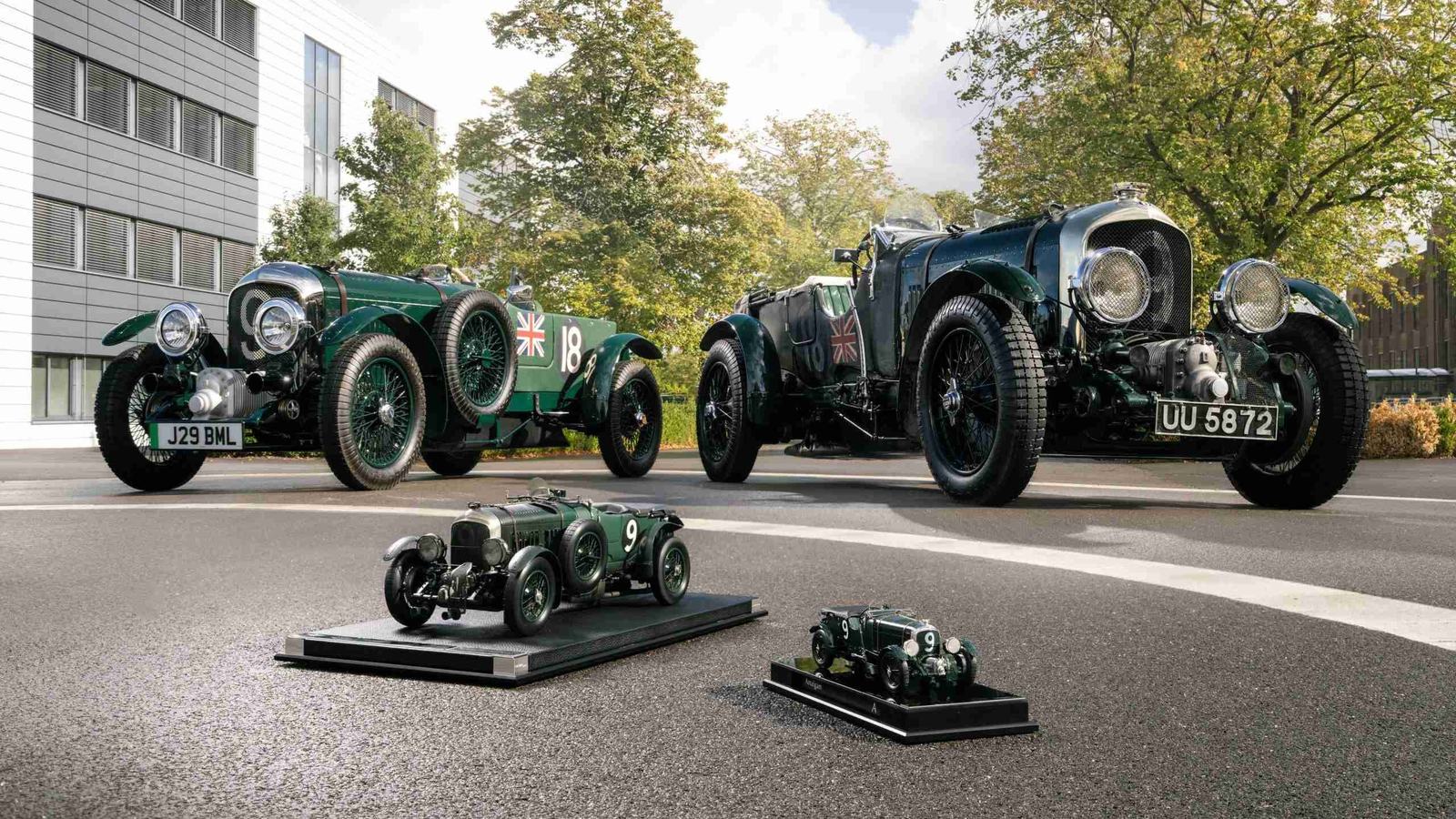
Bentley's original 1929 Team Blower meets the 85%-scale electric Blower Jnr and Amalgam Collection's miniature recreations, illustrating a century of specialist craftsmanship.
Four interpretations of the Bentley Blower meet at Crewe
Bentley has brought together its original 1929 4½ Litre Supercharged Team Car No. 2 with three different modern recreations at its headquarters in Crewe. The presentation, publicised on 15 October 2026, includes Hedley Studios' electrically powered Blower Jnr and two detailed scale models from Amalgam Collection. The meeting provides an unusually clear way of comparing the same famous design across nearly a century of engineering and craftsmanship.
The full-size original is part of Bentley's Heritage Collection, while the smaller vehicles are modern products with different uses and construction methods. These are not four surviving vintage cars and the display should not be mistaken for a new full-size Blower production announcement. Its appeal lies in seeing how the proportions, exposed mechanical details and sporting character can be translated to very different scales.
The original Team Car No. 2 anchors the story
The central vehicle is the 1929 supercharged Bentley carrying registration UU 5872. One of four original Team Blowers constructed for racing, it competed in the 1930 24 Hours of Le Mans and remains an important artefact of the marque's early motorsport history. Its front-mounted supercharger, long bonnet and muscular stance are part of an instantly recognisable silhouette.
Unlike many historic cars kept permanently behind glass, Bentley says Team Car No. 2 continues to take part in selected events and driving activities. Running an irreplaceable historic vehicle requires special mechanical attention, careful preparation and a willingness to manage preservation risks. The ability to operate it gives modern observers a different connection to its history from simply viewing a static exhibit.
Blower Jnr brings electric power to an old shape
Hedley Studios' Blower Jnr reproduces the original car at approximately 85 percent scale while giving it a modern electric drive system. The company lists output of 31 brake horsepower, a top speed exceeding 50 mph and a certified range of up to 75 miles. It is a road-going vehicle designed to evoke an early Bentley, not a miniature using the original racing car's petrol engine.
The engineering challenge is particularly interesting because the old design leaves little visual room for modern requirements. Lighting, brakes, electrical architecture and even a reversing camera must be integrated without overwhelming its analogue character. Bentley reports that the first 25 examples have been built at Hedley's Bicester facility, with the manufacturer's own example already delivered to Crewe. The planned series totals 349 vehicles.
Amalgam works at one-eighth and one-eighteenth scale
Amalgam Collection has developed a new 1:18 Blower to complement a larger 1:8 version unveiled in 2020. Small scale does not necessarily mean simple construction: reproducing external plumbing, mechanical fittings, the radiator, instruments and interior details involves fine tooling and careful assembly. Amalgam describes the smaller edition as one of its most technically demanding models.
Owners of Bentley's modern Blower Continuation Series can request scale models configured to reflect the specifications of their actual vehicles. This creates a connection between the individual car and a display piece, rather than merely buying a generic replica. The level of documented detail and the finish of the model will influence its appeal to a collector, although it should not be confused with an original period artefact.
A thirty-piece model remembers Le Mans damage
Another Amalgam offering is a race-weathered version of the 1:8 Blower, restricted to thirty examples. Its makers have recreated the grime, patina and damage associated with Team Car No. 2 after the 1930 Le Mans event, including bent rear mudguards attributed to tyre failures. Rather than presenting the Bentley as a spotless showpiece, this interpretation attempts to communicate the physical demands of a race.
Collectors of detailed models may value this approach because racing history is not always best understood through a factory-fresh finish. A carefully researched surface can be part of the story, although the line between documented wear and artistic reconstruction should be transparent. Buyers may wish to examine photographs, edition certificates and the maker's records when considering an expensive limited-production miniature.
What the quartet says about heritage collecting
The four Blowers demonstrate the range of experiences available around one celebrated design. The original provides provenance and a direct connection with pre-war racing; Blower Jnr offers a modern vehicle that can be driven; and the smaller models bring engineering detail into a home or collection without requiring garage space. These products involve very different costs, responsibilities and kinds of authenticity.
Bentley's Crewe presentation is a celebration of craftsmanship rather than evidence of a sale or a new motorsport achievement. Its significance is the way a historic car has inspired engineers, designers and model makers to work in different materials and at different scales. Nearly a century after the original competed, its influence remains visible in objects intended for collectors with very different interests.