A Biscayne National Park superyacht experience from Miami with accurate National Park Service limitations for reef moorings, Fowey Rocks, Maritime Heritage Trail and tender safety.
A reef landscape on Miami's doorstep
The most revealing luxury excursions are sometimes those closest to a major city. Biscayne National Park lies beside metropolitan Miami but protects a broad marine landscape of mangrove shores, islands, seagrass flats and coral reefs. For a superyacht owner, its value is not simply that the water looks beautiful from a deck; it is that a carefully organised day by suitable tender can place guests among marine habitats and historic wreck sites that are otherwise easy to overlook.
The National Park Service describes more than 250 square miles of park waters, much of it shallow. That depth profile is the defining operational issue for yachts over 24 metres. A deep-draught mothership cannot assume that a charted channel or a popular snorkelling buoy provides safe access, and a 45-foot buoy rating changes the equation further. The most sensible expedition is one that separates the yacht's offshore position from the tender's permitted movements within the park.
Why a reef mooring buoy is not a superyacht berth
The park's mooring guidance establishes a maximum vessel length of 45 feet for standard reef mooring balls unless the park expressly authorises a different vessel. It also limits each boat's use of a buoy to four hours. These are important constraints: even a relatively compact 25-metre motor yacht exceeds the standard size ceiling, while a large superyacht may be more than twice that limit.
The white plastic mooring spheres with blue markings are installed to keep visiting boats from putting anchors and chains across fragile reef systems. They are environmental infrastructure for suitably sized craft, not miniature marina berths. A captain should verify the rating and condition of every intended buoy and never attempt to load an unsuitable system with the weight of a mothership. A properly equipped, suitably sized tender may be the correct platform for a short guided underwater visit.
Fowey Rocks and the appeal of a heritage dive
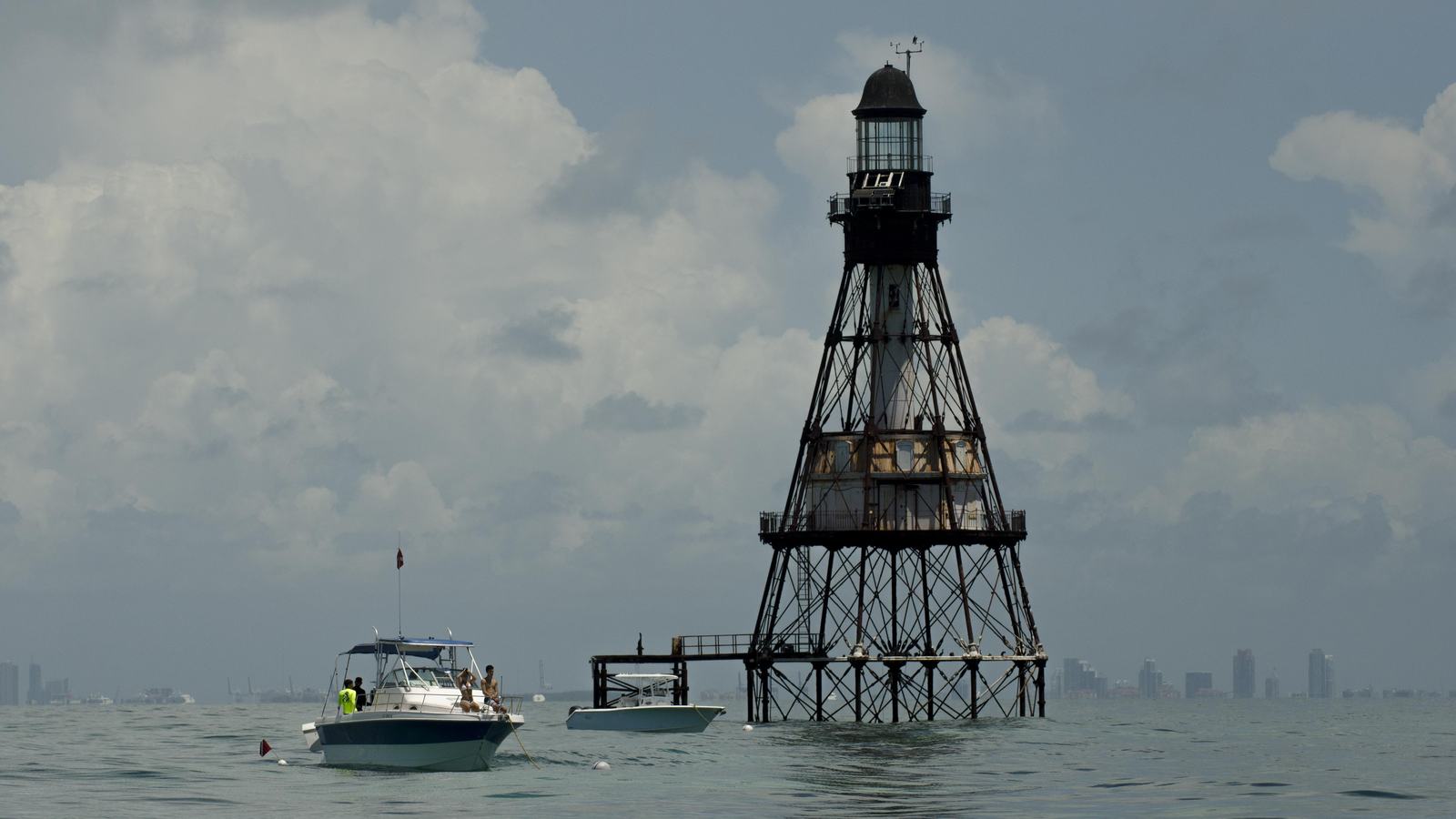
Near Fowey Rocks Lighthouse, the National Park Service maintains several visitor moorings and publishes their coordinates and charted water depths. Some are in water only around eight to fourteen feet deep, while a more offshore position on the official list has substantially greater depth. This variation in a compact area is precisely why bridge teams should not infer navigational clearance from the name of a destination alone.
The lighthouse is a memorable landmark with an intricate underwater context, but a superyacht's approach must remain governed by current charts, tides, weather, vessel draught and the rules for approaching moorings. Tender crews should look for the actual buoy, assess its pennant and confirm that using it will not put the propeller or hull over coral. If a buoy is absent or defective, the crew needs an alternative itinerary, not an improvised anchor set beside the reef.
The Maritime Heritage Trail deserves a deliberate itinerary
Biscayne's Maritime Heritage Trail brings together wreck sites and their human stories. The National Park Service's official mooring list names locations associated with Alicia, Arratoon Apcar, Erl King, Lugano, Mandalay and the Schooner Wreck. They are not interchangeable places: the published depths differ, underwater conditions change with weather and some visits demand experience beyond that of a casual first-time snorkeller.
For a high-value guest programme, the diving team can match the site to certifications, visibility, surface conditions and the availability of suitable support boats. Interpretive material prepared in advance can turn the excursion into a maritime-history experience rather than an anonymous swim. More demanding sites should be staffed with appropriately qualified personnel, while guests who prefer not to enter the water can still appreciate the lighthouse, islands and geological story from an authorised boat tour.
Four hours means four hours
The four-hour maximum is explicit in the Park Service's mooring-buoy information. It makes good operational sense as well: limited buoy availability is intended to be shared, and prolonged occupation of a reef buoy may prevent other visitors from accessing a site without anchoring. A captain and tender coxswain should build the excursion around a realistic arrival, underwater briefing, water time and departure.
The schedule also needs a contingency for damaged or missing buoys. NPS warns that environmental conditions can leave a listed buoy out of service. Its public inventory provides coordinates and nominal depths rather than a reservation guaranteeing the installation will exist when a boat arrives. When conditions are poor, a shorter or cancelled tender excursion can be the right decision, even after substantial guest planning.
Anchoring: stay off coral and away from buoy fields
The National Park Service says boats should not anchor within 300 feet of a reef mooring buoy. Where anchoring is otherwise permitted, the park directs mariners to sandy bottom and advises positioning downwind of the reef so anchor rode cannot sweep over living coral. These restrictions should be interpreted alongside any additional protected-area rules and local navigation notices rather than as an open invitation to anchor throughout the park.
Anchoring decisions depend on the complete geometry of the vessel and its ground tackle. A yacht may have enough depth for its hull yet be unable to swing safely without reaching an exclusion area or coral outcrop. The bridge team should calculate a conservative radius, evaluate wind shifts and verify a genuinely suitable seabed before deployment. If such a position cannot be confirmed, there is no obligation to anchor simply because the itinerary suggested it.
Shallow water is a larger threat than it looks
The park's seagrass flats are ecological nurseries and feeding grounds, not empty patches of sand. National Park Service grounding guidance explains how propellers can tear scars into seagrass and how attempts to power away after grounding can make the damage worse. Running aground can also jeopardise cooling-water systems, underwater appendages and the vessel's ability to manoeuvre.
A careful expedition therefore starts with soundings, official charts and tides rather than the assumption that clear tropical water must be deep. Polarised glasses, reduced speed, an experienced lookout and a willingness to reverse course are practical safeguards for tender crews. If a grounding occurs, NPS advises stopping and avoiding powered attempts that further damage the bottom; the immediate priority is safety and a controlled recovery.
Elliott Key, Boca Chita and the island dimension
Coral reefs may draw the photographs, but Biscayne's keys are essential to its atmosphere. Islands such as Elliott Key and Boca Chita Key add mangrove-lined approaches and a sense of geographic separation from the city. They can provide a rewarding alternative when swell makes a reef swim unwise, although visitors must still account for channel depths, facilities, designated landings and any seasonal restrictions.
These are not private island resorts with guaranteed guest services. A yacht should carry drinking water, sun protection, medical provisions and clear plans for returning passengers to the mothership. Tender arrival times also have to be flexible: wind over a shallow bay can make a route uncomfortable long before sea conditions offshore appear exceptional. Crew should check the current National Park Service visitor and dock information before promising a shore visit.
Water sports must respect park prohibitions
Biscayne's boating guidance specifically prohibits personal watercraft such as jet skis and WaveRunners in park waters. For superyachts carrying an extensive water-toy inventory, this must be addressed at the activity-planning stage. The availability of a jet ski in the garage does not imply that guests may use it throughout the itinerary.
Park speed zones also protect swimmers and wildlife, and mooring approach manoeuvres should be deliberate. Guests keen on wildlife observation can enjoy low-impact trips using appropriate craft operated in authorised waters, including guided snorkelling and viewing from a stationary tender. A briefing on wildlife distance, reef contact and responsible behaviour makes the experience richer while reducing the chance of a damaging incident.
Build the expedition around the right support craft
A superyacht can serve as a comfortable base for the wider Miami and Biscayne Bay region while smaller, properly rated craft undertake the park's shallow-water passages. A 45-foot maximum on standard reef moorings, the four-hour time limit and the difficulty of finding safe deep-water approaches all favour this operational separation. It also gives guests a choice between an energetic reef outing and a quieter day in the air-conditioned comfort of the mothership.
Captains should review tender insurance, operating licences where applicable, recovery capability, radio communication and fuel reserves for repeated short trips. Dive guides should confirm environmental and weather conditions immediately before entering the water. Itineraries can then include a heritage site, time to learn about seagrass and a relaxed return, without trying to fit a deep-draught yacht into infrastructure designed for much smaller boats.
The details that make the day exceptional
An exceptional Biscayne visit begins long before the first tender leaves the swim platform. The team checks official park guidance, carries updated charts, confirms current buoy locations, assigns a qualified tender skipper and briefs guests on how to move near shallow reefs. The day can have a clear narrative: lighthouse history, the underwater archaeology of wreck sites and the relationships between mangroves, seagrass and living coral.
The result is a form of luxury defined by access and knowledge instead of proximity to a famous photograph. The right small craft, an expert guide and the freedom to change plans when a mooring is missing can create a more distinctive experience than pushing a large yacht toward the edge of its navigational envelope. In Biscayne National Park, restraint is an important part of good seamanship.