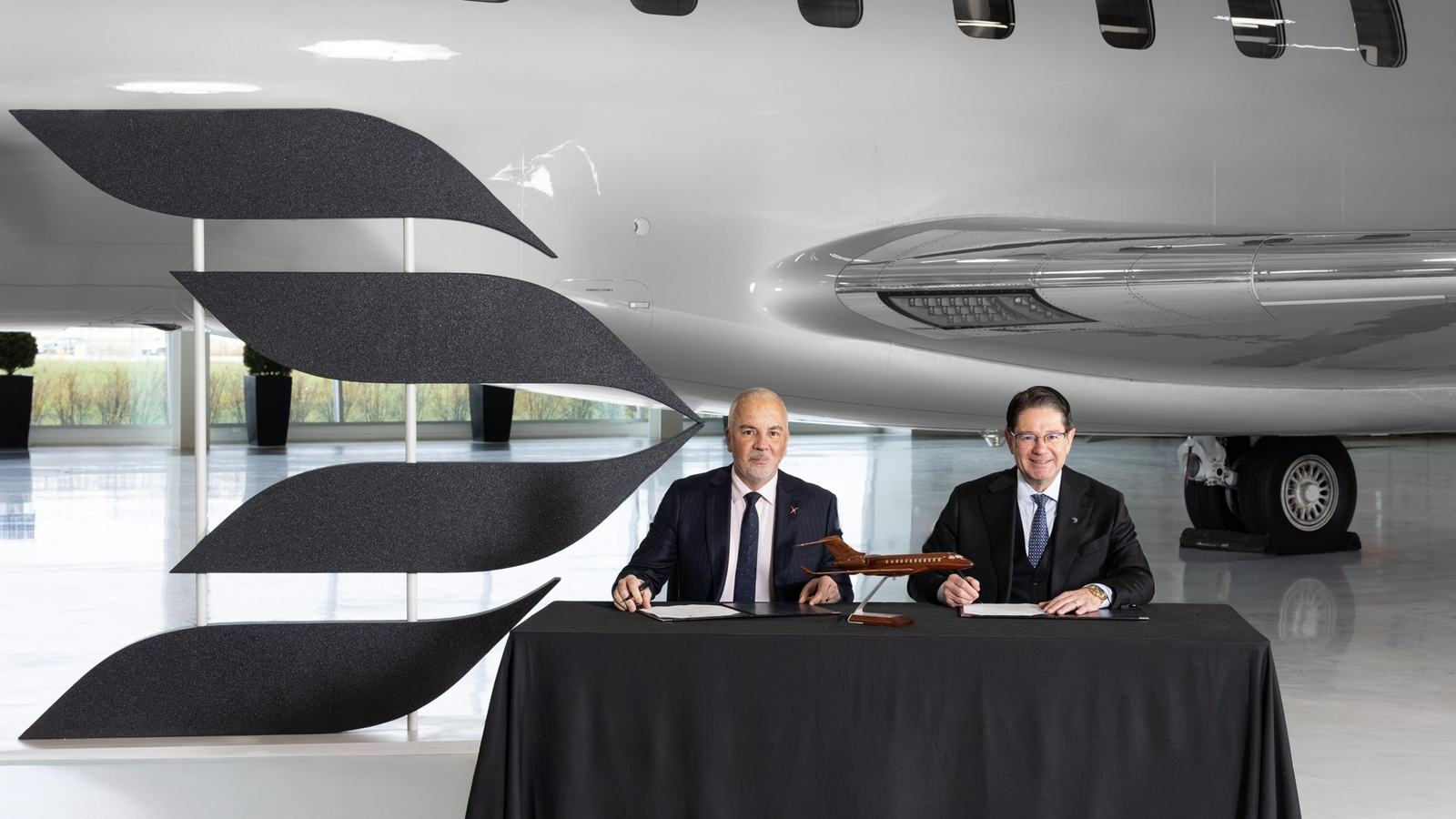
THC confirms twelve Bombardier business jets and options for forty-eight more, establishing a multi-category private aviation fleet for the Saudi market.
From commercial helicopters to business jets
Bombardier and Saudi Arabia's The Helicopter Company announced binding aircraft purchase agreements on 13 November 2026, converting the letter of intent disclosed at the Farnborough airshow earlier this year. The transaction involves a firm order for twelve aircraft, comprising five Challenger 3500s, five Global 5500s and two Global 8000s. The agreements also include options for up to forty-eight additional aircraft. Bombardier values the firm component at approximately US$568 million using 2026 list prices; the parties have not published the actual negotiated consideration.
The significance for private travellers is that a company whose established activities centre on helicopter operations intends to build a fixed-wing business aviation fleet. The three types selected address substantially different flight requirements. This is not an announcement that sixty aircraft have been bought, nor does it establish that the twelve firm aircraft are already available to charter. Delivery, induction, maintenance and regulatory preparations will be essential to converting the order into functioning aviation services.
The aircraft mix in context
The five Challenger 3500s will form one element of a fleet intended to cover regional and intercontinental missions. Bombardier lists a nominal range of 3,400 nautical miles and accommodation for up to nine passengers for the type. Such a specification can be particularly interesting for journeys within the Gulf region, where the ability to tailor timings and ground arrangements may be more useful than having the largest available aircraft.
Choose the aircraft against the full journey requirements rather than the most impressive headline performance figure. A short flight to meet a yacht may involve several people, luggage and equipment that are not reflected in a passenger count. Families may have differing preferences concerning the allocation of seats and time on the ground. A larger aircraft may offer more space, but it will not necessarily be the most appropriate choice if the party is small and the distance modest.
An operator must establish whether particular airports and operating conditions are suitable for the proposed flight. Advertised aircraft range is normally defined using specified assumptions. It is not a guarantee of a direct flight between all city pairs separated by a particular calculated distance. Weather, payload and safe fuel reserves can affect the flight plan and the ability to operate from individual airports.
Global 5500 and the longer journey
The five Global 5500s introduce an aircraft category designed for longer-range operations. Bombardier's announcement gives a nominal range of 5,900 nautical miles and accommodation for up to sixteen passengers, with three living areas within the cabin. For a party travelling from the Gulf to Europe or between other distant regions, a larger cabin can transform the experience of a lengthy flight.
The value of subdivided cabin space becomes apparent when passengers want to pursue different activities. An executive may need to review documents while other members of a party wish to eat or rest. A family group travelling towards a charter may prefer to keep a predictable daily rhythm rather than beginning its holiday already exhausted. An aircraft's actual seating arrangements, sleeping configurations and baggage limits should be confirmed for the individual aircraft assigned.
Configuration is particularly important when comparing aircraft of the same type. Operators can order different cabin layouts and equipment. An advertised maximum passenger accommodation figure may not describe the arrangement available on a specific flight. A charter advisor should establish the exact seating and cabin features before a customer commits to a journey based on them.
The two Global 8000s
The Global 8000 is the longest-range type in the announced mix. The manufacturer's stated range is 8,000 nautical miles, accompanied by a cabin divided into four living areas. Bombardier uses Riyadh to Los Angeles as an example of a possible city pair served without an intermediate stop. As with other range figures, actual dispatch planning remains subject to the particular conditions of the flight.
For a superyacht owner who divides time between homes, offices and vessels situated in different parts of the world, reducing intermediate stops can have considerable practical value. It may simplify the organisation of ground transfers and reduce the number of changes to an itinerary. But an exceptionally long nonstop flight also involves significant time inside the cabin, making the arrangement of seats, rest facilities and catering particularly relevant.
Ask the charter provider how it plans crew duty, required operational approvals and passenger arrangements for journeys of that duration. Comfort is important, but does not replace the regulatory and safety requirements of a flight. An owner accustomed to the freedom of a private yacht may value the ability to choose departure schedules, while still accepting that the aircraft commander and operator determine whether an itinerary can safely be flown.
Connecting fixed-wing and helicopter services
The Helicopter Company began operations in 2019 and has developed a range of helicopter services, including medical, tourism, charter and aerial work. The company describes its current helicopter fleet as exceeding sixty aircraft. Its move into business jets could broaden the types of journey it can support. That does not mean that every fixed-wing flight will automatically come with an integrated helicopter transfer, or that every yacht will become a suitable helicopter landing site.
For travel connecting a superyacht and a private aircraft, the most useful arrangements often involve careful coordination of several independent services. Aircraft arrivals may be influenced by air traffic, weather and airport procedures. The yacht may need to alter its berth or anchorage because of maritime conditions. The people organising the journey should therefore establish one responsible contact for managing changes across the itinerary.
A helicopter landing aboard a yacht requires particular facilities, operational arrangements and approvals. Do not presume that a vessel's visible helideck establishes its suitability for an intended aircraft or flight. A qualified aviation operator and the captain must assess the specific operation. Where an appropriate landing is not possible, a transfer through an authorised shore facility may offer a better alternative.
Building the support system
Bombardier has announced that its partnership with THC includes a long-term strategic investment and local presence in Saudi Arabia. The details of the planned footprint have not been disclosed in the order announcement. The support arrangements will nevertheless be significant to the operation of a multi-type fleet.
Business aviation depends on a great deal of infrastructure that may be invisible to passengers: trained flight crew, qualified maintenance personnel, tooling, spares, dispatch, approved procedures and reliable facilities. Introducing several aircraft types can involve distinct training and maintenance requirements. A fleet operator must organise those capabilities before customers can expect the benefits promised by a purchase programme.
A prospective charter customer should evaluate the operational provider separately from the aircraft manufacturer. The aircraft's design and capability are only part of the proposition. The operator's actual permissions, safety management, crew arrangements and ability to support a planned journey remain important. Confirm the identity of the operator responsible for dispatch and the arrangements for any replacement aircraft if the nominated type becomes unavailable.
An order of twelve rather than sixty
The announcement deserves particularly careful reading because the headline scale of the potential programme is much larger than the committed order. The five Challenger aircraft, five Global 5500s and two Global 8000s represent the initial firm purchases. The remaining forty-eight are options, which may or may not be exercised. The press release gives no basis for treating those options as aircraft already funded, delivered or assigned to a service schedule.
At list-price valuations the initial order is substantial, but that figure is not necessarily the purchase company's final cost. Fleet agreements can involve negotiated commercial terms, training or support provisions and other factors not revealed in a public statement. The report should not be used to estimate the future price of a charter or the utilisation required to make the programme profitable.
For travellers, the future availability of particular routes or aircraft will depend on delivery schedules and the company's actual operating preparations. Ask the relevant provider for confirmed details when making travel arrangements. Until those details are published, it is appropriate to regard the order as an investment in future capacity rather than a description of services available today.
What this means for private journeys
The November agreement is noteworthy for its planned combination of regional, long-range and ultra-long-range aircraft within an operator already active in helicopter services. It suggests that THC intends to develop a wider portfolio of aviation options in Saudi Arabia. The collaboration may eventually create useful choices for owners and charterers travelling between the Gulf and international destinations, but individual services still need to be established and assessed.
The practical lesson for superyacht guests is to consider the entire journey rather than simply the ability of a particular aircraft to cover a particular number of miles. A successful flight-to-yacht itinerary requires suitable aircraft, appropriate airport facilities, reliable service providers, accurate transfer arrangements and contingency plans. The development of a broader business aviation fleet is relevant because it can add choices to that process, provided that the promised capacity is placed into service and properly supported.
For now the confirmed news is the firm twelve-aircraft order, the options for additional deliveries and Bombardier's announced commitment to a longer-term partnership. The wider implications are best assessed against the progress of the fleet as deliveries and actual operational arrangements become public.
Primary source: Bombardier / GlobeNewswire (distributed press release).
Bombardier and THC signing ceremony, Dorval, Quebec, 9 November 2026. Source: Bombardier / GlobeNewswire (distributed press release). Official source.
