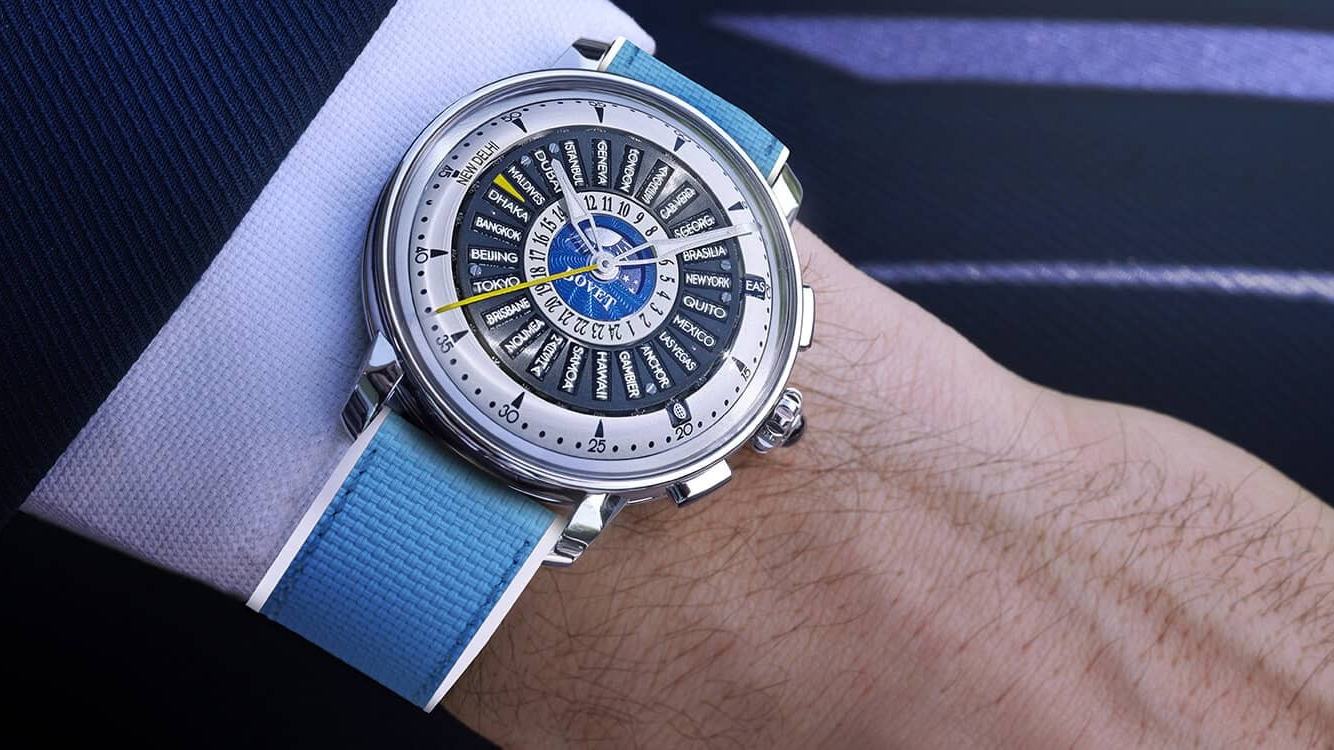
Bovet's Récital 30 translates world time into a miniature mechanical atlas, with 26 rollers and an automatic movement.
A world map that moves with the wearer
For those whose lives span the Mediterranean, the Americas and the Asia-Pacific, the ability to understand time at several destinations is surprisingly practical. Bovet's Récital 30 approaches this familiar problem with a mechanism that is anything but ordinary. Inside a 42-millimetre watch is a system of 26 rollers, forming a miniature display of cities, seasonal time arrangements and world-time information. It gives the owner a way to contemplate the movement of the planet through a visible mechanical performance rather than the anonymous flicker of a screen.
The collection sits within Bovet's Dimier family, with the crown placed at three o'clock rather than the bow-and-crown arrangement associated with its Fleurier designs. That might seem a modest distinction, yet the case geometry helps the watch accommodate its densely organised dial without sacrificing a coherent silhouette. For collectors, the interest lies not only in how many functions fit into a wristwatch but in how comfortably and intelligibly they coexist. Mechanical world time is at its most persuasive when the apparent complexity serves an understandable purpose.
Bovet describes the Récital 30 as a superlative worldtimer, and that label should be judged against the technical description. There are 24 city rollers, a separate roller for time period selection and another for world-time information, backed by a central 24-hour indication. An additional offset minute hand and a day-night indication help complete the reading. The result has the character of an instrument for a traveller who enjoys thinking about geography and temporal relationships rather than simply asking a device for the current hour.
The daylight-saving complication
Time zones are not as static as they appear on the average airport clock. Some countries change their clocks seasonally, others do not, and the dates on which changes occur are far from uniform across the world. That makes a conventional mechanical worldtimer a fascinating but imperfect reference during parts of the year. Bovet's solution, developed around a roller architecture, addresses variations that can otherwise leave an elegantly engraved city ring one hour adrift. It invites a more accurate understanding of international schedules.
This attention to seasonal time is especially relevant to private-yacht operations, where crew movements, provisioning calls and flight connections often involve several jurisdictions. A watch is never a substitute for up-to-date port guidance or operational timekeeping, but the mechanical distinction remains meaningful. By explicitly representing the relevant time period, the Bovet system acknowledges that local civil time is shaped by policy as well as longitude. It combines a longstanding horological ambition with a practical complication of modern global travel.
The display also provides a useful reminder that different forms of information need not be compressed into a single dial graphic. Rollers introduce a three-dimensional quality and a changing visual rhythm as their positions are adjusted. For the owner, this is a more deliberate interaction than tapping an airport code on a smartphone. It brings a small ceremonial element to moving between residences, yachts and business centres, while preserving the clarity required to check home time during an international itinerary.
An automatic movement under the dial
The Récital 30 uses an automatic manufacture movement with a quoted 62-hour power reserve. That reserve gives a useful margin when a watch is placed aside for a day or two during travel, although the owner still needs to verify its indications after any longer interval without wear. The mechanism supplies hours and minutes as well as the elaborate world-time display. Its function is to coordinate a number of indications within a compact case, each requiring a precise relationship to the movement's underlying timekeeping train.
Bovet lists case options that include Grade 5 titanium, 18-karat red gold and ceramic, with different dial colour arrangements. The official specifications give the 42-millimetre Dimier case a height of 12.9 millimetres, a notable packaging exercise for such a visually intricate mechanism. Materials affect both the physical character of a watch and the way its details reflect light. A titanium interpretation may place greater emphasis on technical lightness, while a gold case offers a warmer, more formal presence for an evening engagement.
Finishing is central to the attraction of independently made haute horlogerie. Even when a complication is mechanically ingenious, an owner will notice the transitions between polished edges, engraved markings, functional pivots and contrasting dial surfaces. The Récital 30 rewards observation because its components are arranged in depth, inviting the eye to follow several routes through the display. That is the kind of visual interest which can outlast the thrill of an initial purchase and sustain a relationship over years.
Collecting for life across continents
A watch intended for a global traveller deserves to be evaluated as part of a real wardrobe and schedule. Its case size, thickness, strap and the owner's preferred style of cuff all matter as much as the list of complications. The various material and dial choices make it possible to select a more discreet version or one with a pronounced visual signature. Neither approach is inherently superior: a highly personal collection works best when each piece has a recognisable role within daily life.
Care is also part of responsible collecting. Mechanical watches require attention to the manufacturer's service advice, sensible storage and an understanding of how shocks, magnetism and moisture can affect precision. A sophisticated worldtimer should not be assumed suitable for swimming or marine exposure merely because its owner travels by yacht. Appropriate wristwear for the tender or beach may be very different from a complication selected for dinner ashore. The object is best appreciated within the conditions for which it was designed.
The deeper pleasure of the Récital 30 is its ability to make an abstract global system tangible. Twenty-four hours, national clock conventions and the movement between day and night become a small landscape of turning parts. For collectors with a curiosity about engineering, it has a relevance beyond decorative luxury; it asks how a difficult information problem can be solved without software. That question feels apt aboard a superyacht too, where technical excellence often succeeds precisely when a complicated system becomes straightforward for the person using it.