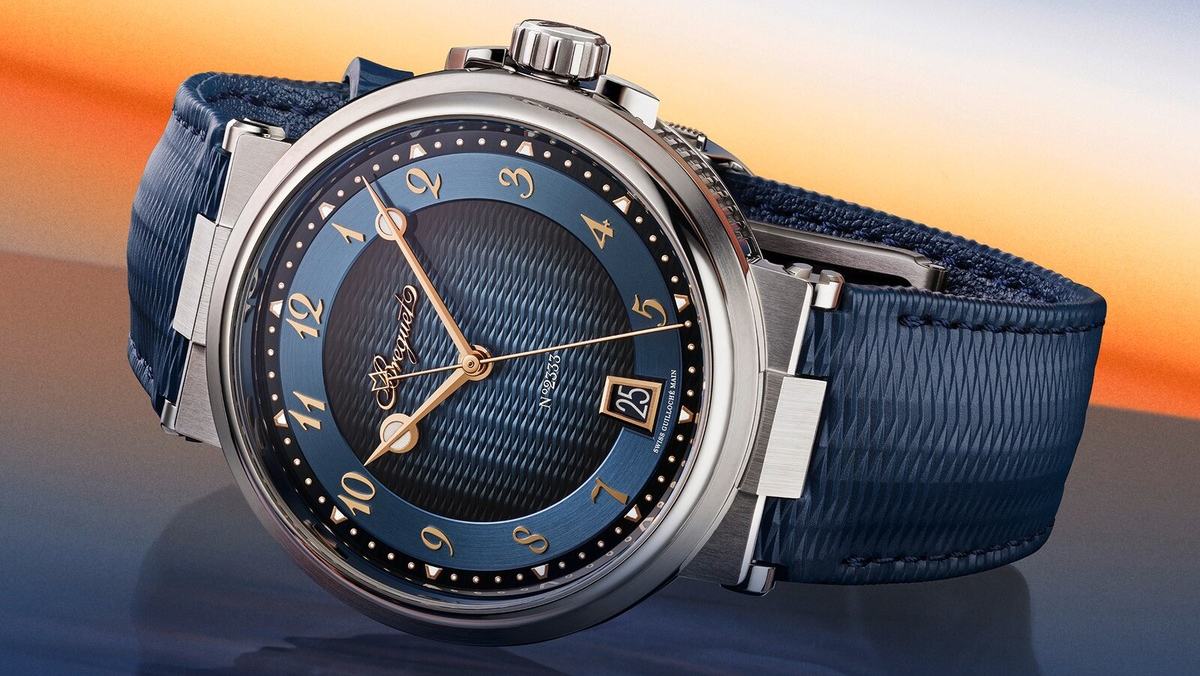
The 2026 Breguet Marine 5517 adds a more balanced date presentation and fresh colour treatments to a three-hand watch whose details reference the French Royal Navy, navigation and traditional watchmaking.
A nautical watch with a genuine historical connection
Breguet's Marine collection draws on a meaningful piece of the manufacture's history rather than attaching a maritime name solely for atmosphere. In 1815 Abraham-Louis Breguet was named Watchmaker to the French Royal Navy, a role associated with the precision instruments required at sea. More than two centuries later, the Marine 5517 interprets that association through a carefully finished modern wristwatch. Its most recent official presentation in 2026 revisits the dial, materials and small nautical references without abandoning the model's three-hand character.
The refreshed Marine 5517 is deliberately less complicated in function than many of the house's grand complications. Hours, minutes, seconds and a discreet date create an instrument designed to be consulted quickly. A familiar dial can still be technically sophisticated when attention is given to readability, resistance to moisture and how the watch behaves as its owner moves through different environments. In this case, the relative simplicity allows fine finishing and subtle case details to carry much of the luxury message.
The latest interpretations position the date at six o'clock, creating a more symmetrical composition than the earlier arrangement. Breguet describes options in white gold, rose gold and titanium, with contrasting dial treatments that give each a different personality. An ice-blue gold version, a darker rose-gold version and a blue-gradient titanium execution show that nautical styling does not require one fixed colour scheme. Buyers should confirm the exact dial and strap pairing associated with each current reference.
The number 5517 has become a recognisable element of the contemporary Marine family, but collectors should avoid conflating the full sequence of earlier and newer releases. A model first produced in one dial configuration does not make every later treatment identical. The 2026 presentation is most interesting where small changes produce a cleaner face and a different sense of formality. That evolutionary approach is well suited to a luxury watch meant to remain wearable beyond a single season.
How the sea is expressed in the details
The dial finish is one of the most visible distinctions among the refreshed versions. Breguet uses hand-guilloché decoration on precious-metal dials and describes the motif as Quai de l'Horloge, a reference to its Parisian origins. In appropriate light, the pattern catches the eye without obscuring the indications. It is a reminder that dial making is a separate craft from movement construction and deserves attention in its own right.
Numerals and shaped hands retain the brand's established visual language, giving the watches an unmistakable family resemblance. At twelve o'clock, a gold Breguet appliqué introduces a discreet signature without relying on oversized typography. The design is confident enough to leave space around its indications. Good legibility results from the balance of proportions, colour and contrast rather than from any one decorative element.
Breguet's seconds-hand detail refers to the maritime signal flag for the letter B, while the crown area carries wave-inspired shaping. The line between interesting visual reference and decoration for its own sake can be narrow, yet these touches are small enough that they reveal themselves over time. They reward someone who enjoys noticing and explaining craft rather than attracting an immediate audience. That is a compelling approach to the idea of quiet maritime luxury.
The automatic winding rotor visible through the sapphire caseback is shaped to recall a ship's rudder. It is a more intimate nautical reference because it can only be appreciated when the owner removes the watch or turns it over for inspection. A transparent back also turns ordinary winding motion into something a collector can observe. Engineering and symbolism meet most successfully when the visual device does not interfere with movement reliability.
What lies inside the 40-millimetre case
The self-winding calibre 777A powers the Marine 5517. The maker describes a movement with a 55-hour power reserve, silicon balance spring and 235 components, facts that give a useful sense of the engineering involved. Unlike a manual-winding movement, it uses the motion of the wearer's wrist to replenish energy while in use. The design does not eliminate servicing needs, but it can suit someone who wears the watch regularly.
A 40-millimetre case makes this a relatively approachable size in the sports-luxury market, where proportions can be more consequential than the largest possible dimensions. Breguet's current product specification identifies the titanium case at approximately 11.5 millimetres thick, with substantial lugs and a distinctive grooved caseband. Because the gold and titanium variants can feel very different on the wrist, a physical fitting is advisable. Case weight can alter the sense of comfort even when the nominal diameter stays the same.
The collection's advertised resistance to 100 metres is a practical departure from the expectations placed on delicate traditional dress watches. That figure does not mean an owner should ignore water-resistance testing, the condition of seals or the suitability of the fitted strap. Regular exposure to salt and moisture demands maintenance of a completely different kind from occasional evening wear. Before bringing a precious timepiece aboard, it is sensible to follow the brand's operating and care recommendations.
Breguet also offers rubber-strap and metal-bracelet alternatives for the new interpretations, according to its launch material. This choice changes the watch's character considerably: a bracelet can feel more formal and integrated, while rubber may be easier to manage during casual coastal travel. Material preferences depend on climate, daily use and individual comfort. Purchasers should make sure the exact reference includes the combination they want rather than assuming all options are interchangeable at no cost.
Why the design matters to the yacht-owning collector
A yacht owner or frequent charter guest is likely to encounter a watch under varied conditions: warm decks, formal dinners and travel between ports. A Marine 5517 is appealing because its styling has an authentic naval ancestry while the display remains direct and the case is intended for active use. It does not try to serve as a replacement for the navigational instruments on board. Its purpose is different: to connect personal craft and maritime identity in an object worn every day.
Collectors should still inspect practical details before purchase. Ask an authorised dealer about the exact case material, the current dial version, water-resistance testing, warranty arrangements and recommended service intervals. Examine hand alignment, the finish around the date window and the fit of the strap at normal wrist positions. Such observations can be more valuable to long-term enjoyment than marketing descriptions of exclusivity.
It is equally important to treat resale expectations with caution. A famous historic name and precious-metal construction may give a watch strong collector appeal, but neither guarantees future appreciation. Secondary-market demand, condition, documented servicing and the availability of the exact version all influence value. The most durable reason to acquire the 5517 is an appreciation of its dial work, restrained function and deeply rooted nautical symbolism.
The 2026 refresh illustrates how a watchmaker can modernise a familiar design without making it unrecognisable. Symmetrical date placement, varied materials and colour treatments give the Marine 5517 a contemporary presence, while its rudder-inspired rotor and signal-flag detail maintain the connection with navigation. Its three-hand display is a virtue, not a limitation, for someone who wants a clear daily instrument. The result is luxury watchmaking informed by the sea rather than merely decorated with it.