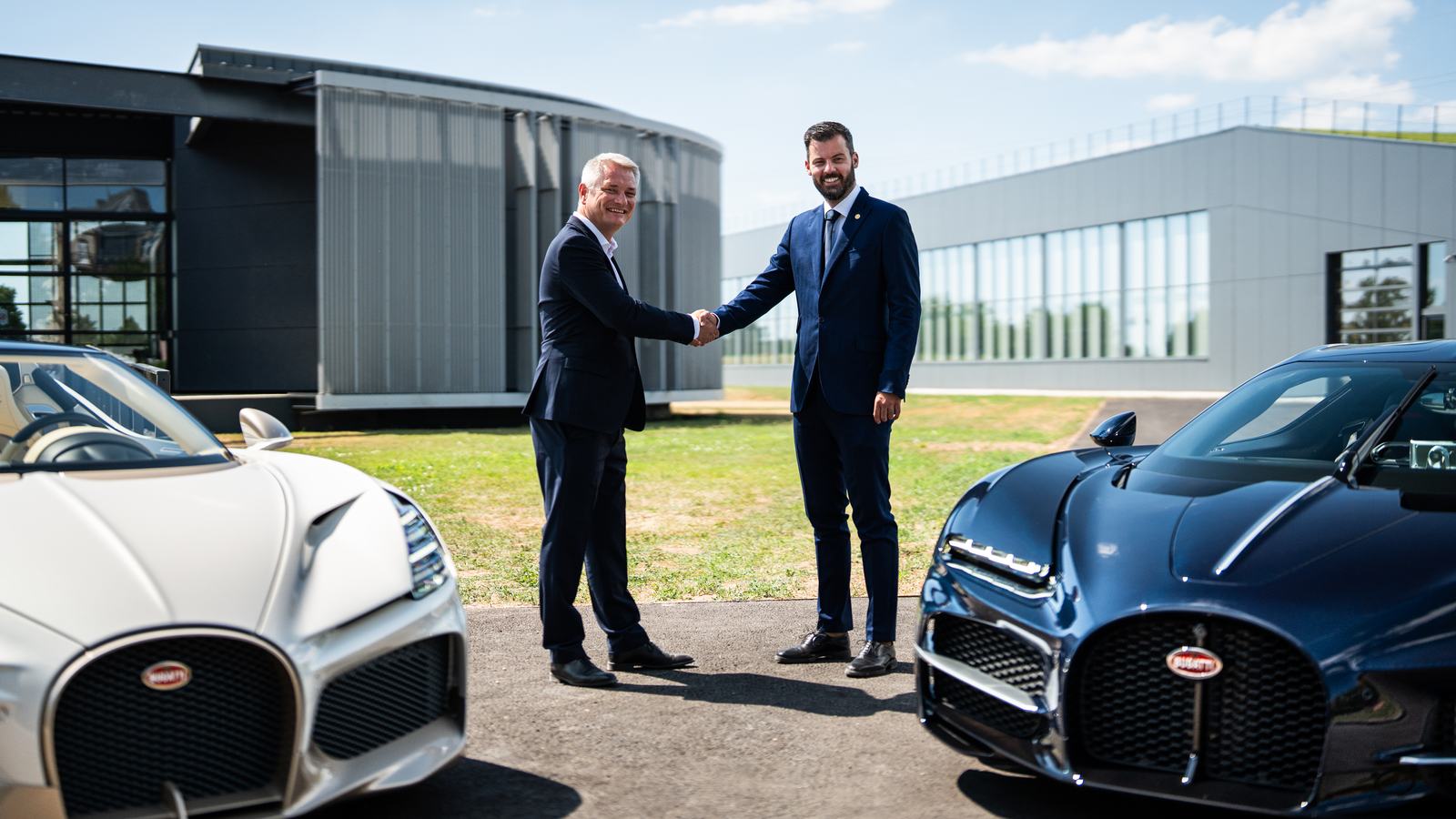
Bugatti is marking Christophe Piochon’s final month with the marque after a career spanning early Veyron prototypes, quality control, test driving and senior leadership.
Bugatti is looking back on Christophe Piochon’s 24-year career in Molsheim as he prepares to leave the marque at the end of October. His time with the company stretches from assembling and validating early Veyron prototypes through the W16 years and into the new Tourbillon era, making his career unusually close to the modern Bugatti story itself.
The story begins with Veyron prototypes
Piochon joined the project in late 2001, working around the first Veyron prototypes before the production car existed as a finished customer proposition. Quality management in that environment meant solving problems while the engineering, processes and expectations were still being defined.
That early involvement gave him a perspective few executives could reproduce later. He understood the car not only as a finished hypercar but as a sequence of difficult engineering decisions, tests and manufacturing compromises that had to become repeatable.
Testing put him behind the wheel for tens of thousands of kilometres
Bugatti says Piochon accumulated around 100,000 kilometres in its cars, including approximately 60,000 kilometres as a test driver. That direct experience linked executive decision-making with the behaviour of the product on real roads rather than relying only on reports.
For collectors, this connection between leadership and physical product is significant. Hypercars are built in tiny volumes, so the people overseeing quality can remain unusually close to individual cars in a way that is impossible at mass-production scale.
Molsheim grew around a changing definition of Bugatti
During Piochon’s career, the operation expanded from a comparatively small team into a larger organisation preparing for Tourbillon production. The opening of La Manufacture in 2026 marks another shift, creating new space and processes for the next generation of cars.
The transition is important because Bugatti has to preserve the intimacy of low-volume construction while supporting more complex technology. Growth cannot be allowed to make the product feel industrial in the ordinary sense, particularly for clients who expect individual attention.
Continuity matters when a brand changes technology
The move from the W16 era toward the hybrid Tourbillon creates both opportunity and risk. Customers may welcome new performance and engineering, yet the emotional continuity of the marque depends on people, craft standards and institutional memory as much as specifications.
Piochon’s departure therefore marks more than an executive change. It closes a human chapter that began before the Veyron reached customers and continued through the period that established modern Bugatti as one of the defining names in ultra-high-value automotive collecting.
Official sources: newsroom.bugatti.com.
Source
newsroom.bugatti.com