Explore Château d’If off Marseille through royal fortifications, real prison history and The Count of Monte Cristo, with practical guidance on ferries, weather and responsible superyacht shore planning.
An island fortress within sight of Marseille
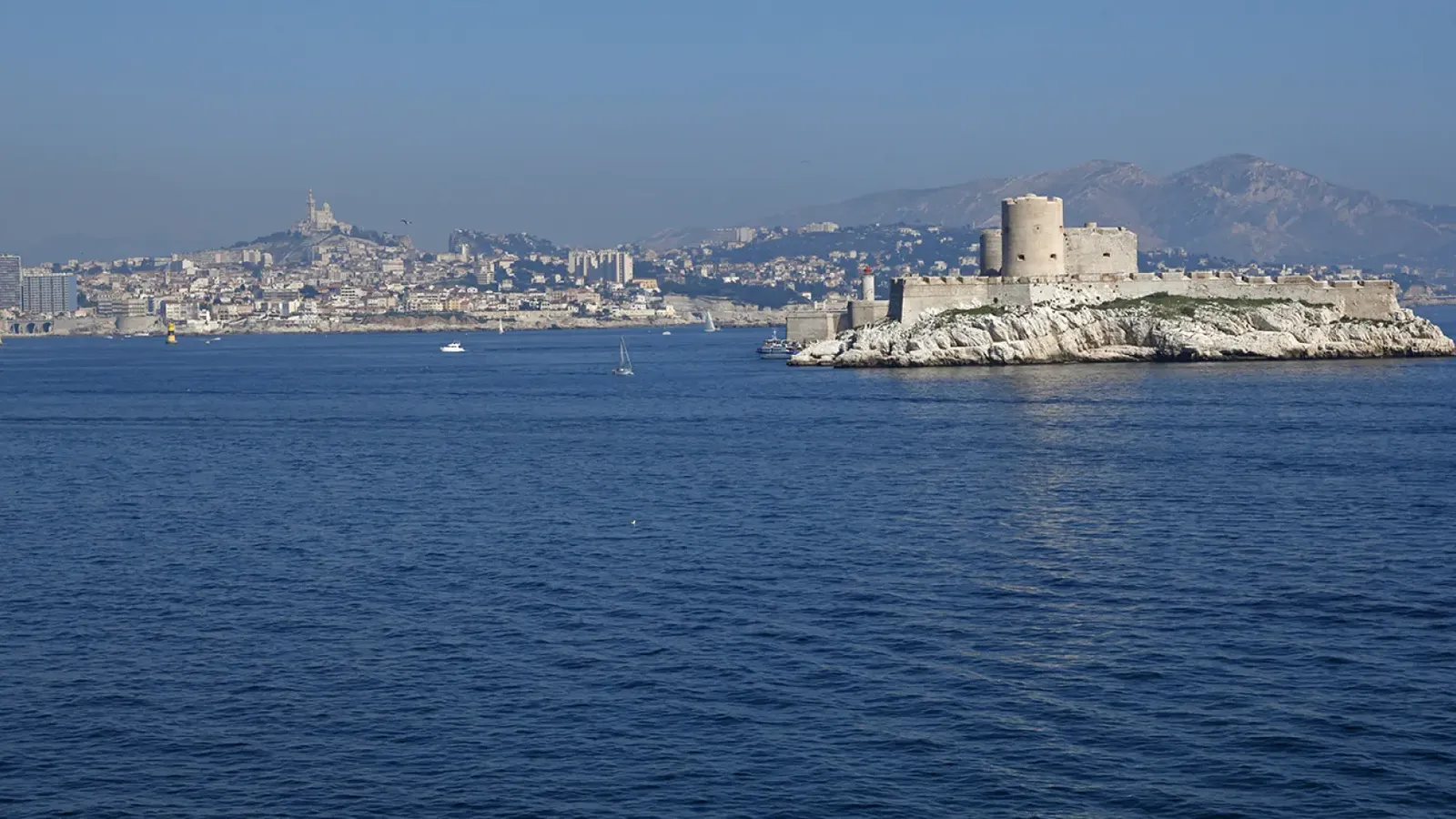
From the seaward approach to Marseille, Château d’If looks less like a conventional Mediterranean landmark than a stone vessel anchored permanently in the bay. The compact fortress occupies a rocky island in the Frioul archipelago, close enough to the Vieux-Port to fit into an unhurried shore programme yet sufficiently exposed to remind visitors that the sea, not a road, controls access.
For a superyacht itinerary, the appeal is unusually layered. A morning ashore can combine sixteenth-century coastal defence, the history of French state imprisonment, the literary imagination of Alexandre Dumas and open views back towards Marseille’s harbour. It offers a more distinctive memory than simply crossing the city to another shopping street or restaurant terrace.
The French Ministry of Culture places the limestone island at about one nautical mile from Marseille and describes it as roughly three hectares in area. Those dimensions help explain both the monument’s commanding position and the limits of the visitor experience. This is a historic site to explore carefully on foot, rather than a large island resort with extensive land transport.
From royal stronghold to state prison
Château d’If was built during the reign of Francis I as a strategic response to the maritime approaches to Marseille. The city of Marseille says the monarch ordered a fortification on the Frioul island in 1516, with a royal citadel designed to watch vessels entering and leaving the harbour. The fortress thus tells a story about royal power as well as protection from attack.
Its rectangular mass, corner towers and high perimeter walls are emphatically functional. The Marseille municipal history describes a three-storey square structure around 28 metres to a side, flanked by three towers and protective artillery platforms. From the roof and exposed terraces, the reason for occupying this isolated rock becomes immediately apparent: the surrounding water leaves approaching traffic visible in almost every direction.
The island did not remain merely a coastal bastion. By 1580 it was also being used as a state prison, becoming associated with prisoners whose backgrounds and political circumstances varied enormously. The monument’s own historical material discusses religious detainees, revolutionaries and other inmates, grounding the darker part of the island’s story in real lives rather than fiction.
Why Alexandre Dumas made the château immortal
The château’s worldwide fame owes much to a man who never existed. Edmond Dantès, the fictional sailor unjustly incarcerated in Alexandre Dumas’s The Count of Monte Cristo, escapes the island prison in one of the best-known plots in adventure literature. Marseille Tourism explicitly reminds visitors that this character belongs to the novel and must not be mistaken for a real historical prisoner.
The confusion is understandable because the setting gives the story extraordinary force. A prison surrounded by open sea creates a visual contradiction: freedom seems almost close enough to touch, yet stone, wind and water make it inaccessible. Dumas transformed that tension into an image that has endured far beyond the history of the actual inmates.
Visitors can appreciate the literary association without treating displays or labelled cells as proof of the fictional character’s imprisonment. The distinction between dramatic storytelling and documentary history is part of the pleasure of the visit. Read a passage of Dumas before coming ashore, then let the real architecture supply its own, more complicated account of confinement.
Inside the walls: cells, graffiti and sea views
The monument’s visitor material invites guests to walk the prison spaces, courtyards and viewpoints at their own pace. Among the subjects highlighted by its curators are inscriptions left by nineteenth-century political prisoners, including revolutionaries associated with 1848. Such details are more revealing than the simple label of a fortress or prison, because they document how people inhabited an otherwise forbidding site.
The upper parts of the complex also open a wider geography of the bay. Marseille’s old harbour, coastal hills and other Frioul islands form a changing panorama as the light shifts across the stone. In clear weather the visual relationship between city and stronghold is striking, while gusts and sea spray can make the fortress feel much more remote than the short crossing suggests.
This is not an environment for elaborate shore-day wardrobes or unsteady footwear. Expect exposed steps, stone surfaces and changes in level that reward a deliberate pace; guests with reduced mobility should check the monument’s current accessibility guidance before booking. The natural setting is beautiful, but a historic fortification is not designed around modern resort-style convenience.
Getting there: the official ferry is the reliable reference
Marseille’s tourist office says visitors normally reach Château d’If on a passenger ferry from the Vieux-Port, with the crossing taking approximately twenty minutes when conditions permit. Boats are an essential part of the experience because the island has no road connection. The tourism office also warns that strong winds can stop departures, even if a visit was planned well in advance.
For a superyacht anchored offshore or berthed in Marseille, that distinction is crucial. The existence of a small visitor landing does not mean a yacht tender is automatically authorised to use it, or that the captain may improvise a private drop-off at the monument’s quay. Unless the relevant port, national-park and monument authorities confirm an approved arrangement, plan around the established public visitor service.
The sensible shore-day sequence is to arrange a safe transfer to Marseille’s recognised passenger embarkation point, take the booked ferry and allow flexibility for a weather-related change. A concierge can coordinate tickets and the shore-side transfer, while the captain remains responsible for vessel and tender operations. Guests should never rely on an unofficial assumption about mooring rights in a protected coastal area.
Ticketing, touring and the rhythm of a visit
The Centre des monuments nationaux operates the château and publishes its current visit details, including independent visits and scheduled interpretive activities. Its English-language visitor pages describe self-guided exploration supported by printed information in ten languages. They also list short historical introductions in French, while other organised visits can be limited in number.
The most useful planning step is to check both the monument opening calendar and the ferry operator before fixing a lunch reservation elsewhere in Marseille. Marseille Tourism advises that the château is closed on Mondays, though exceptional closures or opening changes may occur. That makes a same-day verification more valuable than relying on a standing itinerary drawn up months earlier.
Families, art-minded guests and history enthusiasts may prefer different paces. An independent visit provides time for the cells and skyline without a tightly scripted schedule, whereas a guided presentation gives more context to the architecture and prisoners. If anyone in the party is likely to tire on steep or uneven surfaces, shorten the island portion and preserve energy for a later meal ashore.
The Frioul setting deserves respect
Île d’If is part of the Frioul island group off Marseille, and the monument’s own history notes that the entire island became part of the Calanques National Park when that protected area was created. That designation is more than a scenic label. It makes responsible activity around the shoreline, wildlife and marine environment part of a properly considered visit.
Superyacht crews should check the current national-park and maritime rules before any plan involving anchoring, tenders, swimming or another boat-based activity nearby. Restrictions can differ by place, season and activity, so the presence of pleasure boats in the wider bay is not proof that a particular manoeuvre or landing is permitted. Following an approved passenger route also reduces pressure on vulnerable visitor infrastructure.
Once ashore, the island’s limited space encourages a quiet approach. Stay on designated paths and respect monument protections, especially around aged stonework and historical inscriptions. Château d’If is best approached as a fragile cultural site surrounded by a living marine environment rather than an exclusive backdrop for unsupervised activities.
Marseille after the island: turn the visit into a complete day
Returning to the Vieux-Port creates an easy transition from the island’s austere architecture to the everyday life of a Mediterranean city. The old harbour is a natural place to pause, watch working waterfront traffic and discuss how the fortress once controlled the same approaches. Maritime history becomes much more vivid when the visitors have just observed those approaches from the seaward side.
An arts-focused group may want to continue with a museum visit or a carefully chosen gallery, while food-minded travellers can structure lunch around seasonal Provençal produce and seafood. These are editorial possibilities rather than named commercial endorsements, and table availability should be checked directly. For guests embarking on a longer superyacht passage, the aim is a balanced day, not a hurried attempt to see every Marseille landmark.
The most rewarding version of the excursion builds in room for uncertainty. A morning ferry, ample time within the château, a relaxed return and an afternoon on board form a credible framework in settled weather. In strong winds, an entirely land-based Marseille culture day is a sensible alternative, with the fortress left for a future favourable crossing.
The value of a place where fact and fiction meet
Many Mediterranean excursions promise history, scenery or atmosphere; Château d’If provides all three in an unusually concentrated setting. It is close enough to Marseille to feel connected to the city and isolated enough to make the story of confinement understandable without elaborate explanation. The encounter between a literal royal fortress and Dumas’s invented prisoner adds something that even the finest waterfront address cannot reproduce.
For superyacht guests, the experience also offers a welcome change of scale. The vessel may provide private space, refined service and complete control of the day, but the island asks visitors to accept an older maritime reality: the need to obey weather, a shared landing and the protection of public heritage. That contrast is one reason the visit can stay with travellers long after they leave the bay.
Plan it with the same care used for a technically complex landing: verify the official crossing and opening times, respect the park, and let the history unfold without haste. The reward is an island excursion that feels unmistakably connected to the sea, to Marseille and to a story that has travelled around the world.
Official sources and image attribution
Historical and operational facts were checked against the Centre des monuments nationaux history of Château d’If, the official visitor activities page, and the French Ministry of Culture entry. The City of Marseille and Marseille Tourism visitor guide independently substantiate the geography, city context and ferry access.
The opening schedule, prices, ferry operations and marine regulations can change and should always be confirmed for the intended day of travel. Hero photograph: Château d’If viewed from the sea, sourced from the official Marseille Tourism visitor guide; no generated imagery or generic substitute has been used.