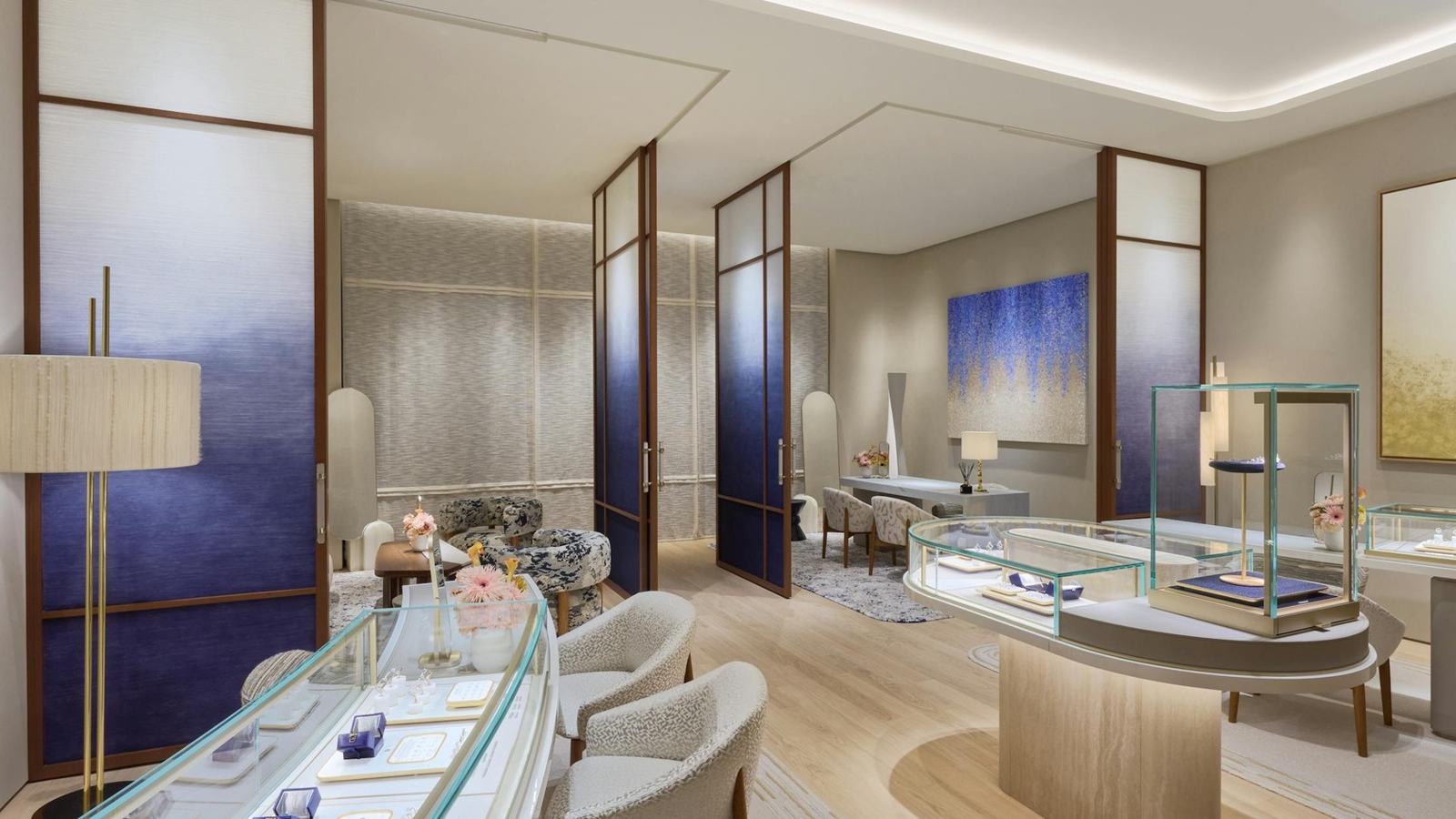
Chaumet’s Quartz Shinsaibashi flagship in Osaka brings Parisian jewellery heritage into dialogue with Japanese plasterwork, a tiara wall and two VIP rooms.
A new Japanese address for a Place Vendôme maison
LVMH's announcement of 13 November 2026 describes the new Chaumet flagship at Quartz Shinsaibashi in Osaka. Opened on 12 September, the boutique is identified as the Maison's largest in the Kansai region. Its design combines elements of Chaumet's Parisian architectural language with works produced using Japanese decorative craftsmanship. The store also incorporates two VIP rooms on its first floor, alongside presentations of jewellery and timepieces.
The November announcement provides a broader description of an address already opened earlier in the autumn, rather than reporting a second opening in November. For collectors of fine jewellery, the importance of the flagship lies partly in the way it brings together the Maison's historical design references and an architectural response to the city in which it is situated. A visit to a jewellery boutique may involve considerably more than examining items offered for sale. The organisation of displays, the interpretation of historical motifs and the availability of a setting suitable for detailed consultations can influence how a visitor encounters the work.
Shinsaibashi and the choice of a local architectural identity
The new boutique occupies a position at Quartz Shinsaibashi, within one of Osaka's established districts. The exterior employs the distinctive blue associated with Chaumet, while the interior uses warmer, more subdued tones. The Maison's design draws on its Parisian architectural identity without treating that identity as an obligation to reproduce an identical interior in every city.
This approach is significant within the context of international jewellery retail. A brand with a long history can communicate its heritage through a consistent palette and references to familiar design motifs. A location-specific interior, however, offers opportunities to work with local artists and craftspeople and to establish a meaningful relationship with the cultural environment of the new address. The contrast between the blue exterior and the softer interior tones also affects how the visitor experiences the transition from the street to the presentation of individual pieces. The published release describes the architectural concept but does not provide a full inventory of the materials or specify the construction methods used throughout the building.
A wall inspired by Chaumet's tiaras
One of the interior's most distinctive elements is identified as the Tiara Wall. Situated at ground-floor level, it combines an azure-blue surface with details in nickel silver inspired by Chaumet's tiara designs. The wall incorporates the design vocabulary of jewellery into the architecture of the presentation space. It is a reference to the Maison's history rather than itself a description of a particular tiara being made available for sale.
Tiaras are especially interesting in jewellery history because of the relationship between their form and the person wearing them. Their design involves considerations of proportion, silhouette and the arrangement of decorative elements across a curved structure. Translating aspects of that visual grammar into a wall changes the scale and intended function of the motifs. A visitor can consider the reference before turning to pieces presented at the scale of actual jewellery. The material identified in the release as nickel silver should not be confused with solid precious silver. Its function within the architectural feature is distinct from that of precious metals and gemstones used in the Maison's high-jewellery creations. This distinction illustrates why descriptions of decorative interiors and jewellery specifications need to be interpreted in their respective contexts.
Generational knowledge in Japanese plasterwork
LVMH identifies works by the Kujū family as part of the interior's artistic installations. The family has transmitted its plasterworking expertise across generations, and the work displayed at the boutique incorporates a wisteria blossom motif connected with Chaumet's design references. Another installation, by Atelier Patricia de la Torre, incorporates an Osaka Castle motif in plaster and gold leaf. These works create a dialogue between a historic Parisian jewellery house and decorative practices associated with its new Japanese setting.
Plasterwork can provide a different kind of visual experience from polished metal or faceted gemstones. Its effects depend on the modelling of a surface and the way light falls across its details. Gold leaf introduces a separate quality of reflection and colour. The materials permit a motif to be integrated into an architectural environment without requiring it to be reproduced as a piece of jewellery. The references to wisteria and Osaka Castle are also meaningful because they connect the installations with particular cultural imagery rather than treating Japanese craftsmanship as an undifferentiated decorative style. The release identifies the makers and motifs but does not give a complete account of their techniques. Visitors interested in the full history of the individual works should seek information from the Maison or their creators.
The role of two VIP rooms
The boutique's first floor incorporates two VIP rooms, reflecting the value Chaumet places on individual consultations within the new address. A private room can offer an appropriate environment in which a collector examines a piece at close range, discusses its construction and considers how it will be worn. The availability of such facilities is particularly relevant for clients considering high jewellery, where decisions may involve detailed conversations about stones, settings, documented specifications and the suitability of a design.
The presence of VIP rooms does not establish that a given service, item or appointment will necessarily be available at a particular time. Clients travelling internationally should arrange consultations directly if they wish to see specific pieces or discuss a potential commission. They should also establish the availability of appropriate language assistance if required. A detailed jewellery consultation may involve different needs from a general visit to a boutique. For international purchasers, matters such as documentation, insurance arrangements, transport and the tax implications of taking goods into another jurisdiction should be addressed separately. A discreet consultation space can facilitate those discussions but does not resolve their practical or legal aspects.
Collections connecting the historic and contemporary Maison
The announcement identifies Joséphine, Bee de Chaumet and Liens among the collections presented in the boutique, alongside high jewellery and watches. They offer different approaches to the Maison's creative vocabulary. The Joséphine name establishes a direct reference to the historical associations highlighted in the announcement. The bee and link motifs provide other recognisable design identities within the contemporary offering.
For a collector considering the relationship between contemporary jewellery and earlier creations, it is useful to distinguish the continuing use of a motif from the reproduction of a specific historical object. A collection name may refer to a longstanding inspiration while individual pieces differ in structure, scale and materials. High jewellery may introduce particular stones or more elaborate work that requires separate examination. The Osaka flagship provides a setting for considering these distinctions through the objects actually presented, rather than relying on an assumption that all versions are available at every international location. The source does not specify individual reference numbers, prices or the range of high-jewellery pieces on display on a given date.
Nearly two and a half centuries of historical reference
LVMH relates the Osaka opening to almost 245 years of Chaumet history and identifies Napoleon I and Empress Joséphine among the Maison's early clientele. These associations help explain the continued prominence of references to tiaras and historic French jewellery in the company's contemporary visual identity. They do not establish that an individual contemporary object has a direct historical provenance from the period.
For collectors, this distinction matters when examining the documentation accompanying jewellery. A piece inspired by a historical motif should be evaluated according to its actual date of creation, materials, maker and ownership history. A reference to the Maison's heritage can enhance an appreciation of its design without replacing the evidence needed to identify a particular object. The architecture of the new store illustrates the way historical references can take on new forms when applied to spaces in a different country. The collaboration with Japanese decorative practitioners also places the Maison's European history within the context of present-day creative activity rather than presenting that history as a closed tradition.
Considering a visit in the context of private travel
For a visitor with an interest in jewellery, design and craftsmanship, the new Osaka flagship provides an additional point of interest during time spent in the Kansai region. The opportunity to examine both the interior installations and the Maison's current presentations may make a visit worthwhile independently of a decision to purchase a piece. Clients who have a specific interest in high jewellery or the historical references behind a collection should contact the Maison in advance to establish suitable arrangements.
For superyacht guests travelling in Japan, shore visits should form part of a broader itinerary agreed with the captain and local agents. The source does not establish yacht access near Quartz Shinsaibashi, and no specific berth or private transport arrangement is implied by the opening of the boutique. The cultural significance of the address lies in the combination of a Parisian jewellery tradition and Japanese decorative expertise, together with spaces intended to accommodate individual consultations. The opening took place in September; LVMH's November announcement provides the verified account of its architecture, collaborators and collections. All purchasing and appointment arrangements should be confirmed directly with Chaumet.
Primary source: LVMH official 13 November announcement.
Chaumet Osaka flagship — LVMH official editorial photograph. Official source.
