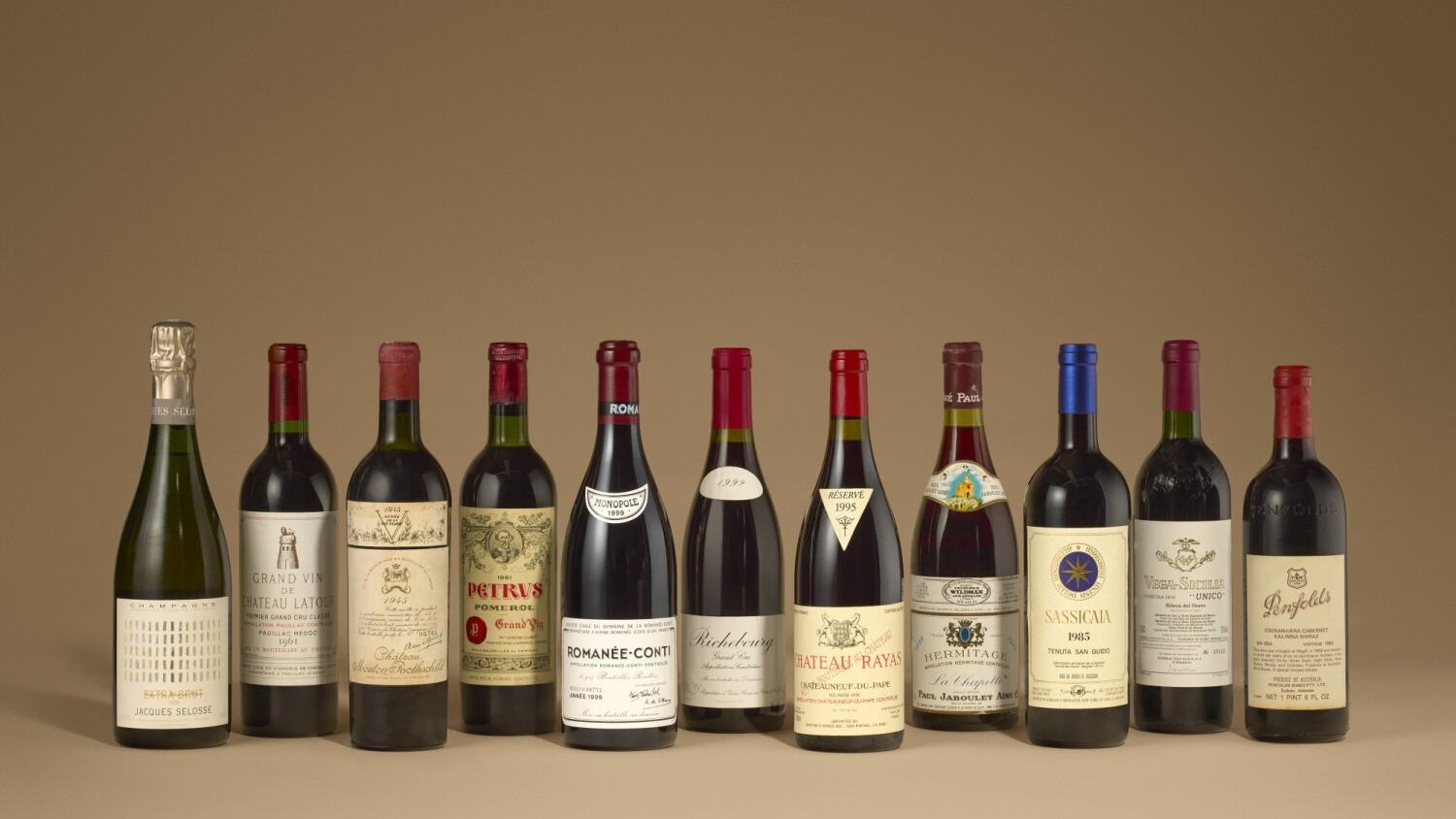
Christie's marks sixty years of wine auctions with a privately assembled 350-lot cellar of Romanée-Conti, mature Burgundy, Rhône and Bordeaux.
Three hundred and fifty lots from a lifetime of collecting
Christie’s will offer 350 lots from The Distinguished Cellar of an American Connoisseur at Rockefeller Center, New York, on 23 October 2026. The collection was assembled over decades, with an emphasis on prestigious vintages, mature bottles and the recorded history of their acquisition. Its scope makes the event more than a parade of famous labels: this is a rare opportunity to examine how one buyer put together a cellar over many years.
The sale has particular weight because Christie’s is marking sixty years since it began holding fine-wine auctions. The original London auction took place on 11 October 1966, and a separate Hong Kong sale of the cellar of the Hon. Henry Tang is scheduled for 10 October 2026 as part of the anniversary programme. Those dates frame the New York offering within a longer story of how collectible wine moved from personal cellars into the international auction market.
Chris Munro, Christie’s head of wine and spirits in the Americas, highlights the breadth of the selection, spanning Burgundy, Bordeaux, Rhône wines and notable New World bottles. The collector’s approach to provenance and condition is an important theme in the auction house’s account. For bidders, that emphasis needs to be tested against the records and details of specific lots, not accepted as a substitute for inspecting the catalogue.
Rare Rhône and Burgundy bottles lead the estimates
Among the top lots are six bottles of Domaine Jean-Louis Chave Ermitage Cuvée Cathelin 1991, estimated at $60,000 to $80,000. A three-bottle lot of Domaine de la Romanée-Conti Romanée-Conti 1999 carries the same published estimate. The contrasting lot sizes illustrate why a simple per-case comparison is a poor way to assess an auction devoted to different producers, regions and levels of scarcity.
The catalogue also features mature Domaine Leflaive, including twelve bottles of Chevalier-Montrachet 1989 estimated at $24,000 to $35,000. Such white Burgundy attracts collectors with a particular interest in cellar history and the way bottles have evolved over time. Buying a mature wine is very different from ordering a current-release vintage for immediate service at dinner.
Guigal’s Rhône wines are especially prominent, with Christie’s describing one of the most comprehensive selections of the estate’s La La wines to appear at auction, including many full cases. These single-vineyard wines appeal to buyers who follow producer and vintage distinctions closely. The appeal of a complete case is not merely volume but the possibility of a group with consistent documented storage history.
Bordeaux, Champagne and New World wines broaden the range
Beyond the headline Burgundy and Rhône lots, twelve bottles of Pétrus 1982 are estimated at $38,000 to $48,000. Christie’s also points to historic Bordeaux names and years, including Château Latour 1961, Mouton Rothschild 1945 and La Mission Haut-Brion 1961. These are details from the sale announcement rather than a complete catalogue of the offering.
A magnum of Louis Roederer Cristal Rosé 1996 is estimated at $1,400 to $1,900, showing that the programme includes Champagne alongside still wines. Collectors often approach large formats with different serving or cellaring intentions, but an estimate alone reveals little about an individual bottle’s life. Fill level, cork and label condition, storage environment and documentation can be as consequential as the name on the bottle.
The New World is represented too, including fifteen vintages of Penfolds Grange reaching back to 1966. Its presence disrupts any assumption that the collection is exclusively French or concerned only with a familiar handful of estates. A cellar built over decades can express personal conviction as well as market status, particularly where a collector repeatedly follows a producer through changing vintages.
Provenance is the real test for mature wine
At these ages and values, two superficially similar bottles may offer different prospects because their storage and transport histories diverge. Temperature stability, light exposure, humidity and the integrity of closures all matter, although none can guarantee the contents of a sealed bottle. Buyers should examine auction disclosures, photographs, bottle conditions and any available provenance documents before making assumptions about drinkability.
Overseas collectors face additional questions concerning shipment, customs rules, duties and specialist insurance. Moving old bottles to a yacht for a celebration may seem tempting, but the movement, vibration and variable storage conditions on board deserve serious consideration. Professional advice on conditioning and transport is particularly important when a collection includes fragile mature wines rather than bottles chosen for casual immediate consumption.
Wine collecting also differs from building a portfolio of durable decorative art. A bottle is both a historical object and a perishable product, and an attractive auction result says nothing definitive about how the wine will taste once opened. Some buyers will seek to drink particular vintages, while others place greater emphasis on collecting sequences, provenance or preserving the original cellar’s identity.
An anniversary sale with a long memory
The New York event is part of Christie’s larger commemoration of six decades in the wine-auction business. By presenting a privately developed collection of 350 lots, the house is emphasising the continuity between the earliest specialist sales and today’s international market. Collectors can evaluate the specific bottles, but they can also observe how tastes and the definition of prestige have developed across generations.
For a superyacht owner planning an exceptional dining programme, the lesson is not simply that rare bottles exist at auction. The work lies in matching wine to occasion, obtaining clear provenance, handling shipment correctly and entrusting service to specialists who respect the bottle’s condition. Christie’s primary announcement confirms the sale date and the cited estimates; final prices and the quality of any opened bottle remain matters for the future.
Source
Christie's Press