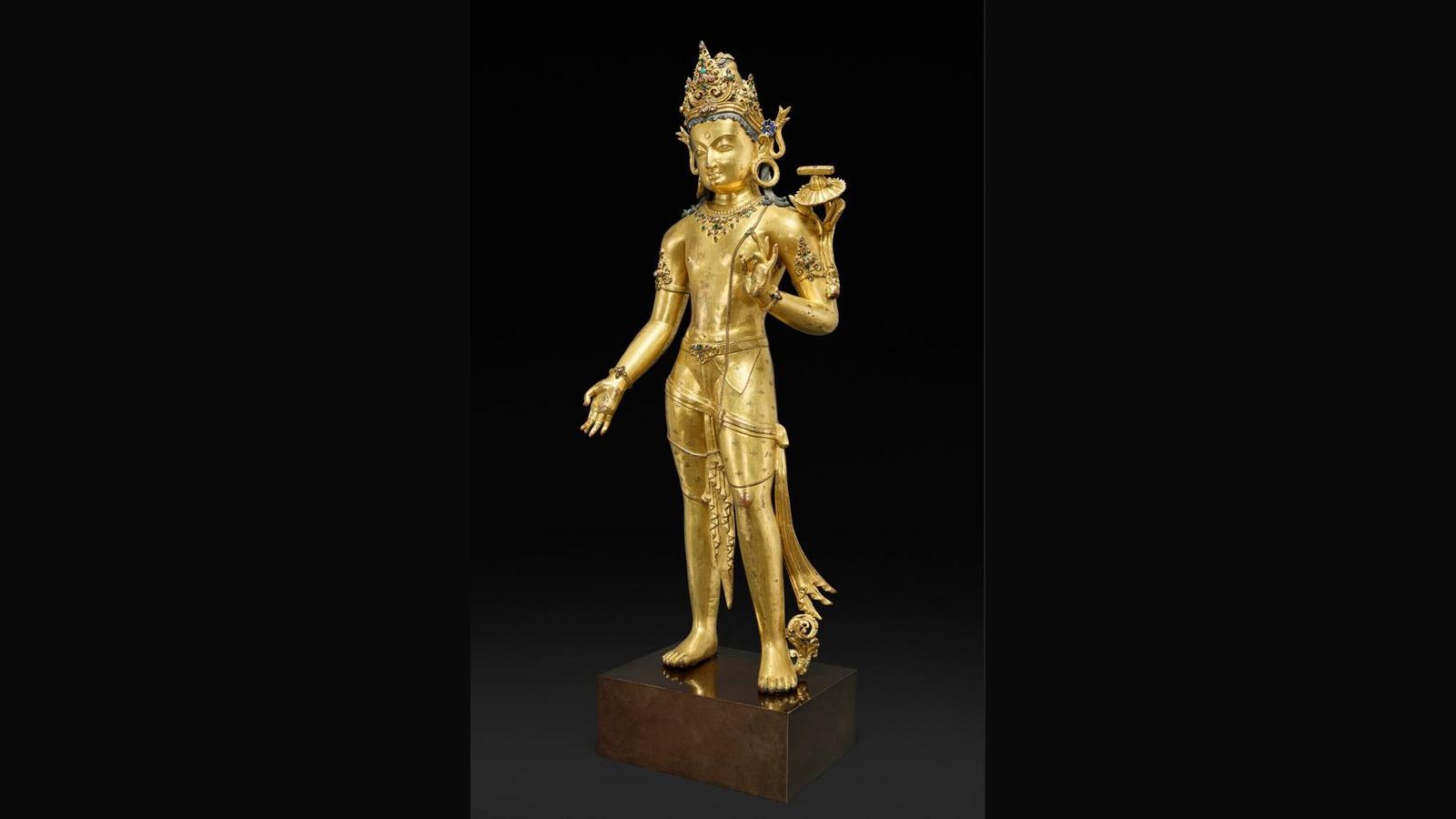
Christie's Hong Kong will present a rare 93-centimetre gilt-copper Manjushri in a dedicated Buddhist-art auction on 30 October 2026.
Hong Kong prepares a concentrated Buddhist-art sale
Christie's will hold a dedicated auction titled Awakening Wisdom: Masterpieces of Buddhist Art from a Private Asian Collection in Hong Kong on 30 October 2026. The single-owner sale is part of Hong Kong Asian Art Week and brings together rare Himalayan sculpture and devotional painting, including works that have remained outside the public market for substantial periods.
The auction sits alongside Christie's regular Indian, Himalayan and Southeast Asian art offering rather than replacing it. Its separate presentation draws attention to the coherence of one private collection, built around artistic quality, historic significance and the complex symbolic traditions of Buddhism. The objects are being offered for sale; their appearance in a catalogue is not evidence that any particular lot has already found a buyer.
A twelfth-century Manjushri leads the collection
The principal highlight is a 93-centimetre gilt-copper alloy figure of Manjushri dating to the 12th century and attributed to Nepal's Newar sculptural tradition. Christie's identifies the deity through the Prajnaparamita scripture resting upon a lotus at the shoulder. The figure's poised stance, elaborate jewellery and expansive gilded surfaces combine spiritual symbolism with extraordinary metalworking.
At a height approaching one metre, the sculpture has a commanding presence unlike much smaller objects made for personal devotion. Its anatomy is rhythmically modelled, with subtle shifts in the hips and torso counterbalanced by a carefully arranged crown, necklace and arm ornaments. The original Christie’s press photograph accompanying this report shows the actual sculpture, not an imagined reconstruction or unrelated religious object.
Newar metalworking crosses centuries and regions
Newar artists working in the Kathmandu Valley made significant contributions to Himalayan Buddhist imagery through sophisticated casting, finishing and gilding techniques. Objects associated with this tradition travelled widely and influenced religious art beyond Nepal. The present Manjushri shows the sensitivity to bodily proportion and fine ornament that specialists often discuss when assessing major works of the period.
Historical attribution requires close attention to casting, surface treatment, stylistic comparisons and provenance. A label such as '12th century' is the auction house's scholarly assessment rather than an exact production date stamped onto the material. Collectors should review the full catalogue discussion and any laboratory analysis, while recognising that religious imagery is not merely a decorative art category.
Why iconography matters to a serious collector
Manjushri is associated with wisdom, and visual attributes help distinguish representations of the bodhisattva across different places and periods. In this example, the scripture supported by the lotus forms an important clue to identification. The ornamentation and posture communicate ideas within a devotional tradition that extends far beyond questions of craftsmanship and commercial value.
Collectors and curators should consider how works are explained to visitors in private or public displays. Accurate descriptions can identify the source culture, represented figure, known use and uncertainties without flattening complex traditions into generic language. Where collections move internationally, consultation with relevant scholars and cultural communities can enrich responsible interpretation.
The thangkas introduce another material language
The sale also includes painted and textile Buddhist works, including thangkas that demand a different set of conservation priorities from metal sculpture. Such objects may contain delicate pigments, fabrics, mounts and layers that respond to light, humidity and handling. Their role as ritual and contemplative images cannot be captured adequately by dimensions or colour alone.
Buyers should seek condition reports detailing any losses, repainting, reinforcement and later remounting. A piece that appears striking in a catalogue photograph may need careful environmental control when exhibited. For private owners, sympathetic storage and specialist advice are preferable to aggressive cleaning or aesthetically motivated restoration.
Provenance is an essential part of the discussion
Christie's describes the collection as privately assembled with a strong appreciation of Buddhist artistic traditions. That description invites examination of the documented ownership history for every lot, including the dates and circumstances of transfers across borders. A prestigious catalogue does not eliminate the need for independent legal and ethical due diligence.
Import and export restrictions, cultural-property law and museum guidance vary by jurisdiction and by the history of an individual object. Prospective bidders should request documentary evidence and professional advice before committing funds. Responsible collecting can contribute to research and preservation, but only when questions of lawful ownership and cultural context are treated seriously.
Hong Kong offers an international viewing platform
Christie's announced a Taipei preview on 17–18 October and viewing in Hong Kong from 22–28 October at its Asia-Pacific headquarters in The Henderson, Central. The auction is scheduled there on 30 October. These events give regional and international buyers opportunities to evaluate the material and speak with specialists before the sale.
Christie's is marking its fortieth anniversary in Asia in 2026, a milestone that provides a broader setting for the October programme. The auction house is using its regional presence to connect collectors with material from across centuries and cultures. It remains important to separate the anniversary's promotional significance from the specific historical claims made for the individual objects.
What the October auction may reveal
The public sale will test demand for a small group of high-level Buddhist artworks at a time when collectors have increased access to specialist scholarship and detailed online catalogues. Christie's describes the Manjushri among the most important examples of its kind to come to market in recent years, but that remains an expert assessment attached to a specific offering.
Final prices should be assessed against estimates, condition and the rarity of comparable objects rather than used as a single measure of cultural importance. For the owners who eventually acquire these works, sustained attention to documentation, conservation and respectful display will be as important as the moment of acquisition.