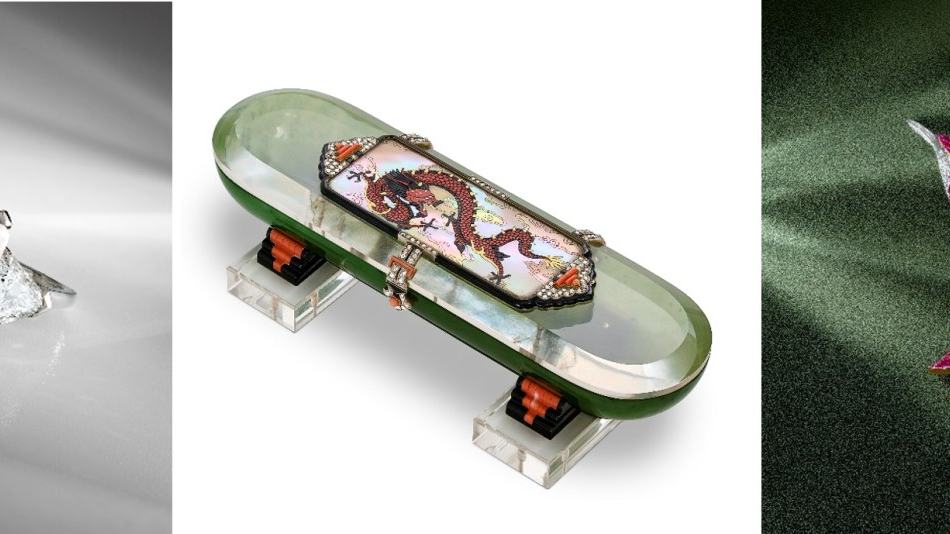
Christie's will offer Exceptional Jewels & Objects of Elegance: A Connoisseur's Collection in Geneva on 10 November 2026, featuring 123 live-sale pieces, while another 152 items are offered online from 5–17 November.
A remarkable private collection comes to Geneva
Christie's is preparing Exceptional Jewels & Objects of Elegance: A Connoisseur's Collection for auction in Geneva on 10 November 2026. The offering brings together high jewellery, Art Deco vanity cases and historic gold boxes assembled over several decades. The auction house describes nearly 300 objects selected with an unusually consistent eye for craftsmanship and design, making the sale as much a study in collecting taste as a presentation of expensive gemstones.
The programme is divided between a live auction at Four Seasons Hôtel des Bergues on 10 November, featuring 123 pieces, and an online sale running from 5 to 17 November with a further 152 items. These are separate opportunities with different bidding arrangements. As of 5 November, the live auction has not taken place, so the published estimates and the house's overall expectation should not be presented as completed sales.
Forty years of decisions behind the catalogue
Christie's says the collection was assembled over four decades, with attention to quality, rarity and the relationship between different materials. It includes twentieth-century jewellery alongside eighteenth- and nineteenth-century objects, an arrangement that reflects the owner's broader interests rather than a single designer or period. That long-term perspective is important because a coherent collection can reveal how tastes and knowledge develop over many years.
Rahul Kadakia, the auction house's president for Asia Pacific and chairman of its luxury division, describes the selection as the result of a family of discerning collectors. His remarks establish the house's interpretation of the provenance, though prospective bidders should still examine documentation relating to individual lots. The significance of an object depends on its maker, materials, originality and history, not only on its association with an admired collection.
Van Cleef & Arpels and the mystery-set technique
A group of eight Van Cleef & Arpels mystery-set jewels forms one of the sale's most distinctive sections. The technique, patented in 1933, allows gemstones to be arranged without the conventional visible prongs that might interrupt an expanse of colour. It demands extremely precise cutting and fitting, making the final visual simplicity the result of considerable technical work.
Among the highlights is an Oiseau Mystérieux bird brooch set with rubies and diamonds, estimated at US$600,000 to US$1 million. Christie's links the bird-of-paradise motif to the house's decorative language and notes that this example was acquired directly from Van Cleef & Arpels in the early 2000s. The estimate is a pre-sale opinion rather than an outcome. Condition and documentation remain essential when assessing a technically demanding jewelled object.
A Fuchsia brooch and a palette of gemstones
The same group includes a ruby mystery-set Fuchsia brooch with a published estimate of US$400,000 to US$600,000, as well as ruby Cadix earrings and a mystery-set ruby ring. Christie’s also points to sapphire-set examples, illustrating how the technique can be adapted to different colours and forms. Such pieces reward close observation of the junctions between stones and the relationship between their cut and the underlying metal structure.
Colour is only part of the collecting interest. Gemstone quality, repairs, later replacements and the survival of original settings can affect how a piece should be understood. A purchaser should review the official reports and obtain specialist advice on valuable coloured stones. The fact that two jewels use a similar design method does not mean they have comparable condition, provenance or future market appeal.
A 14.63-carat orangy-pink diamond
Christie's highlights a David Morris ring set with a 14.63-carat fancy orangy-pink diamond, estimated at US$1.6 million to US$2.6 million. The stone's unusual colour and weight make it a central attraction within the catalogue. Its appearance offers a reminder that exceptional jewellery can be discussed through gemological characteristics as well as the reputation of the design house responsible for the mounting.
An important coloured diamond should be assessed using documented grading information and a clear understanding of any treatments or modifications disclosed by the seller. Photographs can make the hue look different depending on lighting, and a colour designation cannot be judged reliably from a computer screen. The published estimate indicates the auctioneer's expectations before bidding, not the amount the object will necessarily achieve.
Emeralds, rubies and sapphires in the spotlight
Further highlights include Graff earrings containing cushion-shaped emeralds of more than seventeen carats each, estimated at US$900,000 to US$1.5 million. A Bulgari Trombino ring features a 14.38-carat Burmese ruby, while a Van Cleef & Arpels pair uses large oval sapphires with diamonds. These pieces bring three different gemstone traditions into a single collection, ranging from the depth of an emerald's green to the presence of a fine ruby.
Comparing such gems involves more than ranking their weights. Origin, clarity, colour, cutting and any treatment can influence both appearance and assessment. A paired set of stones introduces further questions about matching and the relationship between its components. Buyers should request the available laboratory information for each lot and understand exactly which claims are supported by specialist reports rather than the descriptive language of a catalogue.
Cartier's Art Deco cases bring another perspective
The sale is not limited to wearable jewellery. A group of Cartier Art Deco cigarette, vanity and other cases explores the house's mastery of miniature decorative objects. One highlighted cigarette case combines laque burgauté, coral, diamonds and silver, with an estimate of US$100,000 to US$150,000. Works of this kind draw on artistic traditions beyond Europe, including lacquer techniques and the use of contrasting hardstones.
Cases can look deceptively simple in a display, yet their appeal often lies in precise hinges, carefully fitted lids and elaborate interior compartments. They are useful reminders that luxury craftsmanship historically extended to personal objects carried or used every day. A purchaser should evaluate mechanical condition and the completeness of the piece as well as the quality of the decoration. Repairing an old case may require different expertise from resetting a gemstone.
Gold boxes connect the sale to earlier centuries
Historic gold boxes form another important component of the collection, including snuff boxes and pill boxes dating from the eighteenth and nineteenth centuries. Christie’s highlights examples with carved hardstones, cameos, enamel and mother-of-pearl. A German gold and mother-of-pearl snuff box dating to about 1750 is among the illustrated objects. These works reflect craftsmanship and social customs from an era before modern jewellery collecting became organised around brand names.
The practical purpose of a box may have changed, but its value as a collectible object depends on materials, maker attribution and conservation. Enamel surfaces can be damaged by impact, while later alterations may not be obvious from a catalogue photograph. Collectors also need to understand any restrictions connected with older materials. A careful examination helps distinguish an original historic object from one whose appearance has been significantly altered by restoration.
Two sales require different bidding plans
The live sale of 123 pieces and the online offering of 152 works follow different calendars. The auction house expects the overall collection to realise more than US$25 million, but that is a forward-looking expectation and does not establish the result of either sale. Bidders should check which item belongs to which auction, the available viewing arrangements and the conditions that govern bidding, payment and delivery.
An estimate is not a ceiling on total expenditure. Buyer’s premium, currency conversion, applicable taxes, insurance and transport can materially alter the final commitment. The same caution applies whether the object is a diamond ring or an eighteenth-century box. Prospective owners should also consider conservation and display after purchase. A coherent collection may be attractive as a whole, but each lot remains a separate object requiring independent evaluation.
A collection defined by craftsmanship
Exceptional Jewels & Objects of Elegance presents the idea of collecting as a search for invention across periods and materials. The same catalogue can accommodate a mystery-set ruby brooch, a fancy-coloured diamond, an ingenious Cartier case and a historic gold box because each illustrates a particular kind of craftsmanship. That range gives the sale a distinctive identity beyond the prestige of the makers represented.
For readers interested in jewellery, design and art history, the Geneva offering provides an opportunity to examine how rare objects have been assembled and preserved. Its commercial outcome remains unknown until the auctions close, and not every estimate will necessarily be met. What is established is the breadth of the collection and its November programme. The deeper story concerns a collector's sustained attention to detail and the skill embodied in the objects themselves.
Editorial source: Christie's — Exceptional Jewels & Objects of Elegance press release. This original lifestyle feature is based on information from the named source; confirm current menus, seasonal schedules and reservation conditions with the hotel before visiting.