Christie’s Geneva Rare Watches auction on 9 November 2026 places historic Patek Philippe and Cartier watches beside rare independent creations.
A November appointment for discerning collectors
Christie’s has announced a Rare Watches auction in Geneva for Monday, 9 November 2026, at the Four Seasons Hotel des Bergues. The sale brings together 218 timepieces, ranging from historic production watches to contemporary creations by independent makers. Its public preview is scheduled for 5–8 November. For international collectors, that sequence allows time to examine individual lots and their documentation before the live bidding begins. The auction is part of a busy period of Geneva collecting activity, rather than a private invitation-only exhibition.
The official preview is useful because photographs cannot substitute for an examination of condition, case proportions, dial finish and movement records. Guests visiting from a yacht or another European city should plan enough time for the viewing rather than build a purchase decision solely around an estimate. Christie’s catalogue and specialist department are the appropriate places to obtain condition reports, provenance material and the current terms of sale. None of the published estimates represents a guaranteed transaction price.
Why vintage and independent watches sit together
The auction house identifies more than 35 vintage watches and 39 works by independent watchmakers among the 218 lots. Seven of the independent pieces are described as unique creations. That combination highlights two different collecting approaches: established models whose production histories can be researched, and contemporary watches whose makers control extremely small outputs. In each group rarity matters, but so do originality, mechanical condition, design significance and whether the individual specimen has a credible history of ownership.
A buyer interested in only one maker can still learn from the wider selection. Viewing unusual case designs beside familiar perpetual calendars makes differences in craftsmanship and design language especially clear. The show does not imply that every watch is equally rare or equally liquid. There can be considerable differences between a one-off object, a short production series and a familiar reference in an exceptional configuration. An informed collector assesses the actual lot, not merely the language of scarcity in an auction headline.
A 1948 Patek Philippe reference 1518
One of the historical highlights is a yellow-gold Patek Philippe reference 1518 produced in 1948, with a stated estimate of CHF 500,000–1,000,000. Christie’s notes that the model, introduced in 1941, was the first serially produced perpetual-calendar chronograph wristwatch. Production of the reference numbered only 281 examples through 1954, the auction house says. Its combination of calendar and chronograph mechanisms remains significant in the story of complicated wristwatches, independently of any particular hammer price.
Christie’s reports confirmation from the manufacture’s archives that this example was produced in 1948 and subsequently sold on 17 December of that year. Such documentary confirmation can materially improve a prospective owner’s understanding of a watch, although it does not replace a technical condition assessment. Buyers should consider whether components remain consistent with the catalogue description and what any later servicing has changed. Originality and maintenance are separate questions, and both deserve attention before the bidding opens.
Cartier approaches watchmaking as sculpture
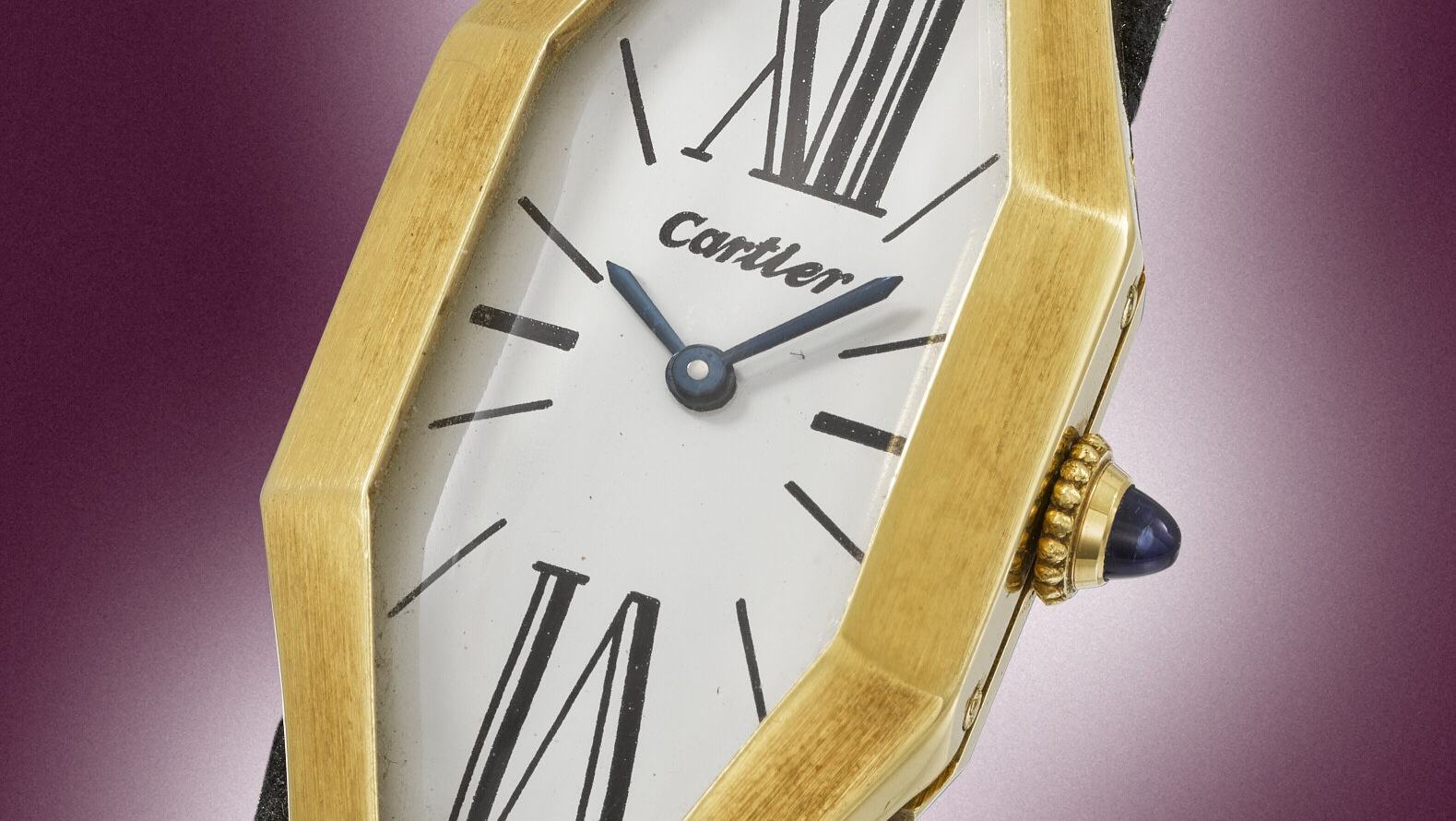
A Cartier Octagonal Allongée made in London in 1990 represents a contrasting design tradition. The lot carries an estimate of CHF 400,000–600,000, and Christie’s says it is the first watch from that particular 1990 series to reach an international auction. The elongated, angular case reflects the London workshops’ willingness to move beyond conventional round and rectangular forms. Its appeal is not explained through technical complexity alone; silhouette, design history and the relationship between jewellery and watchmaking all matter.
Christie’s places the design within the creative environment associated with Jean-Jacques Cartier and the London-made pieces of earlier decades. Collectors should distinguish the 1990 revival from watches created during the original 1960s and 1970s period. That distinction affects historical interpretation and can affect demand. Familiarity with the Cartier name is insufficient when individual references differ so widely. In-person inspection is particularly valuable with an unusual shape because photographs can flatten how a watch actually wears.
A watch connected with the Sultan of Oman
A yellow-gold Patek Philippe Nautilus reference 3700/1, made in 1978 for Sultan Qaboos bin Said of Oman, offers another strand of provenance. According to Christie’s, only five examples of the yellow-gold reference with a Khanjar dial were publicly known before this watch came to light. The auction house says it comes directly from its original owner, who worked closely with the Sultan, and that the watch has remained in that person’s care. This is the auctioneer’s published account and should be reviewed alongside the lot documentation.
The reported personal history is unusually detailed: the owner recalls occasions when the Sultan asked the time and later gave him a watch. This narrative helps explain why the object may have been retained for decades rather than traded. Collectors must nevertheless separate an engaging story from authenticated evidence of a particular watch’s manufacture, presentation and chain of ownership. Original records and a specialist examination matter more than the romance of a royal association when assessing an acquisition.
The distinct hand of a contemporary maker
Among the contemporary pieces is a unique Voutilainen Vingt-8 SC, a watch using an onyx dial and a steel case. Christie’s gives an estimate of CHF 300,000–500,000 and describes its unusual dial, on which the five o’clock position is marked by a Roman numeral V to acknowledge its owner’s birthday. That personal detail illustrates an essential feature of independent watchmaking: small-scale production can permit design choices connected to a specific commissioning client.
A piece that was built for one person may have immense appeal to another, but its bespoke features also complicate direct comparison with auction prices for standard examples. Prospective buyers should seek the full specification, movement details and record of manufacture before deciding how the personalisation affects their own interest. Voutilainen is represented here as a watchmaker with an identifiable technical and aesthetic approach, not simply a label whose name alone establishes value.
Pinaud and Journe extend the independent conversation
Christie’s also highlights a unique Sylvain Pinaud Origine with a black dial and precious-metal components, estimated at CHF 100,000–200,000. The auctioneer notes Pinaud’s training background and the recognition won by the Origine at the Grand Prix d’Horlogerie de Genève. A separate F.P. Journe Tourbillon Souverain from 2001 carries an estimate of CHF 650,000–1,400,000. These watches offer different entry points into the development of modern independent horology.
Independent work is often discussed as a single market category, yet makers differ sharply in production method, finishing and approach to complications. The sale can be read as a conversation between those different philosophies. An owner considering a complex or rare piece should also investigate future servicing arrangements and access to appropriate specialists. Long-term care, insurance documentation and secure transport deserve as much advance thought as a successful bid.
A disciplined approach to the Geneva sale
The public viewing runs from 5 to 8 November, followed by the live auction on 9 November at the Four Seasons Hotel des Bergues. Anyone considering attendance should verify the latest preview hours, bidding registration process and whether a specialist appointment is required for a specific lot. Published estimates exclude the buyer’s premium and any applicable taxes or shipping costs. Collectors planning to move a high-value watch internationally should investigate insurance, customs and import responsibilities before making a commitment.
The strongest reason to visit is the chance to compare watches that represent different moments in design and technical development. Christie’s official release establishes the announced dates, principal lots and indicative values, but bidding outcomes remain unknown. The prudent objective is to understand the objects as well as possible, obtain documentary answers to unresolved questions and establish an acquisition limit that remains sensible after the final invoice. The sale offers an absorbing overview of collecting; it does not promise an investment return.
Primary source: official operator release. Information reflects announcements reviewed 31 October 2026; check current terms directly.
Event calendar: Christie’s Geneva Rare Watches Sale 2026.