Christie’s says its 9 November Geneva Rare Watches sale achieved CHF 47.8 million with all lots sold, led by independent watchmakers and a separate charity component.
Reported sale results, 10 November 2026. Figures and lot descriptions are from Christie’s 9 November results statement. Prices are attributed to the auction house, with hammer and total-sale figures distinguished where specified.
Geneva records a major day for collecting
Christie’s says its Rare Watches auction in Geneva on Monday 9 November 2026 realised CHF 47,824,592, equivalent in its published statement to approximately US$58.7 million. The auction house describes it as its highest watch auction total and reports that every lot offered was sold. It says the sale lasted more than eight hours and attracted registrants from 66 countries. These are event results released by Christie’s, not a forecast or an independent valuation of the watches being traded.
For yacht owners and guests who follow fine mechanical watches, the significance extends beyond the impressive total. A single sale brought independent makers, historically important references and charitable watchmaking projects into the same collecting conversation. Auction results can illuminate taste and scarcity, but they do not make a particular watch an automatically sound investment. The value of understanding a result lies in the details: the model, provenance, condition, buyers’ charges and the precise definition of the published price.
What the headline figure includes
The CHF 47.8 million number is the total Christie’s reported for its Geneva sale, rather than the result of one watch. Its statement also reports a 100 per cent sell-through rate and an improvement of 221 per cent over the previous year. Such comparisons come from the auctioneer’s own accounting of its event and should not be generalised to the entire watch market, where different price levels and channels may perform differently.
Christie’s additionally says the sale realised 250 per cent of its low-estimate level. A low estimate is a guide assigned before the auction and depends on the composition of the lots, so performance against it cannot be translated directly into a percentage gain for anyone who bought a watch years earlier. Buyers may also face taxes, premium and storage or maintenance costs. A responsible collector should compare like with like and distinguish sale-event statistics from the resale prospects of an individual timepiece.
F.P. Journe takes a prominent place
Independent watchmaking was a major theme in Christie’s result statement. The house highlighted seven unique pieces among 44 watches in the independent-watchmaker segment and said each lot in that group sold at or above its high estimate. It also reported interest in a complete F.P. Journe Ruthenium Collection of five matching watches, each numbered 92/99, previously associated with the collection of Formula One driver Michael Schumacher.
The two most valuable named pieces from that Ruthenium set were a Tourbillon Souverain and a Chronomètre à Résonance, which Christie’s says each achieved CHF 1,536,000. The attraction of an intact numbered collection is not solely mechanical performance; shared numbering, presentation and documented ownership history may contribute to collector interest. Yet those elements should be examined in the original documentation rather than assumed from a brand name. Christie’s published figures describe a particular public sale and cannot automatically be applied to superficially similar examples.
The three Vagabondage watches
One of the most striking outcomes concerns F.P. Journe’s Vagabondage trilogy. Christie’s reported that matching-number examples of Vagabondage I, II and III, all in pink gold, were purchased by one private collector for a combined CHF 6,709,200. The sale house also identified a limited-edition Vagabondage wristwatch in pink gold with jumping hours and seconds among its leading individual lots, reporting CHF 2,536,000. These amounts belong to the specific lots and disclosed auction outcomes.
Series collecting raises a different question from buying a single attractive watch. A complete trio or a sequence of related references may tell a technical and design story across years, but completeness must be documented. Service history, replacement components, matching-number evidence and the original presentation can all matter to a specialist. A buyer who acquires a group for its narrative qualities should also ask what happens if one item needs attention, cannot be insured on similar terms or is later separated from the group.
A. Lange & Söhne anniversary set draws interest
Christie’s also presented an intact group of ten A. Lange & Söhne anniversary models issued during 2019 to mark the brand’s twenty-fifth year after its modern revival. The auction house said the ten pieces had stayed together with their original collector. Within the selection, it named the Lange 1 Tourbillon as a leading result at CHF 524,800. This is another example of how an entire collecting programme can be offered as related individual watches rather than as a single undifferentiated asset.
The appeal lies partly in historical coherence. Acquiring all ten releases as new pieces is a different exercise from trying to assemble them years later with uniform documentation and condition. The price of one prominent piece does not reveal the total cost of building such a collection, however. A reader should consult the lot-by-lot results for the full picture and avoid interpreting a headline figure as the value of the complete set unless the source makes that distinction explicitly.
Two notable Patek Philippe references
Among the vintage and neo-vintage watches, Christie’s reported CHF 1,075,200 for a Patek Philippe reference 1518, a perpetual-calendar chronograph first introduced in 1941. The auction house described it in the context of its importance to serially produced wristwatch complications. Another highlight was an 18-karat gold Nautilus reference 3700/1, produced in 1978 for Sultan Qaboos bin Said al Said of Oman and bearing the Khanjar association. Christie’s gave the latter a result of CHF 1,024,000.
These are materially different watches. One draws interest from historical movement design and the legacy of a pioneering reference; the other combines an important sports-watch form with a particular historical commission and an unusual dial association. Provenance claims should be supported by the lot catalogue and appropriate documentation. Neither result suggests that any ordinary 1518 or Nautilus will achieve the same price, because condition, rarity, metal, dial and documentation can differ substantially.
The charity component for ELA
An important element of the Geneva event was Watches for ELA, benefiting ELA International and its work associated with leukodystrophies. Christie’s says 20 brands contributed pieces, alongside a Cartier Pasha associated with footballer Zinedine Zidane. The house reported a combined CHF 501,400 in hammer proceeds for the charity group. The explicit description as hammer proceeds is important, since it should not be mixed without explanation with sale totals that may be presented using a different reporting basis.
An auction with a charitable purpose can attract bidders motivated by philanthropy as well as collectors concerned with the objects themselves. That makes its prices interesting but not always directly comparable with ordinary market transactions. For the public, the relevant facts are the named beneficiary, the auctioneer’s announced charitable component and the reported proceeds. What the charity ultimately receives or spends should be established from its own later reporting, rather than inferred from an auction-day headline.
Who was participating
Christie’s reports that registration came from 66 countries, that 19 per cent of bidders were new to Christie’s and that 40 per cent of registrants were Millennials or members of Generation Z. Those numbers describe people who registered or bid in this particular auction, not the demographic profile of everyone who collects watches. It would be wrong to claim they establish a permanent change in the market, or that every younger registrant completed a purchase.
Still, the reported international reach shows why Geneva events receive attention far beyond Switzerland. Digital catalogues, remote bidding and global specialist networks allow collectors to follow an auction without being present in the room. High-value objects also require careful consideration of time zones, bid limits, identity checks and cross-border logistics. A yacht owner viewing the sale while travelling is subject to those same practical realities, irrespective of the convenience of joining online.
Understanding resale prices with care
Watch collecting includes many motivations: craftsmanship, mechanical innovation, family history, design and the enjoyment of wearing an object. Auction statistics can add context but should not replace those reasons with unsupported expectations of profit. A record for a rare, carefully documented piece says little about the likely sale price of a modern production model, even from the same house. Market conditions can change, and publicly reported exceptional results are not a complete record of unsuccessful private offers.
If a collector is considering purchase or sale, a proper comparison needs the exact reference, configuration, condition, restoration history, service information and provenance. Commission, tax, insurance and currency conversion can affect the net amount received or paid. Christie’s is reporting what occurred in its sale, while a private appraisal asks a different question. Our account is intended to explain the event, not to suggest that any particular model is an investment opportunity.
The practicalities for owners travelling with watches
A collection of rare mechanical watches is easy to carry in size but can be difficult to move responsibly across borders. Ownership records, insurance coverage, servicing plans and secure transit should be arranged before an itinerary rather than improvised during travel. Customs and import obligations depend on individual circumstances and jurisdictions; a yacht’s private status does not remove the need for accurate declarations where applicable. Confidentiality around who owns a particular piece is also a sensible aspect of personal security.
A captain or purser may help coordinate appointments or transport, but should not be expected to make specialist authentication or valuation decisions. Those tasks belong to qualified experts and insurers. For collectors wishing to enjoy a watch aboard, the best plan is usually one that makes the object accessible without creating unnecessary exposure or ambiguity about responsibility. Public auction reporting should not be used to speculate about ownership by any named yacht or private guest.
What comes next in the Geneva luxury week
The watch sale took place on 9 November; Christie’s announced that its Geneva luxury programme continues on 10 November with the Exceptional Jewels & Objects of Elegance sale and Magnificent Jewels Including the Bulgari Pink. They are separate auctions with separate objects, schedules and results. The watch figures should not be presented as though they include the following day’s jewellery sales, which were not part of the confirmed 9 November watch statement.
For readers who want more detail, the auction house’s official results release is the primary source for the CHF 47,824,592 total and the individual highlights discussed here. Future coverage should distinguish confirmed hammer prices from totals including premium, and announced sales from lots still awaiting bidding. Geneva’s autumn auctions offer a compelling window into fine craftsmanship, but accurate reporting depends on keeping their dates, lots and accounting bases apart.
Photo licence and source
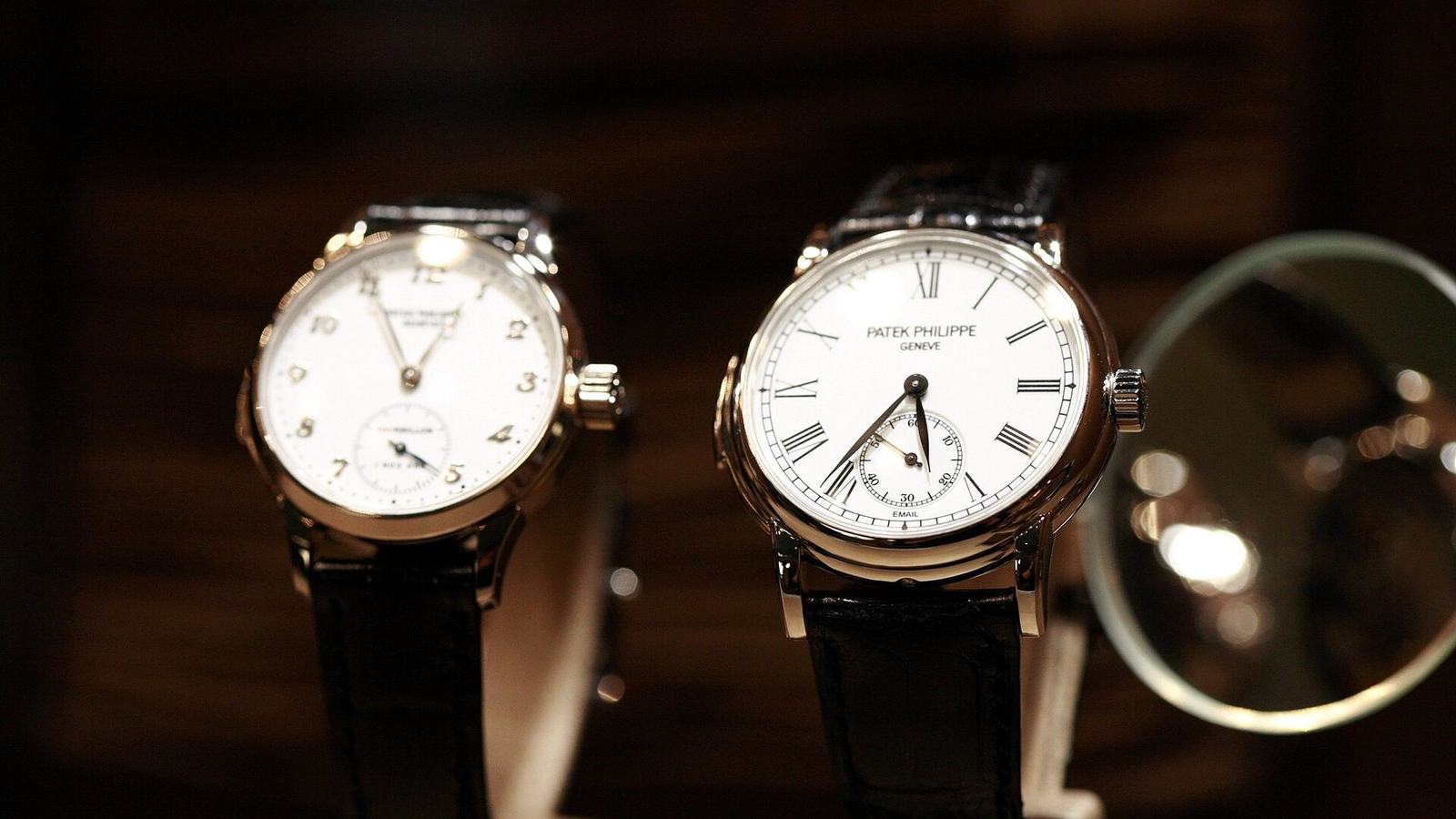
An archival independent photograph of Patek Philippe watchmaking, not a Christie’s 2026 sale-room or an auction lot. Photograph by Rama, CC BY-SA 2.0 fr; Wikimedia Commons source. Image resized for web delivery.
