Christie's brings nine works spanning five centuries, including four Picassos, into a November New York sale programme estimated near $100 million.
A private collection worth about $100 million
Christie’s has announced Heroes and Lovers, a nine-work private collection estimated in the region of $100 million, for its forthcoming New York sale programme. The group spans roughly five centuries of art and brings together paintings and sculpture whose subjects move between devotion, intimacy, myth and human conflict. Rather than being presented as a conventional sweep through art history, the selection is being positioned around the collector’s distinctive interest in figures and emotion.
Seven of the nine works are scheduled to appear in Christie’s November 20th Century Evening Sale, while two Old Master works are intended for Classic Week in 2027. This split matters because the collection is not a single nine-lot auction: buyers considering individual works will be entering different sale calendars and potentially different specialist markets. It also creates a longer public life for what was previously a private ensemble.
The planned sale comes as collectors increasingly expect major auction houses to present a coherent narrative alongside individual masterpieces. Here the thread is the human figure, from religious sculpture and classical mythology to twentieth-century images of desire and psychological tension. Christie’s estimate is for the collection as a whole, not a guaranteed sale result or a valuation of any one work.
Picasso's two markedly different portraits
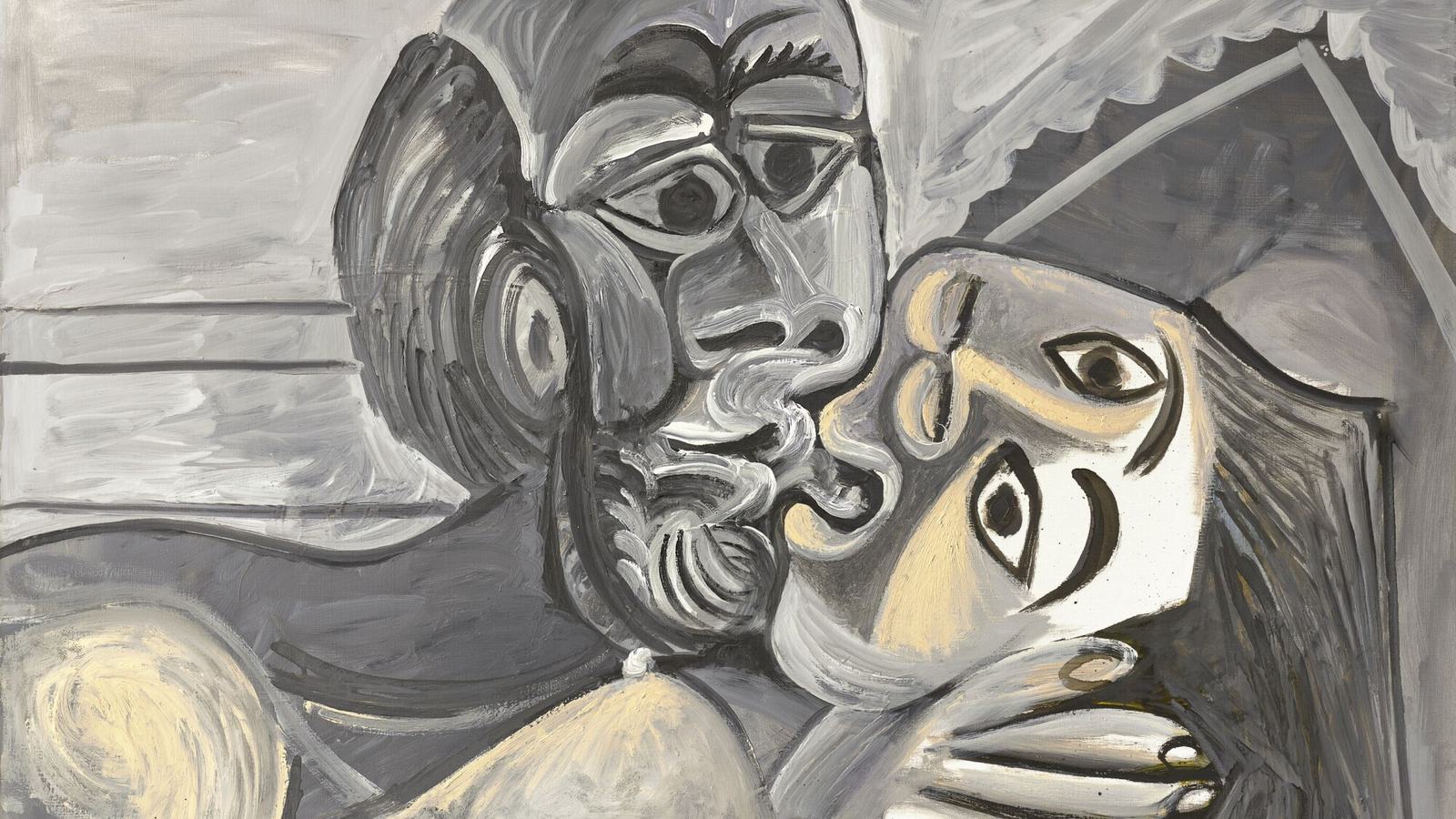
The headline work is Pablo Picasso’s Le Baiser, painted on 24 October 1969 and measuring approximately 97 by 129.9 centimetres. It depicts two lovers in an embrace and is connected by the auction house to the artist’s relationship with Jacqueline, his final wife and muse. Created late in Picasso’s career, it represents a very different artistic moment from the works he made during wartime Paris.
Another of the four Picassos in the collection is Tête de femme (Dora Maar), dated May 1941 during the Nazi occupation of Paris. The fractured portrait of the Surrealist photographer belongs to a period when Picasso’s personal relationships, visual experimentation and surrounding political circumstances collided. The collection therefore makes room for both a late, exuberant image of affection and a work carrying the unease of an earlier decade.
Four works by a single famous artist might easily overwhelm a sale announcement, but they do not account for the full range of Heroes and Lovers. Christie’s has assembled the programme to encourage comparison between modern painting and much older depictions of courage, virtue, desire and vulnerability. That breadth is likely to shape how the works are discussed at previews as much as how they are bid upon.
Old Masters introduce a different scale of history
Among the Old Master highlights is Cornelis Cornelisz. van Haarlem’s Hercules and Achelous, an ambitious treatment of the mythological struggle drawn from Ovid’s Metamorphoses. Christie’s says the canvas set a record for the artist when it last came to auction nearly two decades ago, before spending time on long-term loan at the Metropolitan Museum of Art. That exhibition history is a meaningful part of the work’s public record, although bidders must still examine condition and ownership documentation.
The collection also includes a carved limewood Saint Catherine by Tilman Riemenschneider, a leading figure of late Gothic sculpture. Its presence broadens the group from canvases intended to be viewed on a wall to an object that occupies physical space and calls for close attention to carving, surface and conservation. Transport and display requirements for such a work are not interchangeable with those of a modern painting.
Christie’s additionally names François Le Moyne, Jean-Honoré Fragonard and Édouard Manet among the artists represented. The resulting dialogue is unusually expansive: a buyer interested in an individual Picasso will encounter older forms of storytelling and portraiture within the same provenance-driven collection. There is no suggestion that every work shares the same estimate, physical condition or collecting audience.
A preview tour before New York
The auction house scheduled an international presentation of highlights beginning in Hong Kong on 6 October, with further appearances planned for London, Paris and Taipei. The full nine-work group is expected to be shown at Christie’s Rockefeller Center headquarters in New York during the November marquee exhibitions. Previews are important for collectors who need to assess scale, colour, texture and the presence of a work beyond a digital catalogue.
Serious buyers will also want to study condition reports, provenance, literature and exhibition history before bidding. Those checks can be particularly involved when a collection ranges across different centuries and mediums, and the auction schedule leaves less room for hurried decision-making than a casual headline suggests. An estimate in the region of $100 million gives a sense of scale, but it does not replace individual due diligence.
For superyacht owners who also maintain collections across multiple homes, the practical questions extend beyond the hammer price. Safe transport, appropriate environmental conditions, insurance valuations and the choice of a permanent display setting should be considered before a work changes hands. A yacht may offer striking surroundings for a collection, but exposure to humidity, movement and sunlight makes object-by-object advice essential.
The wider meaning of a single-owner sale
Heroes and Lovers illustrates how a privately assembled group can be marketed as a cultural argument rather than a list of expensive objects. The combination of four Picassos, a record-setting Dutch Mannerist painting and a late Gothic carving invites the audience to look for connections that are not necessarily visible when works are sold in unrelated consignments. It is those connections, as much as famous signatures, that give a collection an identity.
The coming sales will test interest in both highly recognisable modern works and specialist historical material, but the results cannot be known in advance. Until November and the subsequent 2027 Classic Week, the most useful story is the collection itself: how a collector linked art across five centuries and why those links are now being made public. Christie’s 5 October announcement is the primary source for the details and schedule reported here.
Source
Christie's Press