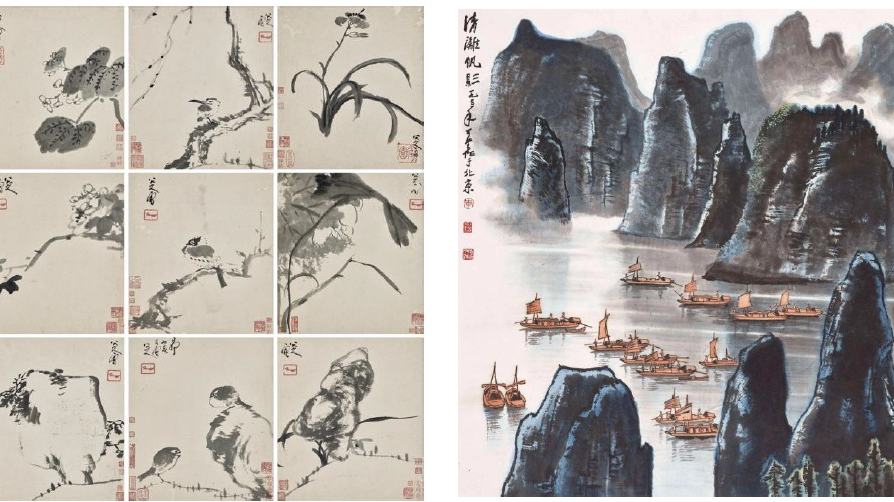
Christie's will hold separate Hong Kong auctions for classical Chinese paintings and contemporary ink works on 27–28 October 2026, with previews beginning 22 October.
Two sales show the range of Chinese painting
Christie's has scheduled consecutive Hong Kong auctions devoted to Chinese painting and calligraphy, beginning with Fine Chinese Classical Paintings and Calligraphy on 27 October and continuing with Fine Chinese Modern and Contemporary Ink Paintings on 28 October. Both events will be part of the city's Asian Art Week programme, when collectors can examine works from different eras within a relatively concentrated timetable.
The distinction between classical and modern ink matters. The categories may share paper, brushes and references to calligraphic traditions, but their collecting histories, condition requirements and stylistic questions can be quite different. A painting from an earlier dynasty should not be evaluated through the same assumptions that guide an acquisition of a twentieth-century ink work.
Private holdings bring rare works into view
The auction house describes important consignments from established private collections, with material chosen to demonstrate the breadth of traditional and later Chinese art. The public preview is scheduled for 22–27 October in Hong Kong, allowing prospective bidders to compare brushwork, mounting and the relationship between image and inscriptions before the sales begin.
Paintings preserved in albums, scrolls or mounted sheets can have undergone substantial conservation over centuries. Identifying the original support, later mounting work and the condition of seals and inscriptions is part of the research. A collector should request a detailed explanation of any attribution, not only a visually appealing image or a distinguished name.
Calligraphy adds scholarly complexity
Chinese calligraphy can make writing a subject of aesthetic judgment, with rhythm, pressure and the arrangement of characters becoming essential to the work. Signatures, poetic references and collectors' seals can contribute evidence of ownership and reception. Their presence alone does not prove authenticity, since marks and later annotations may require separate assessment.
Specialists can compare known examples, paper types and historical records, but uncertainty may remain. The auction catalogue should indicate whether the work is firmly attributed to an artist, associated with a school or described using a more qualified formulation. Bidders should read those distinctions carefully rather than equate all catalogue headings with the same level of scholarly confidence.
Hong Kong remains an important art-market meeting point
An autumn art week can attract regional collectors, international advisers and museum specialists who want to see objects directly instead of relying on remote images. The practical value lies in access to works and conversations at the same time. Bidding may take place in the saleroom or through supported remote channels, subject to the auction house's procedures.
Buyers acquiring a work internationally must also think about export conditions, conservation during transport and local tax treatment. The cost of mounting a large scroll safely can be significant even relative to the object's value. Collecting demands proper planning for storage, insurance and specialist display after the excitement of bidding has passed.
October's sales have not yet produced results
The announced dates and categories establish a future auction programme rather than a completed sale. Christie's has not supplied a single aggregate result for the events because the lots have not yet crossed the rostrum. Any later total should be interpreted alongside the number of lots offered, withdrawals and the proportion that found buyers.
For collectors, the strongest opportunity is to understand the works in context during the preview. The paired auctions provide a practical lens on continuity and change in Chinese painting, whether one is seeking a museum-quality masterpiece or beginning a more focused collection.
Source
Christie's Press Office