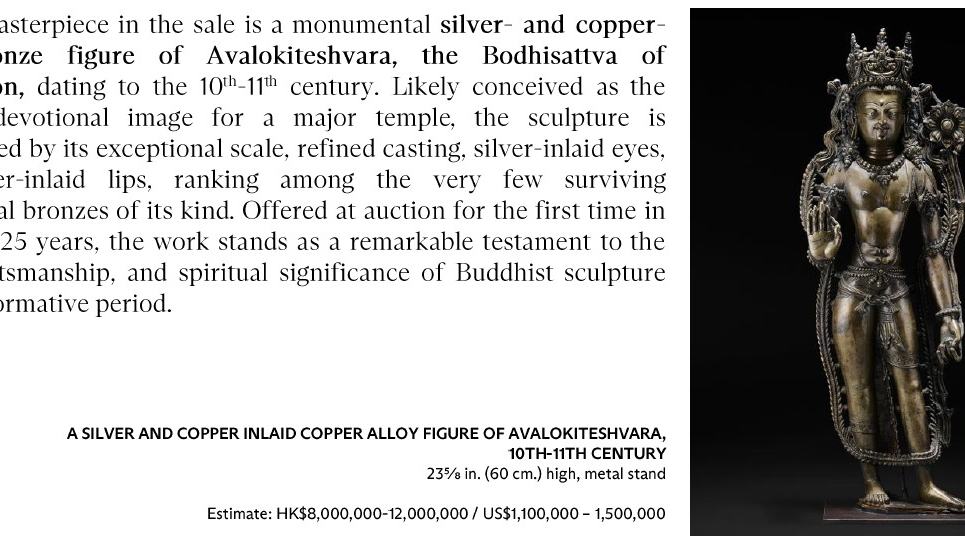
Christie's Hong Kong will hold its annual Indian, Himalayan and Southeast Asian art auction on 30 October, drawing on fresh-to-market private collections.
A regional art market gathers works across centuries
Christie's has announced its annual Hong Kong sale of Indian, Himalayan and Southeast Asian art for 30 October 2026. The selection draws on privately held objects and different cultural traditions, spanning approximately a millennium of artistic production. Its placement during Hong Kong Asian Art Week provides an opportunity to examine works in relation to other exhibitions and auctions rather than as isolated lots.
The broad category covers objects with distinct historical and ritual meanings. A sculpture associated with the Himalayan region cannot responsibly be treated as interchangeable with an object made in Southeast Asia simply because both are sold through one department. Their materials, iconography, patronage and legal histories require specialised research.
The sale highlights privately held sculpture and painting
Christie's describes a fresh-to-market selection from important private collections, including works of Buddhist and Hindu artistic traditions. For collectors, the appeal may lie in the rarity of a particular iconographic subject or the quality of metal casting and surface finishing. Some objects will have been made for religious environments rather than for the secular display settings familiar today.
Careful presentation should acknowledge those original functions. Provenance, the circumstances of removal from a source country and relevant export documentation can be particularly significant in this field. Buyers ought to consult specialists in both art history and applicable cultural-property law, rather than rely on commercial descriptions alone.
Iconography can be as important as material value
A figure's posture, attributes and surrounding motifs often provide clues to the tradition in which it was made and how devotees understood it. Yet visual similarity does not necessarily prove date or origin. Comparative studies of known examples, inscriptions and metallurgical or pigment analysis may support an attribution while leaving certain questions open.
Conditions of preservation also vary substantially. A gilded surface can show deliberate historical wear, later restoration or loss caused by storage and handling. A sound conservation report should distinguish those circumstances so that bidders understand what is original and what may have been repaired.
An October preview enables closer study
Christie's plans sale previews in Taipei and Hong Kong ahead of the 30 October auction. Such exhibitions are valuable because scale, surface quality and the relationship between an object and its base or mount can be difficult to judge from photographs. A collector may discover that a smaller work has greater refinement than a visually imposing large piece.
Visitors should confirm registration requirements and the precise dates of public access before travelling. Religious or fragile objects may be subject to handling restrictions, and viewing does not necessarily mean a buyer can remove a work from its mount. Technical questions can be discussed with specialists during the exhibition period.
Auction values will follow from the individual lots
The 30 October sale has been announced, but no final results exist before bidding concludes. Christie's general market commentary about collector demand cannot substitute for a lot-by-lot assessment of authenticity, provenance, condition and valuation. The final price of an exceptional sculpture is not a reliable measure of all objects from the same tradition.
For serious collectors, the event is a chance to deepen scholarship as well as acquire material. A thoughtful approach begins with understanding what the object represents and the responsibilities that accompany stewardship. The auction's lasting value will depend on accurate cataloguing and informed collecting as much as on headline prices.
Source
Christie's Press Office