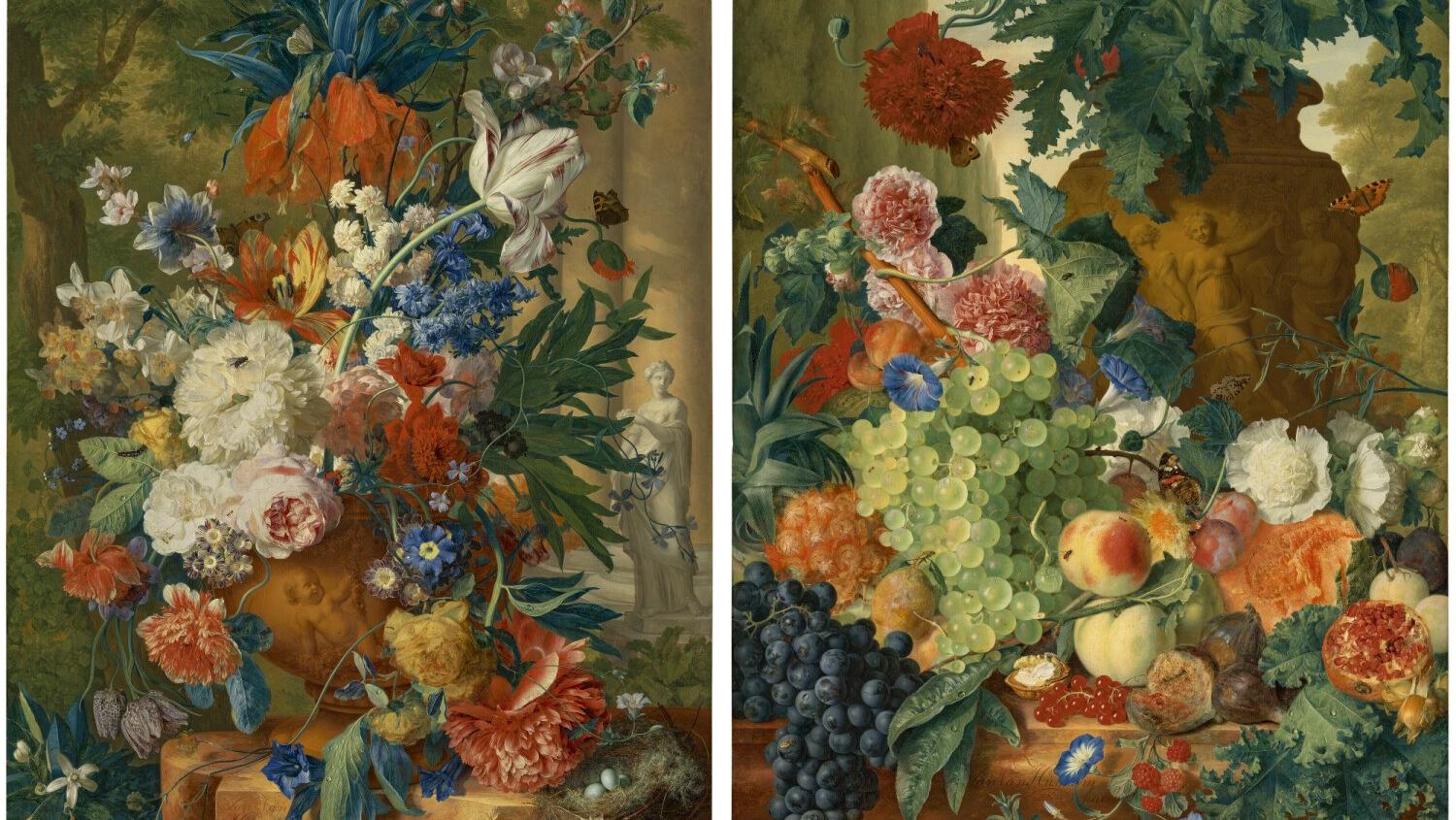
Christie's London will offer the only known large-scale Jan van Huysum flower-and-fruit pendants still in private hands, estimated together at £6m–£8m.
Old Master collecting, 12 November 2026. The two paintings are being offered together in a future 8 December sale; estimates are not confirmed sale prices. These are distinct from a different Van Huysum pair offered by Christie's earlier in 2026.
A matched pair reaches the London market Christie's has announced that two remarkable still-life paintings by Jan van Huysum will lead its Old Masters Evening Sale in London on 8 December 2026. The works are described as the only known large-scale fruit and flower pendants by the artist remaining in private hands and carry a joint estimate of £6 million to £8 million. Painted in the early 1730s, they have remained together since their creation, according to the auction house. Their arrival is especially significant because a matched pair can offer a visual and historical relationship that individual still lifes cannot reproduce. The public story is not simply about the estimate. It concerns the survival of a commission across nearly three centuries and the opportunity for a new owner to keep that relationship intact. The estimate is a pre-sale guide, not a record of money paid.
Paintings designed to be seen together One panel depicts an arrangement of flowers with a bird's nest, architectural details and a sculptural figure; the other features fruit and flowers including grapes, peaches, figs and a pineapple. Christie's describes the paintings as large-scale pendants, meaning they form a coordinated composition rather than two works later grouped solely for convenience. They date from 1731 to 1733 and are painted in oil on panel. For a collector, the relationship between the canvases' subjects, colours and composition is part of their significance. Separating pendants can change how each is perceived and may diminish the evidence of the original artistic intention. A prospective buyer should study the pair's physical and documentary history carefully, including whether the frames and installation arrangements are original or later adaptations. Even an apparently symmetrical display can have a complex history.
Van Huysum's technical sophistication Jan van Huysum is associated with unusually accomplished eighteenth-century flower and fruit painting, a genre that demanded close observation and technical discipline. The illusion of different textures—delicate petals, glossy fruit, water droplets and architectural surfaces—depends on precise brushwork and a carefully planned arrangement. Such paintings should not be dismissed as decorative simply because they depict familiar objects. Their complexity includes relationships between light, depth, colour and the symbolism that viewers may have attached to natural forms. The most successful examples can reward prolonged study, revealing details that are not immediately visible in reproductions. For a private collector, this depth of craftsmanship helps explain why a pair may hold particular appeal within a wider group of European Old Masters. The condition of fragile painted surfaces, however, can be crucial to whether those details remain legible.
An ownership chain with major collecting names Christie's cites provenance connected to the Landgraves of Hesse-Kassel, the Baring family and the Rothschilds, three important European collecting dynasties. The works have reportedly been in an English private collection for approximately eighty years. Such a distinguished chain can enhance historical interest, but it should be examined through evidence rather than accepted as a substitute for verification. A rigorous provenance review should establish the sequence of owners, identify documentary gaps and distinguish confirmed archival records from later catalogue traditions. The appeal of a famous name should not obscure the importance of the paintings themselves. Conversely, tracing where an object was displayed and how it was valued can illuminate its cultural history. These records may be as significant to future scholarship as the works' eventual location.
Old Master panels demand specialist conservation An eighteenth-century oil painting on wooden panel behaves differently from a modern canvas. Wood can respond to changes in temperature and humidity, while the paint and varnish layers may have undergone centuries of ageing or restoration. The condition of joins, supports and any historical interventions should be assessed by a qualified conservator. A buyer considering installation in a grand residence should ensure that the environmental conditions are appropriate and that the display plan does not expose the works to avoidable stress. A pair may require consistent conditions to preserve the relationship between the two surfaces over time. Transport is another major issue: packing and handling need to accommodate panel movement and surface vulnerability. The responsibility to protect rare paintings is more demanding than securing an attractive wall and a substantial insurance policy.
Exhibition opportunities before the auction The paintings are being shown in New York until 16 November, with a London pre-sale exhibition scheduled for 4 to 8 December. For collectors, those dates offer a chance to examine the works with specialists before making an expensive commitment. Personal viewing is especially valuable for paintings whose effects depend on delicate colour and surface texture. Photographs may communicate the overall composition without revealing varnish changes, old retouching or the condition of details. A sophisticated buyer may arrange independent conservation advice, inspect available reports and discuss the provenance with the auction house. Viewings should be scheduled in advance where appropriate. A collector travelling across continents should not assume that the paintings will always be available at a particular gallery location outside the stated exhibition period.
The estimate reflects rarity as well as artistic standing The reported £6 million to £8 million estimate is significant, but two works forming a unique surviving pair are not easily compared with a single still life of similar size. Market valuation may take account of the quality of the composition, provenance, condition, scholarly standing and whether the works are sold together. A buyer should understand what precisely is included in the lot and whether any conditions affect the possibility of future division. The estimate does not include a guaranteed reserve disclosure, final price or all transaction costs. Auction premiums, taxes, shipping and insurance may change the amount ultimately committed. Nor can the estimate be interpreted as a uniform market price for Van Huysum paintings. Individual works may vary substantially, and a sale with few direct comparables can be difficult to predict.
Displaying pendants in a private collection A matched pair invites a considered installation, with appropriate viewing distance, lighting and surrounding works. The visual dialogue between the paintings may be better served by a restrained environment than an overcrowded gallery wall. Collectors with historic residences may be tempted to recreate a period interior, but the preservation needs of wooden panels should take precedence over decorative authenticity. Curators and conservators can work together to choose lighting, mounting and a stable microclimate. A collection intended for private enjoyment may also benefit from a written catalogue explaining why the works are displayed as a pair. When the pieces are moved for exhibition, accurate installation photographs and condition checks can help maintain consistency. The pair's survival over centuries should encourage stewardship that preserves the relationship for future viewers.
Old Master collecting carries legal considerations International transfers of valuable paintings can involve export permissions, customs obligations, taxes and cultural-property review. Ownership records and statements of attribution need careful attention. Works from historic European collections may also raise questions about past transfers that require documentary investigation. A responsible buyer should obtain professional advice and examine the auction conditions. The fact that a painting is offered publicly is not itself a guarantee that it may be imported into every jurisdiction without restriction. Owners who plan to move important art among multiple homes should consider whether frequent transport is appropriate at all. The long-term value of the work includes its physical survival, and repeated handling can introduce risks that outweigh the convenience of displaying it in different locations.
A different pair from the artist's earlier 2026 sale Christie's also presented another Van Huysum flower pair during June 2026 Classic Week. The two works now announced for December are not those earlier paintings. The distinction is essential in a credible art-news archive, particularly when multiple auctions involve the same artist and similar subjects within a calendar year. The current pair is identified through its early-1730s dates, its long shared provenance and its joint estimate of £6 million to £8 million. A collector should consult exact catalogue titles, dimensions and photographs rather than rely on a general headline referring to flower paintings. Proper identification avoids confusion between separate objects and protects the accuracy of market reporting.
What is confirmed for December Christie's 9 November announcement establishes that a pair of large Jan van Huysum flower and fruit still lifes will be offered on 8 December 2026 in its London Old Masters Evening Sale, with an estimate of £6 million to £8 million. The works are linked to the Hesse-Kassel, Baring and Rothschild collections and have been together since their creation. Public viewing is planned in New York and London before the sale. The final result, successful bidder and eventual location are not known from the announcement. For the wealthy collector, the attraction is an unusually coherent historical object: two paintings whose artistic and ownership histories are intertwined. The responsibility of any new steward will be to preserve that coherence as carefully as the painted surfaces themselves.
Primary source: Christie's London, 9 November 2026, Jan van Huysum fruit and flower pendants.