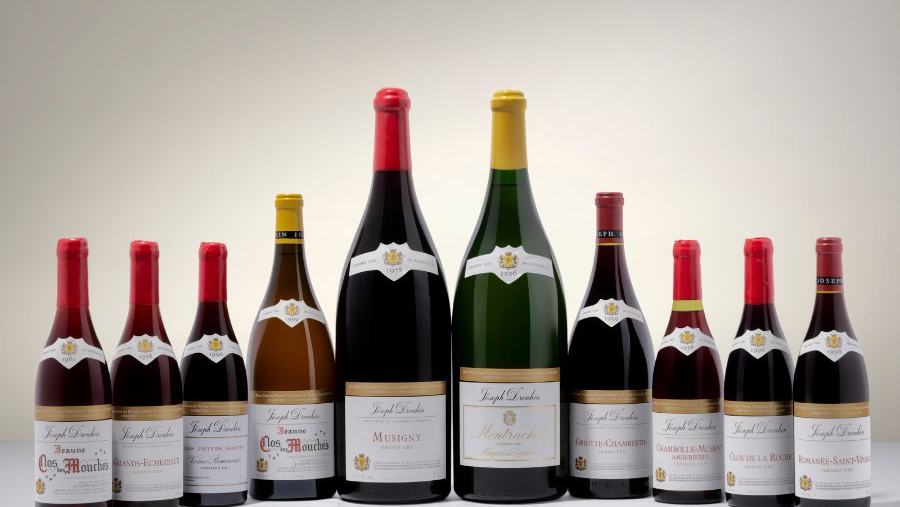
More than 400 lots from the Joseph Drouhin family's Burgundy and Oregon cellars feature in a Christie's online auction running until 17 November, including rare Musigny Jeroboams.
Rare-wine collecting, 12 November 2026. Christie’s is offering more than 400 lots from the Joseph Drouhin family cellar in an online sale closing on 17 November. All quoted lot amounts are pre-sale estimates, not confirmed results.
A family Burgundy cellar enters the auction market Christie's is offering more than 400 lots of wine from the private collection of Maison Joseph Drouhin in an online auction running from 3 to 17 November 2026. The sale has been organised as part of the auction house's programme marking the sixtieth anniversary of its wine department, founded in 1966. It brings exceptional Burgundies from a family associated with the region's winemaking traditions into the international market at a time when collectors are paying close attention to provenance and mature vintages. The announcement is not a post-sale report: the auction remains open as of 12 November. The figures in the catalogue are estimates, not achieved prices, and the outcome will not be known until bidding is complete. Its importance lies in the chance to acquire bottles and large formats that have been associated with a particular producing family rather than assembled through multiple independent secondary-market transactions.
The Drouhin family has a history in Beaune Joseph Drouhin founded the maison in Beaune in 1880, and the company is described as remaining in family ownership across four generations. Its history embraces well-known Burgundy vineyards as well as the development of a business with an international reputation. Such background can be relevant to a collector, but a famous family name does not establish the quality or condition of an individual bottle. The care of the cellar, the circumstances in which wines were acquired and the documentation accompanying them deserve equal attention. The auction house says the wines were carefully stored in historic family cellars, providing an unusually direct connection between production, long-term custody and sale. That is a compelling description of provenance, though it should still be assessed against the documentation supplied for particular lots. At significant prices, a collector should not rely on a general marketing statement alone.
Musigny 1978 leads the selection of large formats Among the prominent lots is a jeroboam of Joseph Drouhin Musigny 1978, for which Christie's published an estimate of £12,000 to £17,000. The format is part of the appeal: large bottles can mature differently from standard bottles because the relationship between wine volume and exposure to oxygen changes. They also have strong visual presence in a collection. None of this means that a mature jeroboam is certain to be in perfect drinking condition. Cork, storage history, fill level and packaging can all influence the buyer's assessment. An estimate should be read as a guide produced before the auction, and the final result may be higher, lower or unsold. For an owner considering such a bottle for an important dinner, the decision also involves whether to preserve the wine as part of a collection or open it at an occasion where careful service can do it justice.
Chambertin and Vosne-Romanée add different histories The catalogue includes Chambertin-Clos de Bèze 1978 with an estimate of £2,000–£2,800 per bottle and a jeroboam of Vosne-Romanée Les Petits Monts 2009 with an estimate of £1,600–£2,200. These examples reflect different vineyards, vintages and styles of collecting. The source describes the Les Petits Monts example as connected with Véronique Drouhin's private vineyard. That specific provenance is part of the attraction but should not be taken as evidence that the bottles have undergone an independently verified tasting shortly before sale. A collector may be looking for maturity, a connection with a particular vintage or a vertical collection representing several decades. Each of those ambitions suggests different buying criteria. Comparing Burgundy solely by the price of a bottle risks missing distinctions in vineyard status, producer, format and preservation that can matter far more than the apparent simplicity of a label.
Modern vintages and the challenge of patience The Drouhin offering is not confined to old wines. Christie's also mentions a Musigny 2024 jeroboam estimated at £4,000–£5,000. This illustrates the different role played by a young prestige Burgundy in a collection. Some buyers acquire such wines with the intention of long storage, while others may be completing a producer or vineyard sequence. Even where a wine is widely regarded as age-worthy, its future development is not guaranteed for an individual bottle. Cellar conditions, closure integrity and storage discipline will remain central to the eventual experience. Nor should the existence of a strong auction estimate be mistaken for a promise that a wine will appreciate in value. A collector's satisfaction may ultimately come from drinking a well-cellared wine on a meaningful occasion, not from checking a price chart. Responsible collecting leaves room for both enjoyment and financial prudence without confusing the two.
Montrachet in a nine-litre Salmanazar Large-format white Burgundy is another notable element of the catalogue. The auction house cites Montrachet, Marquis de Laguiche 2006 in a Salmanazar format with a pre-sale estimate of £4,500–£6,000. A Salmanazar contains nine litres, far larger than the standard 750-millilitre bottle. Such a vessel creates a dramatic centrepiece for an important celebration, but opening it demands a carefully planned service. Storage, decanting decisions, serving temperatures and appropriate glassware become more demanding when a large quantity of rare wine is involved. A mature white Burgundy also merits particular caution around its condition, with a specialist assessment appropriate before significant expenditure. The appeal of a rare format should not override questions about whether the buyer has a realistic opportunity to enjoy it. A bottle can be an extraordinary object, yet its ultimate purpose remains connected with wine.
Clos des Mouches provides another format example Christie's identifies a Beaune Clos des Mouches Blanc 2009 Methuselah estimated at £1,100–£1,600. A Methuselah is six litres, another format that is both visually impressive and logistically challenging. Unlike a case of ordinary bottles, a single large vessel concentrates the experience and commercial value in one container. If the wine is opened for a private dinner, the host needs enough guests and a service team capable of handling it properly. If the plan is long-term preservation, the collection needs suitable storage space and documentation. The varied formats offered in the Drouhin catalogue give buyers options but also require different approaches to risk. This is especially relevant for owners whose wine collection is split between a home cellar and vessels at sea. Historic fine wine is usually better kept in stable specialist facilities than exposed to unnecessary movement and temperature fluctuation.
Oregon connects the collection to another region Maison Joseph Drouhin's family history includes Domaine Drouhin Oregon, established in 1987. The auction features wines from that operation alongside the Burgundy holdings. One example is a six-bottle case of 1990 Dundee Hills Pinot Noir estimated at £300–£400. That is a much lower estimate than the great Burgundy lots, showing that the collection spans a broad spectrum rather than consisting solely of extremely expensive bottles. For an interested buyer, the Oregon wines may illuminate how the family's approach developed beyond France, with different climates and vineyard conditions shaping the resulting wines. A collector might compare the two regions through tastings, but a conclusion about quality or value should be reached through individual bottles and proper context. The presence of Oregon holdings is another reminder that an important private cellar can tell the story of its owners' working lives as well as their drinking preferences.
Why an established storage history matters Provenance is one of the central concerns in the fine-wine market. Old bottles may travel between owners, retailers, auction houses and warehouses over decades, sometimes under conditions that are poorly documented. Temperature excursions, light, humidity and closure deterioration can alter a wine in ways that may not be visible through a photograph. A release from a producer family's cellar can therefore attract attention because it promises a more direct custodial history. Still, the buyer should ask what condition reports are available, whether bottle levels and labels have been inspected, and how the wine will be transported after purchase. The cost and risk of moving fragile older bottles internationally should be considered alongside the bid. Insurance, customs requirements and tax treatment can differ by location, and they should be reviewed before a buyer commits to an important purchase.
The sixtieth anniversary adds institutional context Christie's began its dedicated wine department in 1966, and the Drouhin family sale forms part of the commemorative programme for that milestone. This history is commercially meaningful because established auction houses may have experience attracting specialist bidders, handling delicate inventory and explaining complicated provenance. Nevertheless, the reputation of the intermediary is not a substitute for investigating the condition of particular lots or the terms under which they are offered. Buyers need to understand premiums, potential tax, delivery and any limitations in condition descriptions. Auction estimates may be set with different purposes from retail asking prices, and neither is an unconditional guarantee of future market value. The right approach is to treat the catalogue as a source of carefully presented opportunities while making independent decisions about the role each wine would play in a private collection.
A rare opportunity, not a completed result As of 12 November, the confirmed news is that more than 400 lots from Maison Joseph Drouhin's family cellar are being offered by Christie's online through 17 November. The selection spans important Burgundy holdings, unusual large formats, mature vintages and wines from the family's Oregon venture. Among the published estimates are £12,000–£17,000 for a Musigny 1978 jeroboam and £4,500–£6,000 for a Montrachet Marquis de Laguiche 2006 Salmanazar. None is being reported here as a sale price. For collectors, the significance is the access to wines presented with a particularly direct family connection and the opportunity to examine how a producing house has preserved its work over generations. The next legitimate news milestone will be a verified auction result, not speculation about what bidders might eventually pay.
Primary source: Christie's, 15 October 2026, Rare Wines from the Private Collection of Maison Joseph Drouhin.