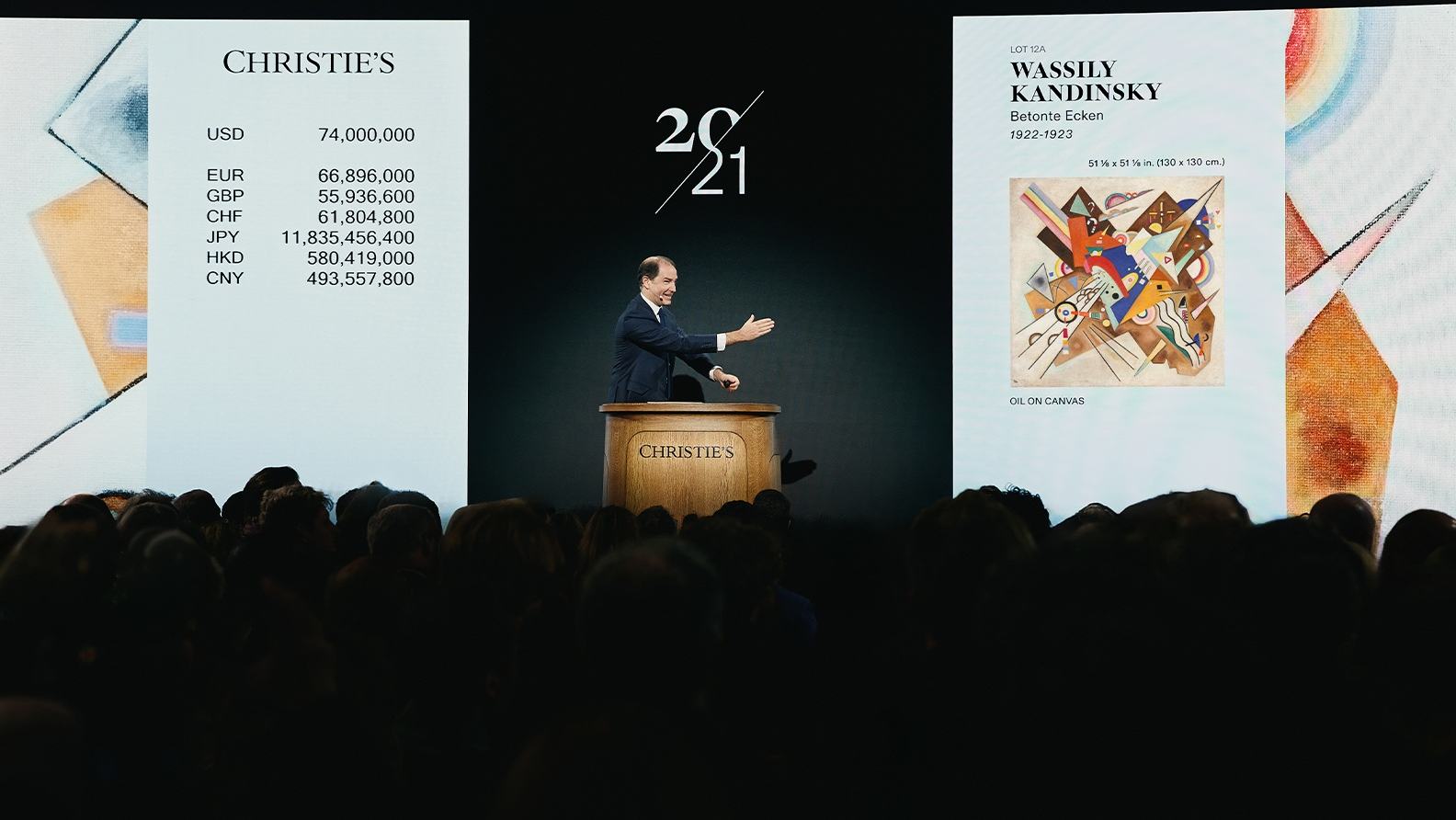
Christie's November 17 evening sale realises $626.6 million, led by Kandinsky’s $85.8 million record and Klimt’s $82.3 million landscape.
Opening night brings two paintings above eighty million dollars
Christie’s opened its November 2026 flagship New York art auctions with a 20th Century Evening Sale that realised $626,621,400 at Rockefeller Center on 17 November. According to the auction house's results announcement, ninety-two percent of lots sold, representing ninety-five percent of the value offered. Wassily Kandinsky's 1923 painting Betonte Ecken led the evening at approximately $85.8 million, establishing a new auction record for the artist. Gustav Klimt's landscape Litzlbergkeller followed at $82.3 million. Together, those works provided the most conspicuous indication of the demand encountered at the upper end of this particular sale. These are realised auction results rather than the estimates reported in Superyacht Guide's earlier preview of the November programme. The auction house's aggregate refers to this particular evening, not all transactions anticipated during the week. Individual figures should be understood according to the published auction results, rather than treated as independent valuations of comparable works held elsewhere.
An auction record for a work from Kandinsky's Bauhaus period
Betonte Ecken, painted in 1923, belongs to a period when Kandinsky developed an increasingly geometric visual language. Its articulated shapes and intervals between colours create a different kind of pictorial relationship from the landscape presented by Klimt in the same auction. For a collector interested in twentieth-century abstraction, its importance extends beyond the identity of its maker to the particular moment in his artistic development that it represents. Christie’s reports sustained competition for the painting from bidders participating in person and by telephone. Its previous auction record for Kandinsky stood at $44.8 million, making the new result almost twice that amount. The comparison concerns two auction transactions involving different works rather than a change in the value of the artist's entire output. Differences in historical significance, condition, ownership history and market availability can substantially affect the price of an individual painting. Buyers should therefore avoid applying the percentage increase directly to other Kandinsky works.
Klimt's landscape offers a contrasting collecting proposition
Litzlbergkeller, painted in 1915–16, had been offered with an estimate of $60 million to $80 million in the auction house's October announcement. The painting reached approximately $82.3 million after almost six minutes of competition, says Christie’s. Its square composition and densely developed landscape place it within the distinctive body of work through which Klimt explored vegetation, architecture and decorative rhythm. The appeal of a major landscape by Klimt is quite different from that of a geometric Kandinsky. A collector might be drawn to the relation of a particular painting to the artist's broader practice or its potential to establish a meaningful dialogue with other pieces. The difference between an estimate and a price realised also merits attention: published estimates generally exclude the buyer's premium, whereas reported sale prices may include it. The apparent difference cannot therefore be interpreted simply as the amount by which the winning bid exceeded the upper estimate. The official lot record and applicable conditions establish the precise transaction basis.
Picasso and Giacometti illustrate the range of the evening
Pablo Picasso's Le Baiser, from the Heroes & Lovers collection, realised approximately $31.2 million. A 1949 bronze by Alberto Giacometti from Herbert Lust's collection achieved $26 million. The latter was offered without a reserve, a material commercial detail because the seller had not established a minimum auction price for the lot. That arrangement did not prevent a substantial result in this instance. It should not, however, be considered proof that a no-reserve strategy is appropriate for every important artwork. Auction decisions involve the characteristics of the piece, the parties' contractual arrangements and the expected level of demand. For a prospective purchaser of sculpture, the particular cast and its documented place within an edition can be central to an understanding of the object. The name of a celebrated sculptor alone does not establish that all casts, versions or later reproductions have the same history or market standing. Christie’s results identify specific objects acquired in this sale.
Impressionism and the significance of individual estimates
Among the Impressionist works highlighted in the results announcement, two paintings by Claude Monet achieved approximately $25.9 million and $12.8 million. The former, a landscape dating to 1890, came from the collection of William I. Koch; the second was painted in 1875. Christie’s describes both prices as exceeding the upper estimates. For a purchaser, the relevant comparison between works by Monet should nevertheless begin with the individual paintings rather than their shared attribution. Subject, period, format, provenance and the history of exhibition can influence the significance of each work. A purchase intended to complement a particular collection may have requirements quite different from one whose main objective is the acquisition of a representative example of an artist's practice. Where estimates from different sales are compared, they should be assessed on a consistent basis. A published estimate represents the auction house's view before a transaction, while the realised price reflects the bidding and applicable charges on the day.
Latin American art and the breadth of record-setting results
A work by Diego Rivera, Vendedora de flores, de Tehuantepec, achieved approximately $9.9 million, against an estimate of $3.5 million cited in Christie’s release. The sale also established a new auction record for Wifredo Lam when Ogue Orisa reached $11.6 million. Fernando Botero's monumental Horse realised $5.2 million, another artist record according to the auction house. These transactions provide three examples of how works associated with different artistic traditions and periods can attract considerable competition within a major international evening sale. Lam's work, for example, invites different historical and stylistic enquiries from those appropriate to a large Botero sculpture. The physical characteristics of a work also matter when considering later exhibition: a monumental sculpture has substantial requirements for handling, support and placement that do not apply in the same way to a painting. A collector contemplating its installation should consider those practical questions independently of the price achieved at auction.
Six records and a strong result across private collections
Christie’s identifies six records in its account of the evening: Kandinsky, Cornelius Cornelisz. van Haarlem, Lam, Botero, Hans Bellmer and Joan Miró, in the latter case a record for a bronze by the artist. Miró's Femme, monument achieved $11.8 million. The private collections represented in the sale generated distinct aggregate results, including approximately $104.7 million for Heroes & Lovers, $66.3 million for works from William I. Koch's collection, $42 million for Herbert Lust's collection and $32.6 million for Clive Davis's collection. Those figures illustrate the importance of established collections within the evening. They are not a precise measure of the original acquisition expenditure, investment return or net proceeds received by the respective sellers. The history of a collection may be meaningful to prospective buyers because it provides context for the selection and stewardship of individual objects. Documentation of that history is consequently a valuable part of developing and maintaining a substantial collection.
What the figures reveal about this particular auction
A high proportion of sold lots and value is useful evidence of the performance of the November 17 sale. Christie’s further reports that its Americas twentieth- and twenty-first-century art category had already surpassed its full-year 2025 total by the evening's conclusion. This is a company-specific observation rather than a measure of the global art market as a whole. A sale containing several exceptional works can contribute disproportionately to an annual aggregate, and different auction houses may encounter different levels of competition according to the material offered. The results nevertheless provide a more concrete basis for assessing this particular group of consignments than the forecasts circulating before the sale. A collector who follows an individual artist may want to examine the relevant lot information, bidding outcome and comparison with earlier transactions instead of drawing conclusions from the total alone. Unsold works also remain part of the context when assessing a market's selectivity.
Stewardship after an important acquisition
An eight-figure purchase introduces responsibilities that continue well beyond the auction. Owners who maintain art at several residences or aboard a yacht should consider the physical characteristics of the work, its insurance terms and the suitability of the intended display location before arranging movement. Historical paintings may require environmental controls and specialised packing. Sculptures can present distinct requirements for installation and structural support. Documentation concerning authenticity, ownership history, conservation and the conditions of purchase should be retained as part of the collection's permanent record. The November sale demonstrates the financial significance that can attach to particular artworks, while offering no guarantee of future returns. Its most consequential confirmed development is the combination of the $626.6 million aggregate with Kandinsky's new record and substantial prices across several other artists and collections. That is a defined auction outcome, not a projection of the performance of subsequent sales during the remainder of Christie’s New York programme.
Primary source: Christie’s official auction results announcement, 17 November 2026.
Further official information: Christie’s official auction results register, checked 18 November 2026.
Photography: Christie’s, official auction photograph of auctioneer Adrien Meyer selling Kandinsky's Betonte Ecken on 17 November 2026. Official source.
