Christie's London 12 November Islamic art sale includes a Mamluk mosque lamp fragment estimated at £200,000–300,000 and rare Mughal manuscripts and Caucasian carpets.
Fine art and historical collecting, 12 November 2026. Estimates in the pre-sale feature remain estimates; this article does not assert hammer prices or results not confirmed by Christie's.
A London sale brings several collecting traditions together Christie's London has highlighted rare material from the Islamic and Indian worlds in an auction scheduled for 12 November 2026. The selection ranges from Mughal manuscript leaves and a fragment of fourteenth-century Mamluk glass to jewellery associated with an American heiress and a Caucasian Dragon carpet. These categories share histories of craftsmanship and trade, but they demand different methods of authentication and conservation. A private collector interested in the group should avoid viewing it simply as a collection of decorative objects. Each work has a cultural and historical context that shapes its meaning, as well as legal and ethical questions attached to its movement between owners and countries. The auction house's pre-sale estimates are indications of the specialists' expectations, not achieved prices. A serious buyer should consult the current lot entries and any later verified results rather than infer sale outcomes from advance publicity.
A fragment of Mamluk glass carries an ambitious estimate Among the most prominent pieces is the upper section of a mosque lamp dating from the period of Sultan Hasan in fourteenth-century Egypt. Christie's gives an estimate of £200,000 to £300,000 for the surviving section. The object is incomplete, but the quality and historical importance of Islamic enamelled glass can make even a fragment a serious collecting proposition. Such lamps were associated with major religious and civic buildings, where their inscriptions, colours and illumination formed part of an architectural setting. The source discusses the Sultan Hasan complex in Cairo, which comprised more than a single prayer hall. Understanding a lamp in that context demands more than appreciating its visual beauty. Conservation history, any reconstructed areas, the surviving inscriptions and the object's documented movement from earlier collections should all be assessed before purchase.
Fragmentary objects require particular conservation care An incomplete glass lamp presents a different risk profile from a well-preserved metal or ceramic vessel. Historic enamel and glass can be vulnerable to changes in temperature, impact and inappropriate cleaning. A collector contemplating installation in a private gallery should ask whether the display mount distributes pressure safely and whether previous repairs are stable. Specialist conservators may recommend environmental conditions that differ from the requirements of furniture, textiles or oil paintings in the same room. Insurance valuations should take account of the scarcity of comparable objects and the difficulty of restoration following accidental damage. It is also necessary to distinguish original substance from later additions or modern supports. The fact that an object commands a substantial estimate is not evidence that it can safely be handled or displayed without specialist guidance. Stewardship begins before the object reaches the owner's home.
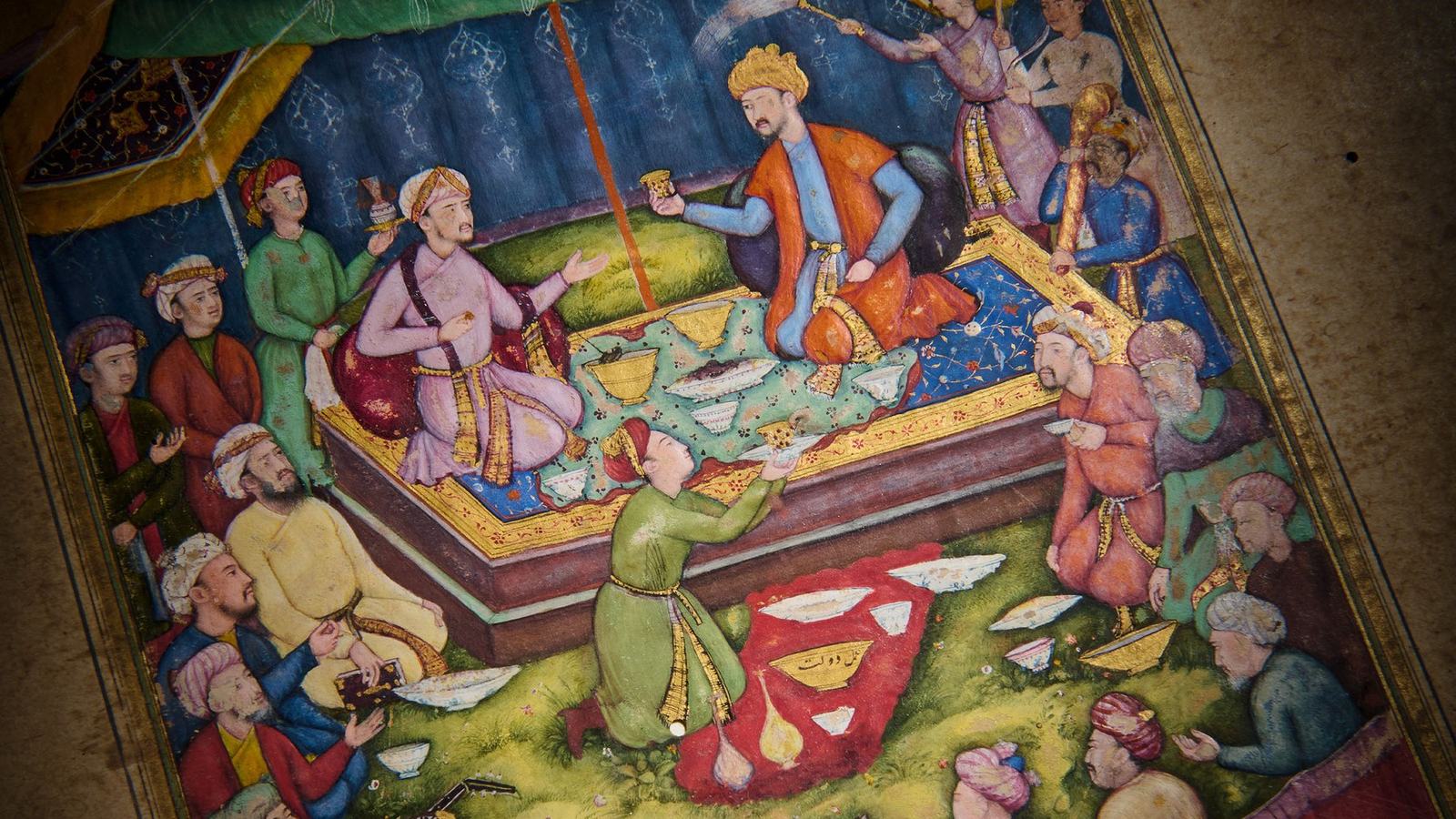
Mughal manuscript leaves connect art and political history Christie's is also offering folios from the Zafarnama, or Book of Victory, commissioned under the Mughal emperor Akbar in the late sixteenth century. The manuscript concerns the achievements of Timur, whose legacy the Mughal court invoked as part of its imperial identity. Among the highlighted leaves is a painting attributed in the catalogue to Dawlat, showing Timur entertaining Amir Khizr Yasuri in Ulugh Maydan and estimated at £120,000 to £180,000. A separate battle composition by Mukund is estimated at £70,000 to £100,000. These are important works because an illustrated manuscript operates simultaneously as a text, a visual narrative and an expression of courtly authority. A buyer should consider the relationship of a folio to other surviving leaves rather than treat it as an isolated miniature whose subject matter is immediately self-explanatory.
Attribution and manuscript history matter Paintings from celebrated ateliers frequently involve questions about artists, assistants, later inscriptions and the changing structure of albums or bound manuscripts. Detached leaves may have passed through several collections, and their original sequence can be difficult to reconstruct. A responsible catalogue entry should indicate what can be established and where uncertainty remains. For a private buyer, high-resolution examination can reveal pigment condition and the presence of trimming, retouching or mounts that affect the image. Scholars may be able to identify relationships to works held in public institutions. Such comparisons can strengthen an understanding of attribution, though stylistic resemblance alone is not decisive proof. Collectors intending to lend manuscript leaves should also consider safe framing, light exposure and whether a public exhibition can explain the literary context. The best acquisitions preserve knowledge as well as physical material.
A Caucasian Dragon carpet bridges regions Another highlighted lot is a Dragon carpet from the Karabagh region of Azerbaijan, dated to the late seventeenth or early eighteenth century and estimated at £100,000 to £150,000. Its motif combines stylised creatures with a complex geometric lattice, reflecting artistic ideas that travelled between regions over centuries. The term Dragon carpet describes a design tradition rather than a guarantee of a single workshop or place of manufacture. Textile collectors should examine the weave, dyes, condition and evidence of repairs alongside stylistic analysis. Christie's specialist account emphasises the unusual colour qualities associated with historical Caucasian carpets, but precise claims about particular pigments need scientific or documentary support. An apparently intact antique textile may contain significant areas of later reweaving. That need not remove its aesthetic importance, although it should be described accurately when determining a price.
Provenance through the story of Adeline Pepper Gibson The auction also includes three South Indian gem-set temple necklaces associated with Adeline Pepper Gibson, an American heiress and traveller who acquired them during a journey to India. Christie’s notes their survival within the family across generations and places individual examples in estimate bands of approximately £20,000 to £30,000. The story offers an illustration of how objects made for one cultural and social setting can enter another through travel and collecting. It also raises questions that require care rather than romantic embellishment: when were the necklaces acquired, under what circumstances, and what documentary evidence supports the ownership chain? Provenance can be historically revealing, but a well-known owner does not automatically settle all questions about an object's earlier history. Collectors should value reliable records, cultural context and precise descriptions over an attractive anecdote.
A private collection may combine very different obligations A buyer of manuscripts, glass, jewellery and textiles needs a conservation strategy that recognises the differences between them. Works on paper are vulnerable to light and humidity; historic glass may require stable mounts and careful cleaning; textiles may need protection against pests, fading and mechanical strain; antique jewellery brings questions about metalwork, stones and evidence of repair. A single gallery with dramatic lighting and unrestricted handling may not be appropriate for all categories. Insurance and security plans should also be tailored to objects that vary in portability and vulnerability. A collection that moves between multiple residences or is occasionally installed aboard a yacht can face additional logistical challenges. Specialist transit preparation may be essential. Affluence enables collecting across media, but responsible care calls for expertise that no decorative designer alone can supply.
Cultural property and export questions cannot be ignored Material with historical connections to Egypt, India, Iran or the Caucasus may be subject to cultural property rules that differ by origin, location and date of movement. The legal position of a particular lot must be established through its actual records and the laws of relevant jurisdictions. It would be mistaken to assume that a public auction listing guarantees unrestricted export or import. Buyers should check the conditions of sale, licences, endangered-material restrictions where applicable and the documentation required to move an object across borders. An independent specialist or legal adviser may be appropriate for particularly sensitive works. The objective is not to discourage responsible collecting but to ensure that an acquisition can be documented and preserved without avoidable legal complications. Public exhibition, charitable gifts and future resale may depend on records secured at the time of purchase.
How the estimates should be read The sale preview places individual objects within different estimate ranges, from five-figure jewellery and textiles to the six-figure mosque lamp fragment. These numbers are not a league table of historical importance. They reflect supply, condition, demand and the commercial situation of specific lots. The value of a manuscript leaf can change according to attribution, quality and associations; a carpet's price may depend heavily on completeness and restoration. Buyers should obtain condition reports, examine images at sufficient resolution and seek advice about the suitability of conservation treatments. Currency conversion, buyer's premium, taxes and transport may materially affect a final invoice. A prudent bidder approaches each object with an all-in spending ceiling and a plan for post-sale care. The excitement of discovery should not displace a clear account of what is actually being purchased.
The proper conclusion before results are confirmed Christie's preview establishes a London sale on 12 November 2026 featuring rare material from the Islamic and Indian worlds, including the Mamluk lamp fragment, Mughal Zafarnama folios, a Caucasian Dragon carpet and South Indian necklaces with a documented private-collection narrative. The published estimates provide a guide to expectations, not completed transactions. Without verified hammer results, this report does not state that any particular lot sold or exceeded its estimate. For the ultra-wealthy collector, the opportunity is to study objects whose interest extends beyond their market value, while applying the same diligence required of any acquisition with substantial historical and cultural significance. The quality of the research and the care of future stewards will be as important to the objects' long-term legacy as the price paid in the saleroom.
Original source: Christie's, 6 November 2026, Islamic and Indian art and rugs London sale preview.