Christie's Paris presents over 220 jewels for December 2026, led by a Kashmir sapphire ring, Van Cleef & Arpels Ballerine brooch and historic designs.
A December sale built around provenance and colour
Christie's has announced more than 220 jewellery lots for its Joaillerie Paris online auction, scheduled to run from 4 to 16 December 2026. The auction house's 20 November announcement places coloured gemstones, historic jewellery designs and pieces by leading Parisian maisons at the centre of the sale. Among the most prominent offerings are a Kashmir sapphire and diamond ring with a €600,000–€800,000 estimate and a Van Cleef & Arpels Ballerine clip estimated at €80,000–€120,000. These are pre-sale estimates, not realised prices, and the auction has not yet taken place.
The Paris exhibition is scheduled for 11–16 December, giving prospective bidders an opportunity to inspect selections in person. For established collectors, the significance of such a preview is that a jewellery photograph can communicate colour and design but rarely the full character of a stone, setting or historic object. The most important questions concern origin documentation, condition and the physical experience of the piece. The public announcement is a starting point rather than a substitute for the catalogue and specialist inspection.
A Kashmir sapphire at the top of the estimate range
Christie's identifies a Kashmir sapphire ring as one of the leading lots, with an indicated estimate between €600,000 and €800,000. Kashmir is a geographic origin associated in the jewellery market with certain historically sought-after sapphires, but origin should never be assumed from appearance or an auction-house headline alone. Detailed laboratory documentation and any accompanying reports are essential for understanding what is actually being offered.
Collectors should distinguish a stone's geographical attribution from the characteristics which influence its appeal. Colour, transparency, proportions, treatment history, size and condition all affect how a gemstone is assessed. The strongest blue in a photograph may not be the most attractive in different light, while inclusions and cutting decisions can change the perception of a stone. A substantial estimate indicates how the seller and specialists have positioned the lot, not a guarantee of its underlying market value or final hammer price.
The Van Cleef & Arpels Ballerine tradition
A gold-and-diamond Van Cleef & Arpels Ballerine clip is another principal highlight. Christie's links the example to the maison's 1946 Paillette collection and notes the wider ballet-inspired tradition begun in New York during the 1940s. Its estimate is €80,000–€120,000. The work is associated with the family of Emma Sandrini, a former Paris Opera Ballet étoile, and the auction description presents it as having passed through generations connected with dance.
That provenance is part of the object's fascination, but collectors should verify it through the published catalogue and supporting documents rather than treating a press-release summary as a complete chain of title. A historical jewel can be compelling because it occupies several worlds at once: decorative art, fashion history, craftsmanship and personal inheritance. In this case the dance connection adds interpretive depth to an already recognisable design motif. The appeal is not confined to the intrinsic value of its precious materials.
Why period jewellery demands particular scrutiny
Vintage jewels have histories that contemporary catalogue photographs cannot always reveal. A brooch might have been altered to suit changing fashions, repaired after damage or fitted with replacement components. Some alterations can be professionally documented and acceptable to collectors, while others may affect how an object is valued. The greater the emphasis on original period character, the more important a careful condition assessment becomes.
With clips and brooches, the reverse of the piece is often especially informative. Mechanisms, signatures, setting work and wear can help specialists understand how the jewel was made and used. An attractive frontal image can conceal such details. Buyers considering a rare piece should review the auction house's condition report, understand the terms of sale and, where appropriate, seek independent advice before bidding. These are sensible precautions regardless of the reputation of the maison involved.
Suzanne Belperron and the collector’s eye
Christie's also identifies an emerald, coloured-diamond and diamond clip-brooch by Suzanne Belperron, with a comparatively accessible €8,000–€10,000 estimate in the context of the sale. Belperron's jewellery is frequently discussed for its distinctive sculptural approach and willingness to move beyond conventional decorative formulas. The announced piece provides an opportunity to explore why authorship and design can matter as much as a simple tally of stones.
Attribution is especially important in jewellery collecting. A name may describe the maker, designer, manufacturer or broader workshop tradition, and those categories should not be blurred. The catalogue's exact terminology and any marks should be examined before drawing conclusions about the object's place within a designer's work. A collector should also consider whether a brooch suits their own style and how it might be worn, rather than buying solely because the designer has a recognised name.
The versatility of Art Deco
An Art Deco aquamarine-and-diamond bangle bracelet is included with an announced €60,000–€80,000 estimate. Christie's describes it as transformable, a feature that reflects the ingenuity of historical jewellery designed to adapt to different forms or occasions. A piece that can be reconfigured invites the owner to see jewellery as both decoration and mechanical craft. The ingenuity of the fittings, however, can also make condition and completeness particularly important.
A transformable jewel should be assessed with the relevant parts, fitting instructions and proper care guidance in mind. Repeated conversion by an inexperienced wearer can risk damage to historic mechanisms. Buyers ought to confirm exactly which configurations are possible and whether all necessary components are present. The word transformable does not justify guessing at specific functions that the public announcement does not describe. Its value lies in a documented design capability and the quality of execution.
Bvlgari brings colour to the Paris selection
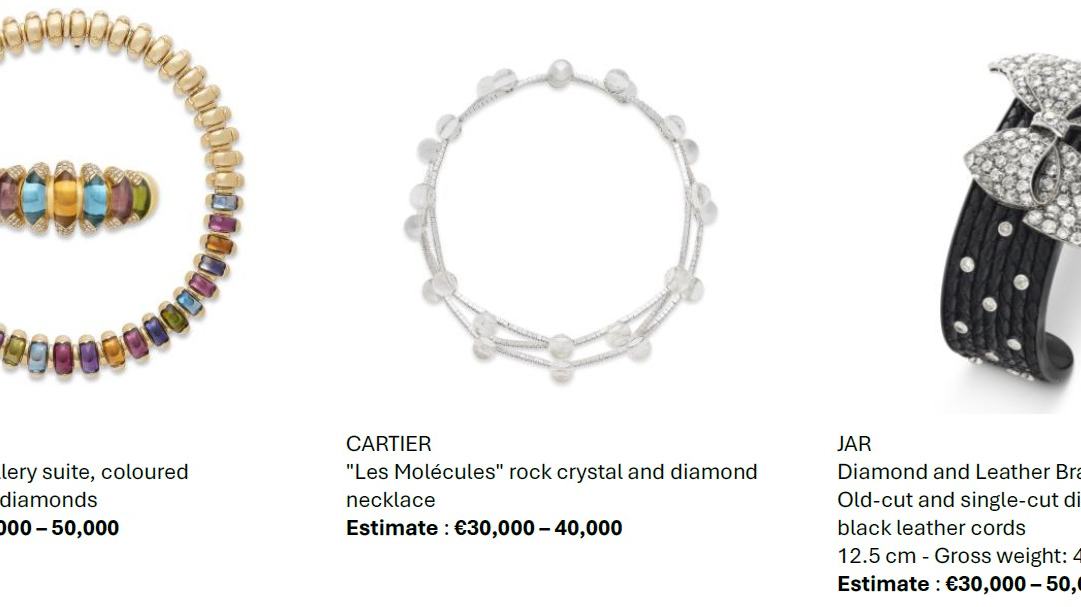
Among other highlights is a suite from Bvlgari's Celtaura collection, described as celebrating varied coloured stones including tourmaline, amethyst, citrine, peridot and topaz. Christie's places an estimate of approximately €30,000–€50,000 on the illustrated necklace-and-bracelet selection. The palette offers a different proposition from the concentrated prestige of a Kashmir sapphire: an emphasis on harmonious colour and the way multiple stones operate as an ensemble.
The experience of wearing colourful jewellery is strongly affected by the wearer's complexion, clothing and lighting. A richly coloured suite may be more versatile than its studio photography suggests, or more demanding to coordinate. The relationship between design and personal use is particularly relevant to buyers who collect jewellery for travel, formal entertaining and occasions aboard a yacht. Safe storage and appropriate insurance remain necessary even where the appeal is primarily aesthetic.
Estimates are not prices
The announced estimate range across the wider auction extends from a few thousand euros to several hundred thousand euros, and the house notes that some pieces may be offered without reserve. A lot estimate is a published opinion of likely auction interest, not an agreed retail price. The final amount payable may include a buyer's premium, taxes and other charges. Currency movements can also change the effective cost for an international collector.
An absent reserve does not mean an item has no minimum prudent value or that bidding will remain low. Interest can accelerate as collectors recognise rarity, or it can be limited for reasons that are not obvious from the photographs. An owner planning to bid should decide upon a total budget before the sale and check the full payment and collection arrangements. A successful bid is only part of acquiring, transporting and caring for a valuable jewel.
Online participation and an in-person preview
The Joaillerie Paris sale is planned as an online auction from 4 to 16 December, while the physical exhibition is scheduled for the later days of the sale. This arrangement allows international buyers to participate remotely, although it also makes careful preparation more important. Someone viewing pieces on a screen should not assume that colour reproduction is consistent across devices, nor that high-resolution photography reveals every mark or restoration.
For a buyer who can visit Paris, an exhibition may provide a more reliable sense of scale, finish and wearability. Where personal inspection is impractical, detailed condition reports, additional images and specialist conversations can help. It remains the bidder's responsibility to read the contractual conditions and understand any cross-border shipping or import requirements. These practicalities apply particularly to gemstones and jewels intended to travel between several residences or countries.
Collecting jewellery beyond the auction headline
The December selection illustrates that fine jewellery collecting can encompass very different motivations. Some purchasers seek a highly regarded gem origin, others focus on a specific maker or designer, and some value the emotional association of a piece with ballet or Art Deco design. There is no single correct hierarchy among these qualities. A collector's satisfaction depends on understanding what distinguishes the item they are buying and how it fits within an existing collection.
Jewellery is also an object of use and stewardship. Careful handling, appropriate storage and regular inspection by qualified specialists preserve both appearance and mechanical integrity. Historical pieces may require more conservative treatment than modern jewels designed for frequent everyday wear. An auction estimate should therefore be considered alongside maintenance obligations and the joy an object can bring, not treated as a simple forecast of appreciation.
What is confirmed ahead of December
Christie's 20 November 2026 announcement confirms a Joaillerie Paris online auction from 4 to 16 December with more than 220 lots and an exhibition planned for 11–16 December. It identifies a high-estimate Kashmir sapphire, a 1946-linked Van Cleef & Arpels Ballerine clip, work by Suzanne Belperron, a transformable Art Deco bangle and colourful Bvlgari jewellery. The stated estimates are preliminary and subject to auction conditions.
For the international collector, this is a particularly informative preview because it joins gemstone prestige with examples of jewellery as portable design history. The next meaningful evidence will come from detailed lot documentation, physical examination and the eventual results after the auction closes. Until then, the appeal lies in the range of craftsmanship and provenance assembled for December, not in imagined hammer prices or unsupported claims about future returns.
Primary source: Christie's original official Joaillerie Paris press release, 20 November 2026.
Jewellery images: © Christie's Images Limited 2026, first-party press visual for the 4–16 December Joaillerie Paris sale. Official source.
