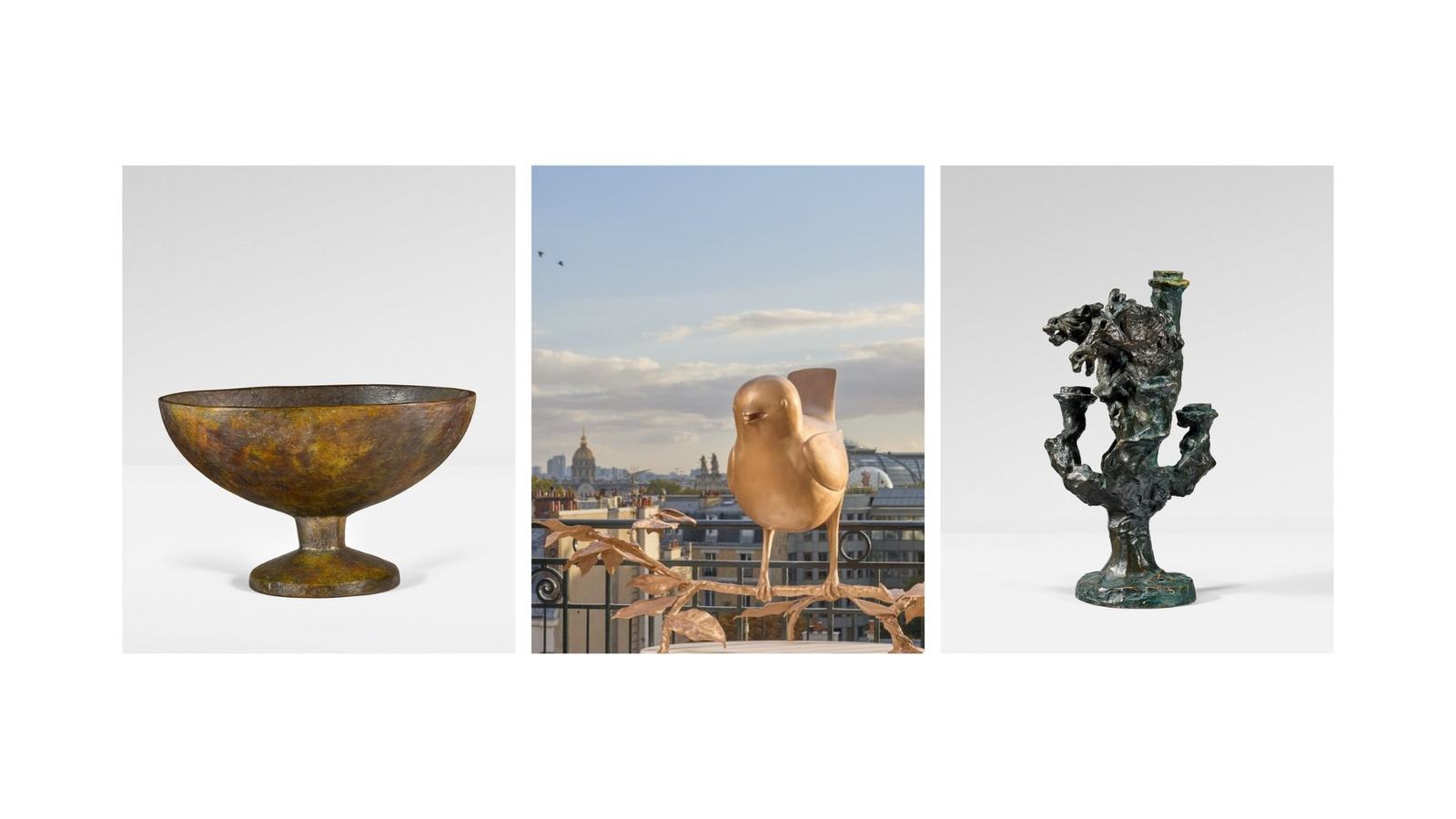
Christie's Paris announces approximately 180 design works for sale on 24 November 2026, including pieces by François-Xavier Lalanne and Alberto and Diego Giacometti.
A Paris sale organised around the possibilities of bronze Christie’s Paris has announced a 24 November 2026 design auction of approximately 180 works, using the expressive possibilities of bronze as one of its main themes. The catalogue is described as moving through a century of decorative arts, from Alberto and Diego Giacometti and François-Xavier Lalanne to Ingrid Donat and Maarten Baas. The public exhibition is scheduled for 19–24 November. This is a specific sale at a defined date, not a general statement that Christie's is increasing its presence in the design market. For collectors who see sculpture, furniture and lighting as parts of one visual conversation, the proposed selection presents an interesting opportunity to compare how different designers used materials and forms to achieve very different purposes.
The Lalanne highlight is a work of sculptural design One of the important lots is François-Xavier Lalanne's Le Grand Oiseau de Peter Branché, with a published estimate of €1 million to €1.5 million. The piece is associated in the auction house's publicity with the relationship between animal forms and functional sculpture that characterises much of Lalanne's work. The estimate is a pre-sale range, not an achieved price or a guarantee of value. Its breadth shows the level of anticipation around a notable work, but a bidder must understand the specific edition, provenance and condition of the object. Prices across the artist's wider market cannot be inferred from one auction estimate without reviewing comparable works and the history of individual examples.
Alberto Giacometti's Coupe ovale offers a different perspective The press release identifies Alberto Giacometti's Coupe ovale, estimated at €400,000 to €600,000. Whereas Alberto is often discussed through his fine-art sculpture, this object places design and the treatment of surfaces closer to the centre of attention. Collectors encountering a decorative piece by a major sculptor should consider its intended use, materials and historical context rather than assume it should be valued in precisely the same way as a freestanding figure. The distinction between fine art and functional design has never been completely rigid, particularly when an artist works across both. The present sale makes that overlap visible while still requiring detailed catalogue research for each individual object.
Diego Giacometti’s horse-head candleholder bridges sculpture and daily life A five-branch candleholder with two horse heads by Diego Giacometti is another named highlight, with an estimate of €120,000 to €180,000. Christie's identifies the piece as a patinated-bronze work made in 1951 for his brother Alberto’s fiftieth birthday. This is not an electric chandelier intended for ceiling suspension. Its sculptural subject and candle-bearing function demonstrate how the artist used a familiar household form to create an object with personality and movement. Buyers considering the work should understand its dimensions, patina, provenance and suitability for their intended display. If candles are to be used, their proximity to valuable surfaces and the risks of heat or wax require sensible precautions. The object is best approached as an important piece of sculptural design rather than simply an elaborate lighting accessory.
Bronze can be both structural and expressive Bronze is valued in sculpture for the way it can capture detailed surfaces and support substantial forms, but it is not one uniform visual material. Patinas, finishing, casting methods and later interventions can produce very different appearances. In decorative design it may become a table support, a sculptural element or a lighting component. Each function changes the technical and conservation questions that a buyer should ask. The Paris sale provides an opportunity to compare such treatments across several generations of makers. It does not mean that every item is made entirely from bronze, or that all artists in the catalogue adopted one method. The material is an organising theme rather than a complete description of each object.
A century of design creates contrasts Christie's places approximately 180 works within a broad account of twentieth- and twenty-first-century decorative arts. Some designs emphasise the forms of nature, while others use geometry, gesture or deliberately unconventional surfaces. This variety can help a collector identify why objects from different periods sometimes work together in the same room. It can also expose the limitations of buying solely by name. A recognised designer may have produced several editions, and small differences in fabrication or documentation can matter significantly. The catalogue should be the authority for a lot's date, maker, provenance and any edition information. An auction preview is useful for orientation, but the physical examination of materials remains important.
Ingrid Donat belongs within the contemporary end of the story Ingrid Donat is among the designers highlighted by Christie's, helping connect the sale's historical works with more recent approaches to sculptural furniture. Her inclusion illustrates a collecting category in which usable design can also make a pronounced artistic statement. A chair or table can be chosen for visual impact while still raising questions about comfort, finish, dimensions and maintenance. Buyers should not assume that every significant design object is intended for continuous daily use. Some are collected largely as works of art, while others are used in interiors with carefully managed conditions. The distinction affects the owner's expectations and the kind of professional support needed after acquisition.
Maarten Baas extends the discussion about function The inclusion of Maarten Baas brings another contemporary voice into a sale that also features the Giacomettis and Lalanne. Baas's work has often challenged familiar assumptions about furniture and the appearance of finished objects. An auction including his designs can prompt a useful discussion about what makes a piece collectible: craftsmanship, concept, rarity, cultural influence or a combination of these. Those considerations do not relieve buyers of the need to understand authenticity and condition. A work's distinctive visual language can attract attention, but long-term ownership still requires knowledge of its materials and any special conservation requirements. The auction provides a marketplace for that range of interests rather than an agreed hierarchy among designers.
Why decorative art attracts owners of private residences An important design object can alter the character of an interior more profoundly than a collection of smaller decorative purchases. A sculptural lamp might influence how a room is lit, while a bronze table can establish the rhythm of an entire seating area. For private residences, villas and superyachts, the challenge is to select pieces that suit the architecture and expected use. Not every valuable object belongs in a marine environment. Weight, vibration, movement and environmental exposure may rule out particular installations, even when the design feels appropriate. An owner planning to place a significant acquisition aboard should involve the yacht's technical team and a conservation professional before committing.
Provenance is especially important with editions and casts Sculptural furniture and bronze works can exist in editions, with differences among casts, dates and fabrication processes. A buyer must understand what the auction house attributes to the designer and what supporting evidence is available. Provenance can include gallery records, previous collections and exhibition history, but gaps may remain. A work described as 'attributed to' or 'after' an artist is not necessarily equivalent to one catalogued as an authentic lifetime production. The exact language of the sale catalogue matters, particularly at the high end of the market. A headline estimate should never take the place of reading those distinctions and obtaining independent expertise where necessary.
The preview runs ahead of the auction Christie's has scheduled the exhibition from 19 to 24 November, with the sale itself on 24 November. A preview offers collectors the opportunity to assess scale, surface and presence in ways that photographs cannot replicate. It also allows conversations with specialists about condition, provenance and shipping. The release does not establish that every lot can be handled or that all consultations are available without an appointment. Visitors should confirm opening times and any specific viewing arrangements. Those unable to travel may use digital information, but an important object benefits from physical inspection by an experienced representative when possible. The time between announcement and sale is a period for preparation, not a reason to rush decisions.
Estimates are not final transaction prices The named ranges—€1 million to €1.5 million for the Lalanne work, €400,000 to €600,000 for Alberto Giacometti's Coupe ovale and €120,000 to €180,000 for Diego Giacometti's candleholder—are estimates provided before bidding. The final hammer price, if the lot sells, will be determined during the auction. A buyer's total expense may also include a premium, taxes, shipping and other charges. Conversely, a work might remain unsold if bidding does not reach its reserve. A responsible article should not treat estimates as completed sales or claim that market records have been established in advance. The actual results can be assessed after the November auction.
What distinguishes this sale from other design auctions The Paris programme gives bronze a central role while placing established names alongside contemporary designers. That differs from an auction organised primarily around one private collector's home or one historical movement. It also differs from earlier Christie’s announcements featuring Lalanne alongside Perriand and Prouvé, which may concern other selections and sale contexts. Here the specific facts are the 24 November date, the approximately 180 works, the 19–24 November exhibition and the named Giacometti and Lalanne highlights. Those are enough to make the new story identifiable without repackaging older coverage of the broader design market.
A useful test of collecting priorities A collector approaching the sale may be drawn to an important animal sculpture, a smaller design object or a lighting piece with strong architectural character. The best choice depends on the owner's interests, intended setting and appetite for long-term stewardship. A famous signature can be compelling, but it does not answer whether a work is authentic, suitable or correctly priced for a particular buyer. The forthcoming Christie’s Paris sale brings these considerations together across a varied selection of bronze-led design. Its cultural interest lies in the different ways artists and designers have made functional objects expressive, while its market significance will only become clear when the bids are recorded.
**Primary source:** Christie’s Paris, 3 November 2026 press announcement and 12 November 2026 Christie’s specialist feature, Design Sale: Lalanne, Giacometti, Donat — Variations on Bronze. All estimates are pre-sale figures. Official Christie's press-gallery image is credited to the auction house.
Primary source: Christie's Paris official Design sale communiqué, 3 November 2026.
Photographs: Christie's Images Limited, official Paris Design Sale press media, November 2026. Official press photograph.
