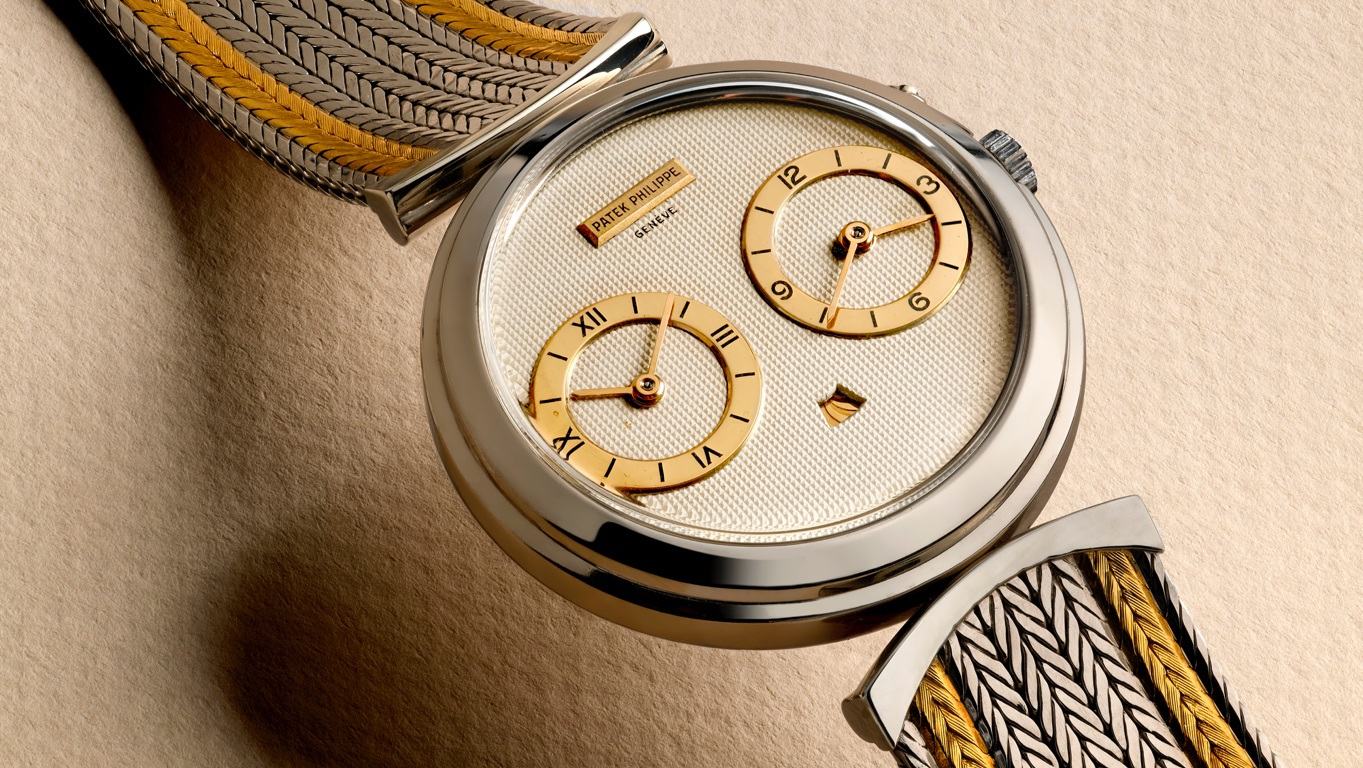
Christie's will offer an exceptionally rare Patek Philippe Dual Time Reference 3452/1 in New York on 4 December 2026, unveiling a Louis Cottier-designed watch kept by its original owner's family since 1961.
A previously unseen dual-time Patek Philippe comes to market
Christie's has announced that a rare Patek Philippe Dual Time Reference 3452/1 will headline its Important Watches auction in New York on 4 December 2026. The watch was acquired by its first owner in 1961 and, according to the auction house's 22 October announcement, has remained in the same family for two generations. Its public appearance is therefore a discovery for collectors, not the return of a familiar auction-lot photograph.
The specialist estimates the watch at USD 800,000 to USD 1.6 million, an indicative presale range rather than a promise of the price it will achieve. The estimate does not include a buyer's premium or other applicable charges. At this level, prospective bidders are assessing provenance, condition, originality and rarity as closely as aesthetic appeal, and a formal inspection remains essential.
One of seven creations associated with Louis Cottier
Reference 3452 and its integrated-bracelet counterpart, 3452/1, occupy an unusual chapter in Patek Philippe history. The auction house says only seven examples of the family were made, all conceived by Louis Cottier, the Geneva watchmaker celebrated for pioneering the world-time display. This newly disclosed piece is described as the last of those seven watches to emerge into public view.
Christie's believes the first prototype dates to 1954, while production of the seven pieces was spread across 1960, 1961 and the years up to 1963. Each differs in at least one design detail, making even the small family of references a collection of individual objects. The house says two were reportedly commissioned for Middle Eastern royalty, but that background should not be mistaken for a statement about the provenance of the watch being offered in December.
The present example is one of the pieces associated with 1961, and the family ownership described by Christie's helps explain why collectors have not previously been able to study it on the open market. Rarity is important, but the long period away from public auction also raises questions only detailed catalogue photography and specialist inspection can fully resolve.
Two time zones from one modified automatic movement
The watch has a distinctive pair of separate time displays rather than the conventional central hands and an additional travel-time pointer. Cottier's engineering allowed both dials to be driven by a single movement. Christie's describes a specially modified calibre 27-460 that lets the displays operate together or independently, with adjustment through a button at two o'clock used in combination with the crown.
That arrangement made it possible to show home and destination time without resorting to two complete movements. The feature is particularly resonant with international travellers and yacht owners who cross time zones as part of ordinary life. It is also a reminder that practical complications sometimes emerged in remarkably expressive watch designs long before travel functions became commonplace.
The case measures 39 millimetres and was conceived with a screw-down back and water-resistant construction by the standards of its period. Such historical claims are not a reason to expose a valuable vintage watch to seawater today; its current sealing and servicing condition would require independent assessment. Christie's notes that this automatic configuration also departed from the hand-wound dual-time watches Patek Philippe produced in the same era.
A two-tone gold dial and integrated bracelet
The unusual face and bracelet give the watch an identity apart from a traditional dress Patek Philippe. White and yellow gold appear together, while gold accents on the hour track and the manufacturer's nameplate provide additional contrast. The shapes and arrangement convey a distinctly mid-century taste without looking like a conventional 1960s round watch.
Christie's believes the elaborate bracelet was almost certainly made by Jean-Pierre Ecoffey, a celebrated Geneva bracelet maker. That attribution is an expert assessment rather than a documented maker's stamp established in the press announcement. The integrated bracelet is a defining aspect of Reference 3452/1, which is distinguished from the related 3452 version.
For collectors, fine differences in dial execution and metalwork can materially affect the attractiveness of an example even within a very small production group. That is why the published photograph, movement details and ownership record deserve close reading rather than treating the estimate as a direct valuation of every watch carrying the reference number.
The route to December's New York auction
Before returning to New York, the watch is expected to be displayed during Christie's Luxury Week activity in Geneva and Hong Kong. Those previews offer opportunities to see its proportions and materials in person and to seek further information from the watch department. Exhibition and inspection access should be verified with the auction house because schedules and viewing arrangements can change.
The Important Watches sale is scheduled for 4 December, and the watch is presented as one of its principal discoveries. A prospective bidder should examine the formal condition report, ask about movement operation and service history, establish all taxes and buyer's fees, and confirm shipping or export arrangements before committing to a bid.
This is especially relevant to buyers who reside across several countries or use yachts as part of a broader travel schedule. The destination of delivery, temporary import status and long-term storage requirements can matter as much as the excitement of winning an auction. No duty treatment or specific tax benefit should be assumed from the watch's historical ownership.
Why this discovery matters to high-end collectors
The 3452/1 announcement combines three qualities that seldom arrive together: a technical link to Louis Cottier, the visual distinctiveness of an experimental-looking mid-century Patek Philippe and a watch kept out of the public collecting market since its original sale. Christie's calls it the first example of this reference to appear on the market in two decades, which makes the event important to specialists in vintage complicated wristwatches.
Whether the realised price meets or exceeds the estimate will depend on bidding interest and the findings of prospective buyers rather than rarity alone. For now, the story is the surfacing of a specific historic object with an identifiable family history and an unusually inventive way to display the time in two places.
The original announcement and image come directly from Christie's press office, dated 22 October 2026. Collectors considering the watch should consult the full sale catalogue and auction conditions when released, because the press announcement is an introduction to the lot, not a substitute for its formal description.