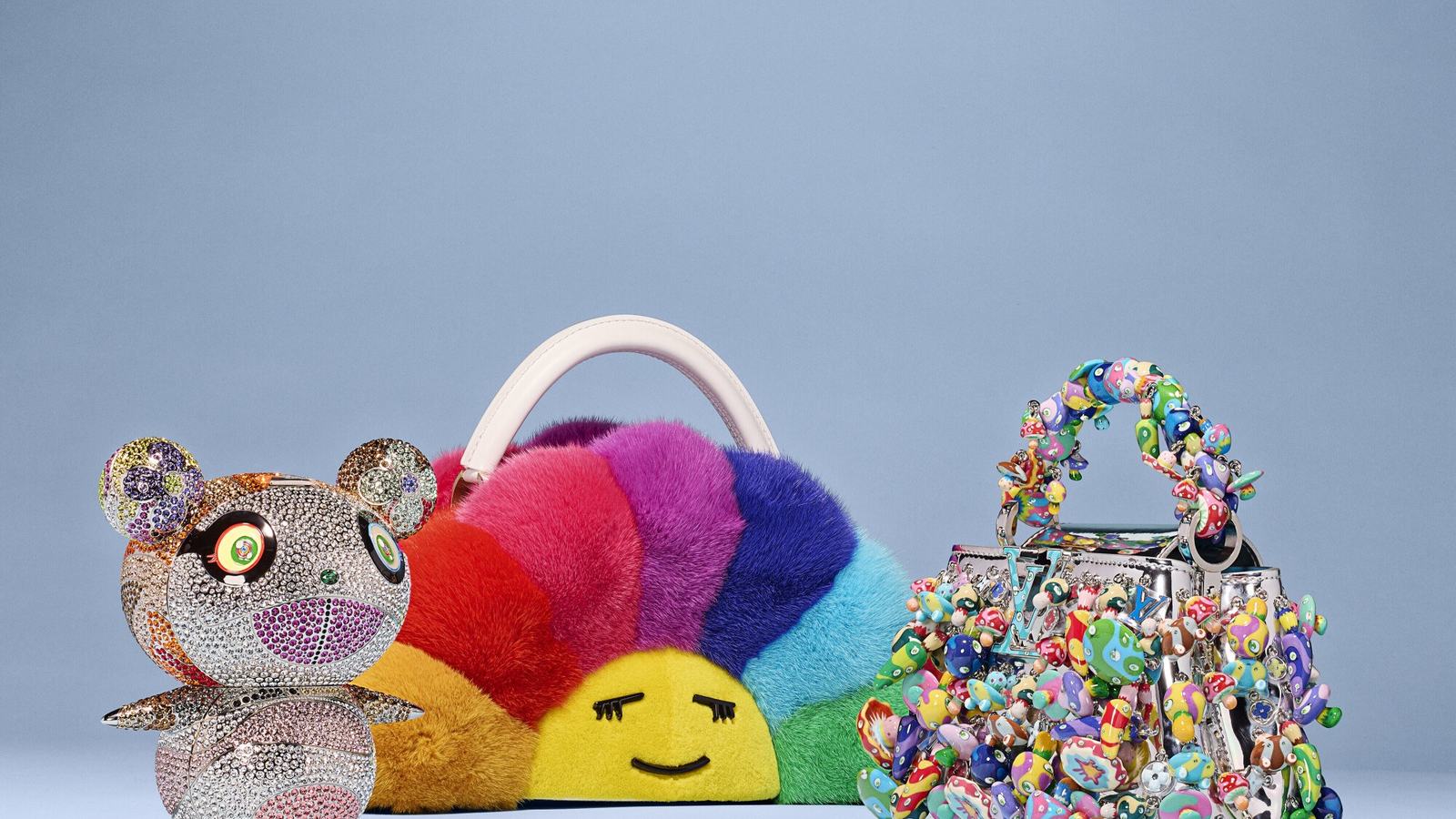
Christie’s offers more than 100 artist-collaboration Louis Vuitton bags in 88 lots, with designs linked to Takashi Murakami, Frank Gehry and Yayoi Kusama.
Christie’s is preparing to offer an unusually concentrated private collection of Louis Vuitton artist-collaboration handbags in New York, bringing together creations associated with Takashi Murakami, Frank Gehry and Yayoi Kusama. Announced on 12 November, *Scarcity & Infinity: An Important Collection* will comprise more than 100 pieces offered across 88 lots within the auction house’s *Handbags & Fashion: The New York Edit* online sale. Bidding is scheduled to open on 25 November and close on 10 December 2026.
The significance of this offering extends beyond handbags as fashion accessories. It illustrates how certain collaborations between luxury houses and prominent artists have entered a collecting category in which provenance, edition size, design history and condition matter alongside the object’s appearance. For a collector who also acquires modern art, watches or rare cars, the attraction may be the ability to follow a particular artist’s visual language into an entirely different medium.
The auction announcement describes the collection as the most comprehensive group of Louis Vuitton artist collaborations offered at auction. That is Christie’s characterisation, not an independently audited market ranking. The distinction is still worth examining: the sale brings multiple chapters of the fashion house’s collaborative history together rather than presenting one or two headline bags among an otherwise general accessories catalogue.
A crystal-covered Murakami clutch leads the estimates
Christie’s identifies a rare Takashi Murakami Artycapucines Crystal Panda clutch as the top estimated lot. The piece is described as one of 130 produced worldwide and decorated with more than 6,000 hand-set Swarovski crystals. Its published estimate is $20,000–$30,000, before any buyer’s premium or applicable taxes and charges.
The scale of the crystal work, the cartoon-like panda motif and the constrained production number each play a part in the piece’s identity. But scarcity alone does not establish future value. Collectors should distinguish the number manufactured from the number that remain in good condition, and should assess whether the seller can document the particular example’s ownership and original components.
Christie’s also lists ten examples from the seventh Artycapucines collection, associated with Murakami’s renewed collaboration with the house and unveiled around Art Basel Paris in 2025. That group may give buyers a chance to compare variations of a coherent artistic programme in one sale. It also invites a familiar collecting question: is the priority to secure a single memorable design or to build a more representative sequence?
A Pink and White Artycapucines Mini Tentacles from an edition of 95 carries an estimate of $10,000–$15,000. Those figures are presale expectations, not results. The price ultimately paid will depend on competitive bidding, item condition and sale-specific fees, among other factors.
Gehry’s architectural imagination in miniature
Frank Gehry’s contribution provides a different kind of connection between art and luxury craftsmanship. Christie’s lists a White Crocodile Drawn Fish Mini Capucines with silver hardware, one of 20 reportedly produced worldwide, estimated at $10,000–$15,000. The house also highlights a Metallic Bear with Us clutch linked to Gehry’s 2014 sculpture of the same name, again estimated at $10,000–$15,000.
The distinctions between these objects matter. One foregrounds the shape and material of a highly limited bag, while the other reinterprets an existing sculptural idea as a portable piece. A White and Red Floating Fish Capucines, inspired by the architect’s fish lamps created for the Fondation Louis Vuitton, is estimated at $6,000–$8,000.
Gehry’s architectural reputation does not automatically make every accessory associated with him an architectural masterpiece. Yet the appearance of these designs in the secondary market does raise an interesting issue for collectors: an object can be commercially manufactured and still become evidence of a significant creative partnership. Documentation identifying the precise design, production run and collaboration is therefore especially important.
Kusama’s motifs enter the handbag market
The catalogue highlights a yellow-and-black monogram leather pumpkin bag with silver hardware by Yayoi Kusama, estimated at $8,000–$10,000. Her recurring pumpkin imagery is instantly identifiable across painting, sculpture and commercial collaborations. In a handbag, the familiar visual motif becomes both design and an expression of the owner’s artistic interests.
It is easy to blur the distinction between buying a unique artwork by an artist and buying a luxury object made in collaboration with that artist. They are not equivalent categories. The handbag’s edition, manufacture, intended use, durability and secondary-market buyer base all differ from those of a canvas or sculpture. Responsible collecting requires an understanding of precisely what is being acquired, rather than relying on the prestige of an artist’s name.
That distinction is not a criticism of the collaboration. It is part of what makes the category compelling: the objects can be appreciated for craftsmanship, fashion history, image-making and their place within the long dialogue between contemporary art and consumer culture.
From Marc Jacobs to a developed collecting category
Christie’s traces the rise of Louis Vuitton’s artist collaborations to the period when Marc Jacobs led the house’s creative direction. Projects involving Stephen Sprouse and Murakami helped establish the idea that a bag could carry a visual identity associated with a contemporary artist while remaining recognisably part of the Louis Vuitton universe.
Over the following decades, the collaborations expanded into a varied body of objects. The new sale brings that history into view by gathering rare designs, reinterpretations of familiar models and striking novelty forms. Christie’s notes that the collection also contains more traditional monogram pieces, including a Murakami White Crocodile Cerises Mini Capucines with gold hardware and a cherry charm, estimated at $10,000–$15,000.
A collection of this breadth can interest more than one buyer group. Fashion-focused collectors may be concerned with model, condition and original packaging. Art collectors may be drawn to the artist’s recurring motifs and the work’s place in a broader creative career. Design collectors may be attracted to construction methods, unusual materials or the translation of sculptural forms into functional objects.
There is no single correct way to interpret these items. What matters is making an informed comparison with similar objects rather than treating all collaborations with a celebrated artist as interchangeable.
The New York viewing schedule
The sale forms part of Christie’s online *Handbags & Fashion: The New York Edit*, beginning 25 November and concluding 10 December. The auction house says highlights will be on view at 20 Rockefeller Plaza during the pre-sale exhibition of twentieth- and twenty-first-century art from 7 to 17 November. It also lists a December Luxury Week viewing period from 3 to 9 December.
Those windows serve different purposes. An early viewing gives prospective buyers time to consider the designs while they are displayed alongside fine art. A later viewing closer to the online auction deadline may help buyers make final comparisons or review condition information. Attendance, display arrangements and availability of individual lots should be confirmed with Christie’s rather than assumed from the broad publicity dates.
The announcement places the handbags in dialogue with important artworks, which is a curatorial choice as much as a marketing decision. For collectors accustomed to studying painting, sculpture and photography, it encourages consideration of how artists’ visual languages move from one format to another.
What collectors should inspect before bidding
The largest published estimate is not always the most important measure of an object’s desirability. Condition is central for handbags, particularly when unusual materials, applied decorative elements or complex construction are involved. Prospective buyers should request detailed reports, examine photographs carefully and, when practical, inspect the object in person.
Crystal decoration introduces different condition questions from those of leather. Highly structured novelty pieces may require specialist storage and careful handling. Unusual hardware, closures and removable charms should be verified against the lot description. Where a bag is said to be one of a limited number, buyers should understand exactly how that edition is defined and what documentary evidence supports it.
Auction estimates are not the same as total purchase costs. A winning bidder may also owe a buyer’s premium, taxes, shipping, insurance and import duties, depending on where the lot is purchased and delivered. A collector transporting a purchase internationally should confirm any material-specific restrictions or documentation requirements, especially where exotic skins are involved.
The existence of an artist collaboration should not be interpreted as a guarantee of appreciation. Secondary-market tastes change, and novelty objects may have a narrower pool of potential future buyers than familiar models. Anyone purchasing for investment rather than enjoyment should be especially careful about liquidity and the comparability of historic sales.
Luxury collecting as an expression of taste
Rachel Koffsky Parker, Christie’s international head of handbags and accessories, presents the collection as an example of the intersection of art, fashion and design. The original statement emphasizes the personal relationship between a collector and an object that can be worn or carried rather than simply displayed.
For owners of substantial private collections, that idea is familiar. A rare object can offer pleasure through its aesthetic qualities, its story and the memory of acquiring it, independently of its future sale price. On a superyacht, an unusual bag might accompany a journey or a private dinner rather than sit permanently in storage. Yet movement and use bring their own practical questions about security, care, climate and insurance.
Such considerations do not diminish the artistic ambitions of the pieces; they underline the difference between an object designed for engagement and one preserved primarily for display. Collectors can reasonably make different choices about how much they use an acquisition.
What the December sale will establish
The catalogue’s breadth gives the market a concentrated opportunity to assess demand for Louis Vuitton artist collaborations in several forms. It will also provide a public record of which designs buyers favoured, though a single auction cannot establish a permanent market trend.
Christie’s announcement provides the number of pieces and lots, the participating artists, selected rarity claims, presale estimates and viewing dates. It does not provide the final hammer prices, the number of bidders or the sale’s total proceeds. Those facts will only become available after the auction.
Until then, *Scarcity & Infinity* is best understood as an important upcoming collector sale rather than a demonstrated market record. Its significance lies in showing how objects once introduced through fashion collaborations can later be gathered, catalogued and interpreted as a distinct field of luxury collecting.
Primary source: Christie's.
Photo: Christie's / official Scarcity & Infinity media release, 12 November 2026. Official press photograph.

Source
Christie's