Cunard reveals a historically informed interior design programme for Queen Mary 2, with its proposed refurbishment drawing on the original 1936 ocean liner.
Cunard has revealed the creative direction for the forthcoming refurbishment of Queen Mary 2, with the ocean liner due to enter dry dock at Damen Shiprepair Brest on 31 March 2027 and return to service on 9 May. The announcement, issued on 11 November 2026, coincided with the liner's departure for its 450th transatlantic crossing. Its proposed decorative scheme, described by Cunard as Cunard Deco, draws on the archives of the company and the visual traditions of the original Queen Mary of 1936. For owners and designers of large private yachts, the programme presents an interesting case study in the adaptation of historic maritime design to contemporary accommodation, particularly where the preservation of an existing vessel's character is as important as the introduction of new interiors.
The archive as a design resource
London-based AD Associates has developed the design direction after studying original material held within Cunard's Liverpool archive. According to the announcement, the designers examined drawings and decorative schemes associated with the original Queen Mary. The historical references are intended to inform a new ensemble rather than result in a straightforward reconstruction of the earlier vessel.
This distinction matters in maritime interiors. Historical styles can be copied through the repeated application of recognisable motifs, but a more considered approach examines how those forms originally operated within individual spaces. Architectural proportions, the arrangement of circulation and the character of materials can each express the relationship between the vessel and the period in which it was conceived.
In the context of a contemporary refit, the original references must be adapted to existing dimensions, applicable shipboard requirements and the practical needs of today's passengers. The creative challenge is to establish a relationship between the two periods without suggesting that the new rooms have remained unchanged since the 1930s.
Connecting the two sides of the Atlantic
Cunard's design account describes the proposed scheme through the metaphor of a woven material connecting Britain and America. The structure of the ship establishes a framework within which details associated with the destinations and experiences of transatlantic travel are to appear.
That relationship is particularly appropriate to Queen Mary 2. The company has operated Atlantic crossings since 1840, while the present vessel has served the route since 2004. The announcement of the refurbishment therefore concerns a ship whose identity is closely connected to repeated journeys between Southampton and New York rather than one whose interior is conceived solely for a particular holiday destination.
Owners commissioning interiors for vessels used in several geographically distinct regions may face a related creative question. A design can draw on references associated with its intended voyages without becoming a series of unrelated themed rooms. Restricting a visual language to a coherent selection of materials, proportions and motifs may allow the individual spaces to retain their own character while still belonging to the same vessel.
A shell motif with different expressions
The announcement identifies the scallop shell as a unifying element within the Grill Suites. Its radiating shape recalls both a natural marine form and decorative devices associated with the Art Deco period. Rather than apply an identical emblem throughout, the designers propose distinct interpretations within different spaces.
The Queens Grill Suites are intended to reflect the bow of Queen Mary 2 proceeding across the Atlantic. The Princess Grill Suites draw on the symmetrical arrangements and architectural outlines associated with Manhattan. Within the Grill Suites Lounge, the shell is to be interpreted in relation to a peacock-like fan, recalling the promenade on the original Queen Mary where passengers gathered socially.
The use of variations upon a recognisable form is particularly relevant to the design of substantial private interiors. A motif can support a coherent identity while still responding to the scale and intended function of an individual room. Its success depends partly on the restraint with which it is repeated. A decorative form that contributes to the visual structure of a surface need not be placed on every object within the room.
The proposed duplex Queens Grill accommodation
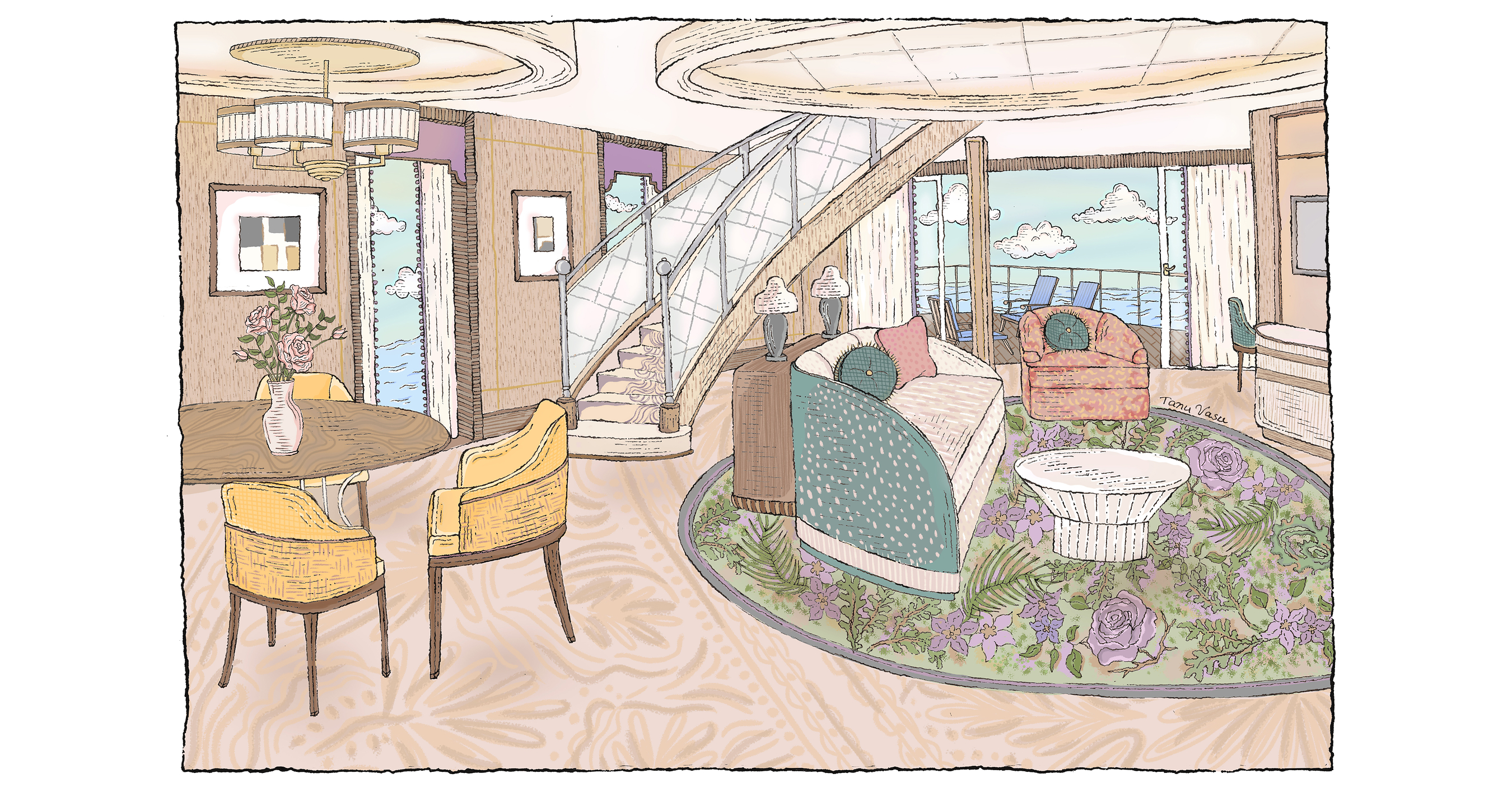
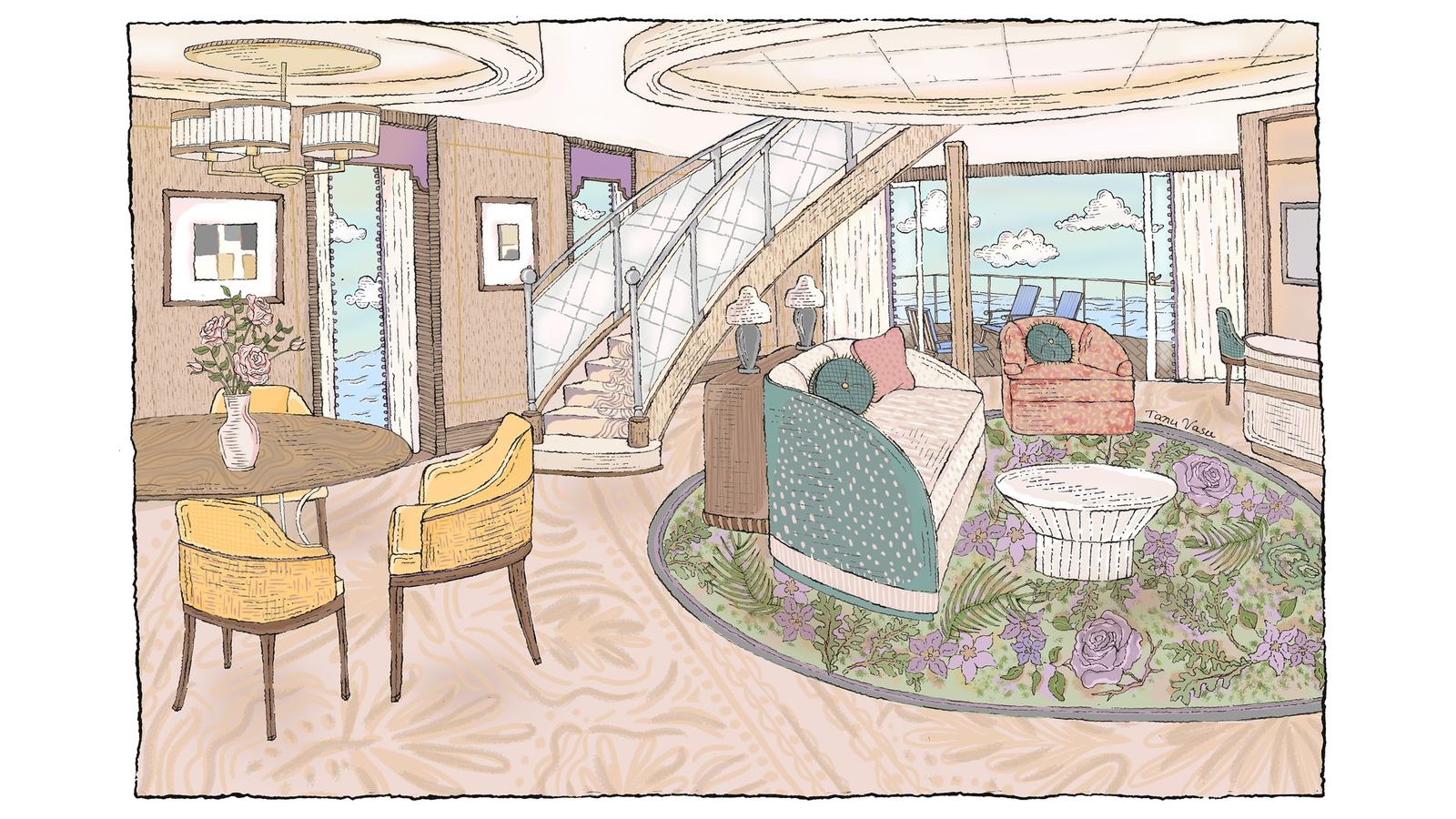
A series of illustrations by Tanu Vasu accompanies the announcement, including a representation of the reimagined living area in a duplex Q1 Queens Grill Suite. These images have been released to convey the design direction and include creatively interpreted elements that may differ from the final installed interiors. They are not photographs of completed work.
The duplex accommodation is a particularly interesting context in which to consider the relationship between vertical and horizontal circulation in a marine interior. A substantially larger interior volume creates opportunities for layered views, varied levels of seating and decorative features experienced from different positions.
For a private yacht designer, the challenge is often to reconcile an ambitious spatial arrangement with practical movement, structural constraints and the operation of the surrounding vessel. The interiors need to remain usable under maritime conditions, rather than function only as a visually impressive architectural composition when the vessel is stationary. The proposed illustrations provide a starting point for considering those relationships but cannot establish the exact details of the finished construction or its technical specifications.
Decorative details that reward closer examination
The Princess Grill proposals include embroidered headboards incorporating urban silhouettes. Another detail identified by the company is the reinterpretation of a transatlantic map designed by Leslie MacDonald Gill, originally displayed in the first-class dining room of the 1936 liner.
The proposed bathroom decoration refers to that older artwork, including a representation of a clock whose hands are positioned at 4:33 pm. Cunard connects the time to the departure of Queen Mary from Southampton in May 1936. The detail introduces a specific historical reference that may not be immediately recognisable to someone entering the room for the first time.
Such features can give a private interior a more substantial intellectual character than a general impression of an historical style. An owner commissioning an artwork, embroidered panel or marquetry component may choose to refer to particular journeys, architectural traditions or historical events. The significance of that element can remain discreet until a guest discovers its context. That approach allows decoration to contribute to the experience of a place without requiring every reference to be explained prominently within it.
Material choices and the value of restoration
Cunard identifies marquetry, cabinetmaking and carpets from British manufacturer Ulster Carpets among the materials and skills informing its proposals. The release also states that existing timber, stone floors and fittings will be retained and restored where appropriate.
The latter decision reflects an issue familiar to owners undertaking significant refits. Replacing every surface can make it relatively easy to establish a consistent new appearance, but may result in the loss of original work that remains suitable for continued use. An assessment of existing components should distinguish between elements requiring replacement for practical reasons and those that can be conserved or refinished to an appropriate standard.
Marine interiors additionally impose particular requirements concerning materials, installation and maintenance. Products that perform well in a shore-based residence are not automatically suitable for use on a vessel. Fire performance, the effects of movement and the relationship between decorative surfaces and technical installations need to be assessed by the responsible professionals. The appearance of the proposed scheme is therefore only one aspect of the wider decisions that must precede its installation.
The relationship between accommodation and public hospitality spaces
The programme is intended to extend through different accommodation categories, from Britannia staterooms to the Queens Grill suites, and to include the Princess Grill and Queens Grill restaurants and the Grill Suites Lounge. Cunard has also identified changes to the wellness offering.
This breadth provides an opportunity to develop a consistent overall atmosphere across spaces that serve very different purposes. The requirements of a private accommodation suite may differ considerably from those of a restaurant receiving groups of passengers throughout the day. Materials exposed to intensive public use may need particular characteristics, and service routes must remain appropriate to the hospitality operations of the vessel.
Private yachts offer a different scale of occupancy and operational organisation, but the relationship between guest areas and the practical requirements of the crew remains fundamental. A successful redesign should account for how the proposed interiors are cleaned, maintained and serviced, as well as for their appearance in the initial photographs. The renewal of an existing vessel is an opportunity to address aspects of daily use that may have become evident over previous years of operation.
A new chapter for an established ocean liner
The proposed refurbishment will take place during a period that marks ninety years since the maiden voyage of the original Queen Mary. The present ship departed on its 450th transatlantic crossing on 10 November 2026, providing a particularly appropriate context for the design announcement.
Queen Mary 2 is a commercial ocean liner, not a superyacht. Nevertheless, the design programme illustrates questions that are highly relevant to private maritime interiors: how an established identity can be sustained through renewal, how archives can inspire contemporary work and how valuable existing craftsmanship can be preserved.
The significance of the undertaking will be clearer when the finished spaces are available to examine after the vessel's scheduled return to service in May 2027. For now, the official illustrations and design description establish an approach rather than a completed result. The most interesting aspect is the proposed dialogue between a historic maritime decorative tradition and the practical demands of a ship continuing to operate across the Atlantic.
Primary source: Cunard, official refurbishment design announcement, 11 November 2026.
Illustration: Tanu Vasu for Cunard, supplied with the official press release via PR Newswire. Proposed design, not a completed interior. Official source.