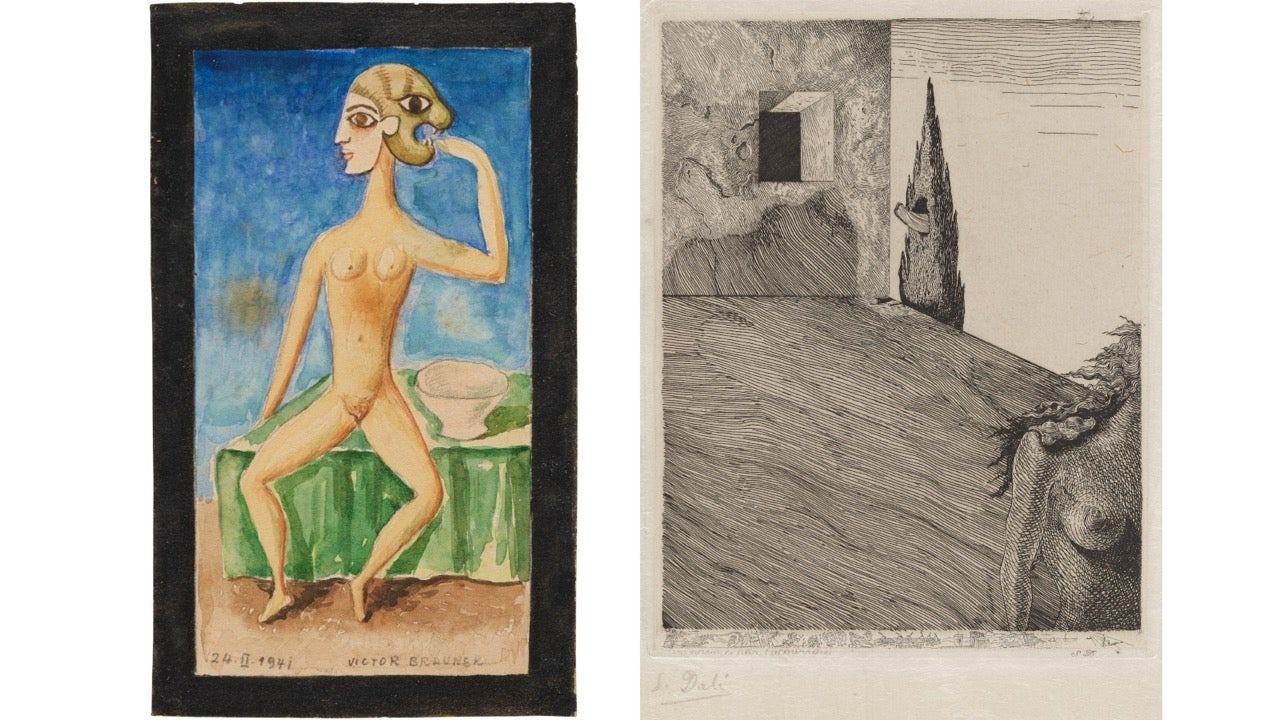
Phillips’ Modernism Editions preview connects Jean Arp, Salvador Dalí, Max Ernst and other avant-garde artists through mythology, graphic experimentation and unusual objects.
A modernist sale built around ideas as much as images
Phillips has presented a group of modernist prints and objects for its October 2026 New York Editions and Works on Paper: Modernism auction, drawing connections between artists who tested the boundaries of representation. The range includes familiar names such as Salvador Dalí alongside Jean Arp, Max Ernst, Victor Brauner and Kurt Seligmann.
Modernist collecting is often organised by school or period, yet the auction house’s preview shows how artists returned to similar concerns through very different methods. Ancient myths, religious imagery, psychological uncertainty and ordinary domestic objects provide recurring points of reference.
For the collector, the auction is an opportunity to assess the reach of an artist’s practice beyond a celebrated painting or sculpture. Editions can preserve experiments that reveal how an image or idea evolved, though the materials and production histories differ sharply from one object to another.
Arp and the modern reworking of mythology
Phillips identifies Jean Arp’s Crucifixion from 1914 as an important early example of his printmaking, describing the example on offer as the only one of his first print. Its treatment of an established religious image makes use of modern visual energy rather than attempting a literal historical illustration.
The preview also looks to Brauner and Ernst for works that transform traditional imagery into unfamiliar or dreamlike forms. Their explorations belong to an avant-garde context in which artists tried to move beyond an ordinary depiction of the visible world.
Attribution, printing technique and the history of any surviving proofs are fundamental questions when a work is presented as exceptionally rare. Collectors should distinguish the auction house’s specific statement about the example offered from broad assumptions about the availability of every related impression.
Dalí and everyday objects take an unexpected turn
Salvador Dalí appears in the presentation as an artist whose use of familiar objects invited new interpretations. His chess-related works are part of a wider modernist fascination with shifting meaning, in which practical objects can become carriers of humour, symbolism or unsettling associations.
Surrealist objects often draw interest from buyers who also collect design, sculpture and decorative art, because their impact is not confined to a framed surface. That cross-category appeal can be significant, but it also creates the need for careful research into fabrication, edition history and later reproductions.
The article places these objects alongside the work of artists who used mythology and text to investigate social and psychological questions. Collectors should resist simplifying that range into one movement’s trademark imagery and examine each artist’s aims in the historical context of the work.
Looking beyond the famous signature
An artist’s name may attract initial interest, but the value and importance of a modernist edition depend on many more specific characteristics. The date of design, the date of execution, the printer or publisher, the number of surviving examples and the condition of the materials all matter.
Specialist examination is particularly useful for works involving mixed media, fragile paper or components intended for display as an object rather than a conventional print. Historic repairs and replacements can change both the aesthetic impression and the collector’s assessment.
Phillips’ October presentation brings these questions into focus by placing avant-garde experiments beside one another. The result is a compelling opportunity to study modernism as a series of individual artistic decisions rather than a catalogue of instantly recognisable names.
Source
Phillips Editorial