The Dalí Museum’s new Florida exhibition pairs Salvador Dalí with Old Masters from Velázquez to Goya, with prints, rare loans and an interactive gallery programme.
A new exhibition opens on Florida’s Gulf coast
The Dalí Museum in St. Petersburg, Florida, opened Dalí: Disruption + Devotion on 7 November 2026, bringing together the artist’s own paintings, drawings and prints with works by the European masters he studied. The exhibition, co-organised with the Museum of Fine Arts, Boston, runs until 18 April 2027. Its premise offers a more substantial proposition than a general celebration of Surrealism: Salvador Dalí’s public image was built on theatrical rupture, yet his artistic practice repeatedly returned to older painting, religious symbolism, portraiture and the technical discipline of earlier schools.
For travellers incorporating Florida’s Gulf coast into a winter journey, the exhibition provides an unusually focused cultural reason to spend time in St. Petersburg. It is not a yacht show and it is not presented as an event for yacht owners. Its relevance to Superyacht Guide’s lifestyle readers is as a destination experience where art collecting, connoisseurship and a shore-based cultural itinerary meet. Readers should keep those distinctions clear: the museum’s programme is confirmed; any particular yacht itinerary, berth or transport arrangement would need to be organised separately.
Dalí as a student of the masters
The museum’s central argument is that Dalí did not simply reject the European tradition. His work can also be understood as a sustained conversation with it, involving admiration, adaptation and, at times, deliberate provocation. Paintings and works on paper spanning nearly five centuries are arranged in dialogue, allowing visitors to look for formal similarities and intentional departures instead of accepting the familiar division between traditional art and twentieth-century experiment.
The organisers name El Greco, Diego Velázquez, Luis Meléndez, Francisco Goya, José de Ribera and Orazio Gentileschi among the historical figures informing that conversation. Their inclusion matters because Dalí’s distinctive images often depend on the techniques that made those earlier painters powerful: controlled light, sharply observed surfaces, psychological tension and the use of recognisable figures in unfamiliar relationships. Those qualities are easier to understand when the older and newer works can be studied in the same visit rather than remembered from reproductions.
The exhibition is organised into six thematic sections: Fantasy and Nightmare; The Last Old Master; Velázquez and the Portrait; Not So Still Life; Higher Callings; and Inexorable Time. The sequence signals that this is not merely a chronological walk through Dalí’s career. It is structured around recurring artistic questions. Portraiture becomes a way to investigate authority and identity; still life becomes a laboratory for objects made strange; and spiritual imagery helps explain why the artist’s relationship with inherited religious forms was never simply decorative.
Velázquez, Goya and the art of transformation
One announced pairing examines Velázquez’s Infanta Maria Theresa alongside Dalí’s Velázquez Painting the Infanta Marguerita with the Lights and Shadows of His Own Glory. The names are formidable, but the visitor’s task is straightforward: look at the treatment of courtly identity and then at the way Dalí transforms the act of painting into the subject of the picture. The encounter opens a discussion about how artists construct their own positions within art history, sometimes by responding directly to established predecessors.
Another strand follows Dalí’s treatment of Goya. The museum places Dalí’s Les Caprices de Goya heliogravures in conversation with Goya’s original etchings, showing how later interventions change the tone and associations of an existing visual language. This is particularly engaging for collectors of prints because medium and process are not marginal details. An original etching, a heliogravure and a subsequently altered image are materially different objects. The exhibition’s curatorial comparison encourages attention to how image-making methods influence interpretation.
The section titled Higher Callings approaches works and imagery connected to El Greco, Ribera and Gentileschi. The museum describes Dalí’s fascination with mysticism, transcendence and religious representation as an important part of his engagement with older painting. That material resists a simplified portrait of the artist as only a celebrity provocateur. It encourages viewers to consider whether apparent opposition to tradition can coexist with an intimate knowledge of, and dependence on, the same tradition.
Prints and works drawn from the permanent collection
The special exhibition is complemented by a new rotation of holdings from the Dalí Museum’s permanent collection. Its announcement identifies Biblia Sacra, the substantial print suite dating from 1967–69, among the displays. The biblical series extends the exhibition’s interest in inherited stories and imagery into a later phase of Dalí’s career. It is also an opportunity to look at how ambitious artistic ideas can take shape across a sequence of prints, not only through singular large paintings.
The museum also highlights Changes in Great Masterpieces from 1974, lithographs that engage with images associated with Raphael, Vermeer, Rembrandt and Velázquez, as well as selections from Les Caprices de Goya de Salvador Dalí from 1977. Some of the newly rotated works have reportedly not been on public display for almost two decades. The curatorial value lies in connecting the special loans to collections that the museum can continue to interpret after the travelling exhibition closes.
For a visitor accustomed to major museum retrospectives, this combination has practical appeal. The gallery experience is not dependent on one spectacular loan being the only object worth seeing. The historical comparison, the broader print material and the museum’s existing holdings offer several distinct points of entry. A collector may focus on technique and provenance; another visitor may be drawn to the religious imagery or to how different artists reuse familiar forms. None of those approaches requires pretending that the exhibition provides a definitive answer about Dalí’s intentions.
Scholarship, catalogue and visitor participation
The exhibition is curated by Jennifer Cohen, Director of Curatorial Affairs at The Dalí Museum, and Frederick Ilchman, Chair and Mrs. Russell W. Baker Curator of Paintings, Art of Europe, at the Museum of Fine Arts, Boston. An accompanying scholarly catalogue includes contributions from researchers and an interview with contemporary artist Jeff Koons. That editorial component matters for people who want to understand a temporary exhibition beyond the duration of a single ticketed visit. An illustrated book can preserve the curatorial argument, although any conclusions should still be evaluated on the evidence presented in the essays.
The museum is also introducing an interactive element developed with students from Ringling College of Art and Design. Visitors can scan QR codes, respond to prompts related to the exhibition’s themes and see the responses incorporated into a changing projection. It is a modest but meaningful departure from the assumption that visitors only receive an authoritative interpretation. Done carefully, such participation can expose the distance between what a painting meant historically and how a contemporary audience responds to it.
Neither a catalogue nor an interactive installation substitutes for time in front of the original works. The advantage of pairing historic paintings with Dalí’s reinterpretations is that scale, texture and technique become visible in ways a phone image rarely conveys. Visitors who want a serious experience should give themselves time to return to individual pairings rather than treating the thematic rooms as a quick sequence of photographic highlights.
Planning a St. Petersburg cultural visit
Dalí: Disruption + Devotion is scheduled from 7 November 2026 through 18 April 2027, and the museum says that the special exhibition is included with gallery admission. Its visitor information identifies regular daily opening, with later Thursday hours, but opening arrangements, special events and ticket availability should be checked directly before travelling. The exhibition website says that tickets are typically released around 30 days in advance. That is useful for planning a visit, but not a guarantee that a particular slot will remain available.
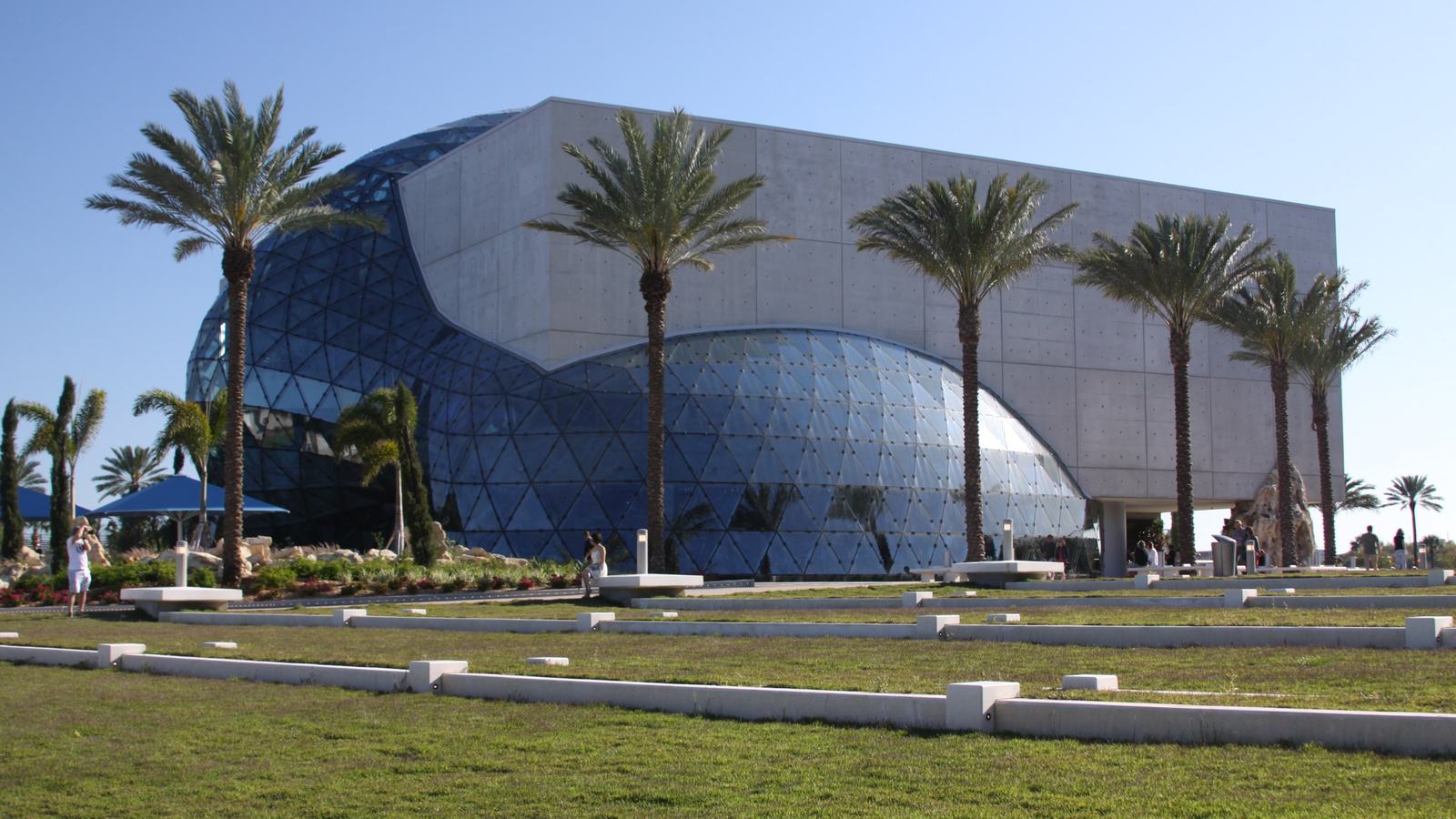
The institution’s published photography rules deserve equal attention. Personal photography may be permitted in some permanent galleries under specified conditions, while rules for special exhibitions are set for the particular display. Commercial and professional photography require separate permission. A visitor should not assume that an artwork or a gallery installation is free to reproduce simply because a phone photograph is technically possible. The hero photograph accompanying this article shows the museum building, not any loaned artwork or a scene from the 2026 exhibition.
For owners and guests moving around Florida by yacht, the sensible approach is to plan the museum day as a land-based appointment and then work backward to the vessel’s actual location and transport requirements. St. Petersburg is on Tampa Bay; a museum ticket alone tells us nothing about available berths, local pilotage or a charter yacht’s permissions. Those operational matters belong with the captain and local agents. Allowing enough time on shore also keeps a cultural visit from becoming an unrealistic dash between a marina and a gallery.
What makes this exhibition distinctive
The strongest feature of Disruption + Devotion is its refusal to set tradition and innovation in separate camps. Dalí’s paintings may appear unsettling, but his imaginative decisions become more legible when shown against the visual disciplines he admired. The historical loans make the claims tangible. The print suites extend them across the artist’s later career, while the catalogue offers a route into the scholarly debate after the museum visit.
For art-focused travellers, the exhibition deserves consideration as more than a seasonal diversion. Its combination of Old Master comparisons, Surrealist reinterpretations and overlooked works offers a programme that can reward both a first encounter with Dalí and a repeat visit by someone who knows his famous paintings. The official exhibition page and press release remain the authoritative sources for the promised content and dates; artwork loans, hours and visitor conditions can change, and should be checked close to travel.
Source information: The Dalí Museum’s 6 November press release; official exhibition details and tickets; and visitor information and photography rules. The archival exterior photograph is by Taty2007 / Wikimedia Commons, CC BY 3.0, taken in 2011 and resized for this page. It illustrates the venue, not the new exhibition.
