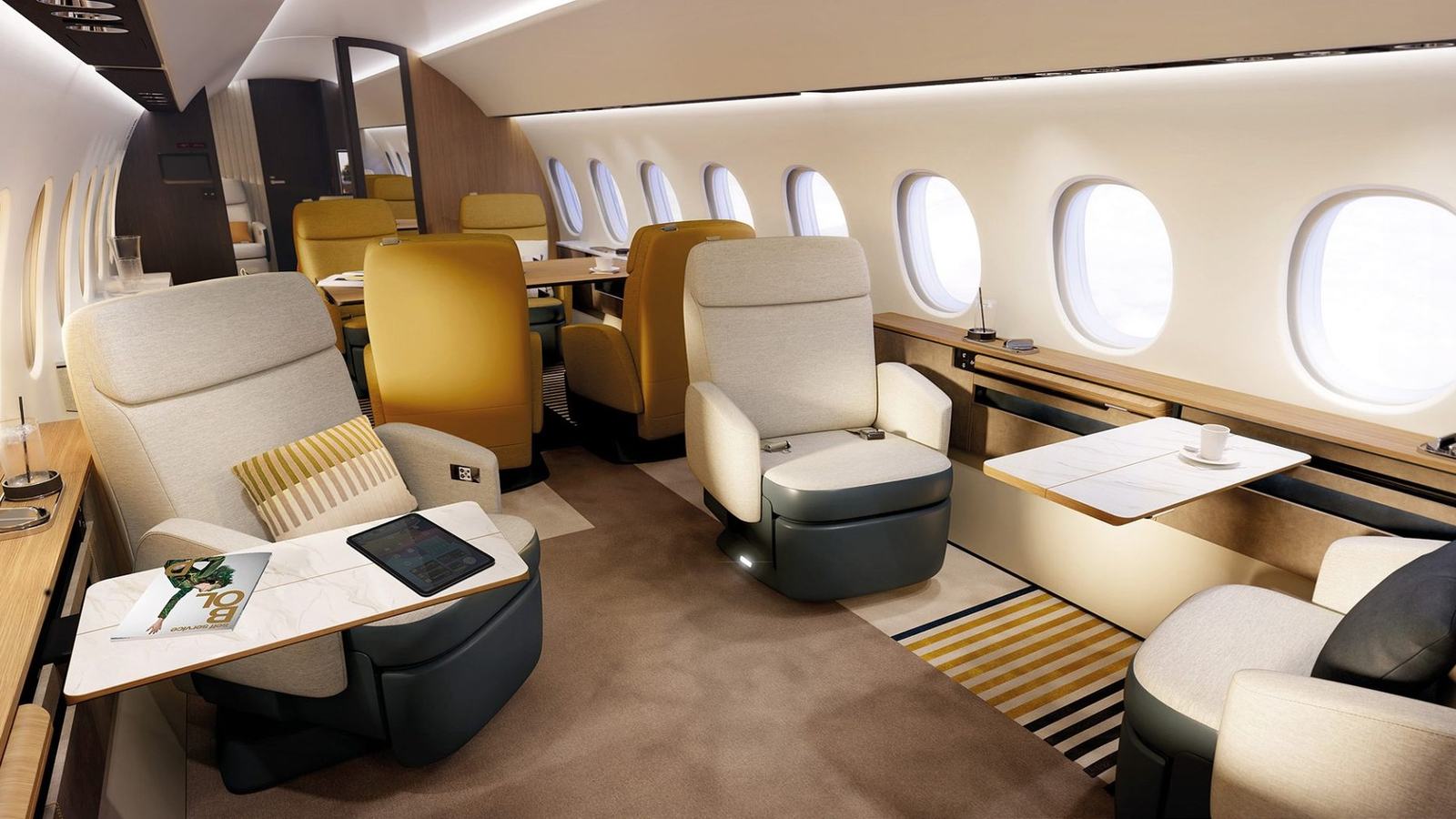
The Falcon 10X combines an unusually large purpose-built business-jet cabin with flexible living zones, extensive glazing and long-range capability. Its promise is as much about life on board as distance flown.
Beyond the idea of a comfortable seat
Long-range private aviation is increasingly discussed in terms of how passengers live, work and rest during a flight rather than how quickly an aircraft can reach a destination. Dassault's Falcon 10X makes that shift unusually visible. The manufacturer describes the largest cabin in a purpose-built business jet, with room for distinct activity zones that can be tailored to an owner's requirements. It is an ambitious design proposition and, as the programme proceeds through testing, prospective customers should distinguish published specifications from the experience of a delivered, operational aircraft.
For a superyacht owner, the analogy with a well-planned private residence is compelling. A long journey may involve a business conversation, dinner, sleep and a quiet period with family, all within the same pressurised space. A good interior enables these activities without making everyone occupy a single room. The result is not necessarily more elaborate decoration; it may be more privacy, better circulation and fewer compromises over how passengers use their time.
A cabin that changes the proportions
Dassault quotes an interior width of 2.77 metres, height of 2.03 metres and usable cabin length of approximately 16.4 metres. Those dimensions allow arrangements that are difficult in narrower business aircraft, including more spacious dining and meeting areas and separate resting zones. The company says its modular approach permits varying zone lengths rather than forcing owners into a small set of fixed room divisions. The appeal lies in specifying the aircraft around typical passenger behaviour rather than an abstract maximum seating count.
The key design decision is often how much space to devote to each function. An owner who regularly flies with colleagues may prefer a well-equipped conference setting; a family travelling overnight might value an enclosed bedroom and generous lounge. These choices affect storage, movement, privacy and the operational load on cabin crew. A mock-up visit and detailed review of layouts are essential before committing to any bespoke arrangement, because the best solution is highly personal.
Light and air shape the experience
The Falcon 10X uses 38 large windows, a feature Dassault connects to a brighter, more open cabin. Daylight can make a major difference to the perception of long journeys, especially when passengers move between work and relaxation. The manufacturer also emphasises acoustic control, cabin-air filtration, temperature regulation and a low cabin altitude as part of its approach to comfort. These are design intentions that should be assessed through verified specifications and, ultimately, real operational experience.
Environmental systems matter because even the most expensive seat becomes uncomfortable when lighting, noise or air quality is poorly managed. Different travellers prefer different temperatures and levels of privacy, while sleep quality can depend on the ability to reduce disturbance between zones. Owners should ask not only how a system is described but also how crew can operate it, what maintenance it requires and which settings passengers can control independently.
A private suite when the journey demands it
Dassault illustrates layouts including a secluded bedroom with a full-size bed, an expanded dining area and a dedicated entertainment space. The optional Privacy Suite is designed to serve several purposes, allowing a meeting by day or more isolated rest at night. Adaptable interiors are attractive precisely because the same aircraft may undertake very different flights within a week. The traveller's preferred balance of privacy and sociability can change with the passenger list and the time of day.
Flexibility is not without limits. Every cabin arrangement must meet aviation certification, safety, weight and equipment requirements, and not all ideas from a residential design studio can be transferred directly into an aircraft. Owners should work closely with specialist designers and flight operations teams when considering furnishings, emergency access and sleeping arrangements. The most elegant proposal is the one that preserves comfort while remaining practical for the people responsible for flying and maintaining the aircraft.
Range supports a new travel rhythm
The manufacturer publishes a 7,500-nautical-mile maximum range and a maximum operating Mach figure of .925 for the Falcon 10X. These figures describe capability under stated assumptions, not a guarantee that every passenger load, weather pattern or route can be flown nonstop. Operational planning depends on winds, reserves, airport performance and numerous other conditions. Still, such a platform can support a different rhythm for clients who regularly move between major international business centres, homes and yacht destinations.
An aircraft's interior becomes particularly important when the distance between places is measured in many hours. The ability to work privately and arrive better rested may be more valuable than marginal differences in schedule. Connectivity can also be part of that experience, and Dassault highlights high-speed Ka-band links and its FalconConnect service. Owners should evaluate service coverage, security, costs and fallback arrangements rather than assuming seamless communications are available everywhere at every moment.
An ambition still subject to real-world proof
Dassault announced the 10X's first flight in June 2026, starting the flight-test campaign. That milestone should not be mistaken for the aircraft's entry into widespread service. Certification, outfitting and delivery arrangements will determine when individual customers can use the platform. This distinction is essential for buyers planning future mobility around a yacht programme or fixed business commitments. Any anticipated delivery date should be verified directly with the manufacturer and an experienced aviation adviser.
The larger lesson extends beyond a single aircraft model. The most sophisticated private travel is designed around what the passenger wants to do en route: rest, think, work or share time with others. Dassault's Falcon 10X uses volume, glazing and flexible zones to make those possibilities tangible. It is an intriguing expression of the private-residence idea in aviation, and one whose ultimate success will depend on how gracefully the promised experience performs once aircraft are flying with their owners.
Editorial source: Dassault Falcon. This original leisure-boating feature is based on information from the named source; check current local navigation requirements and the equipment manufacturer before departure.
Source
Dassault Falcon