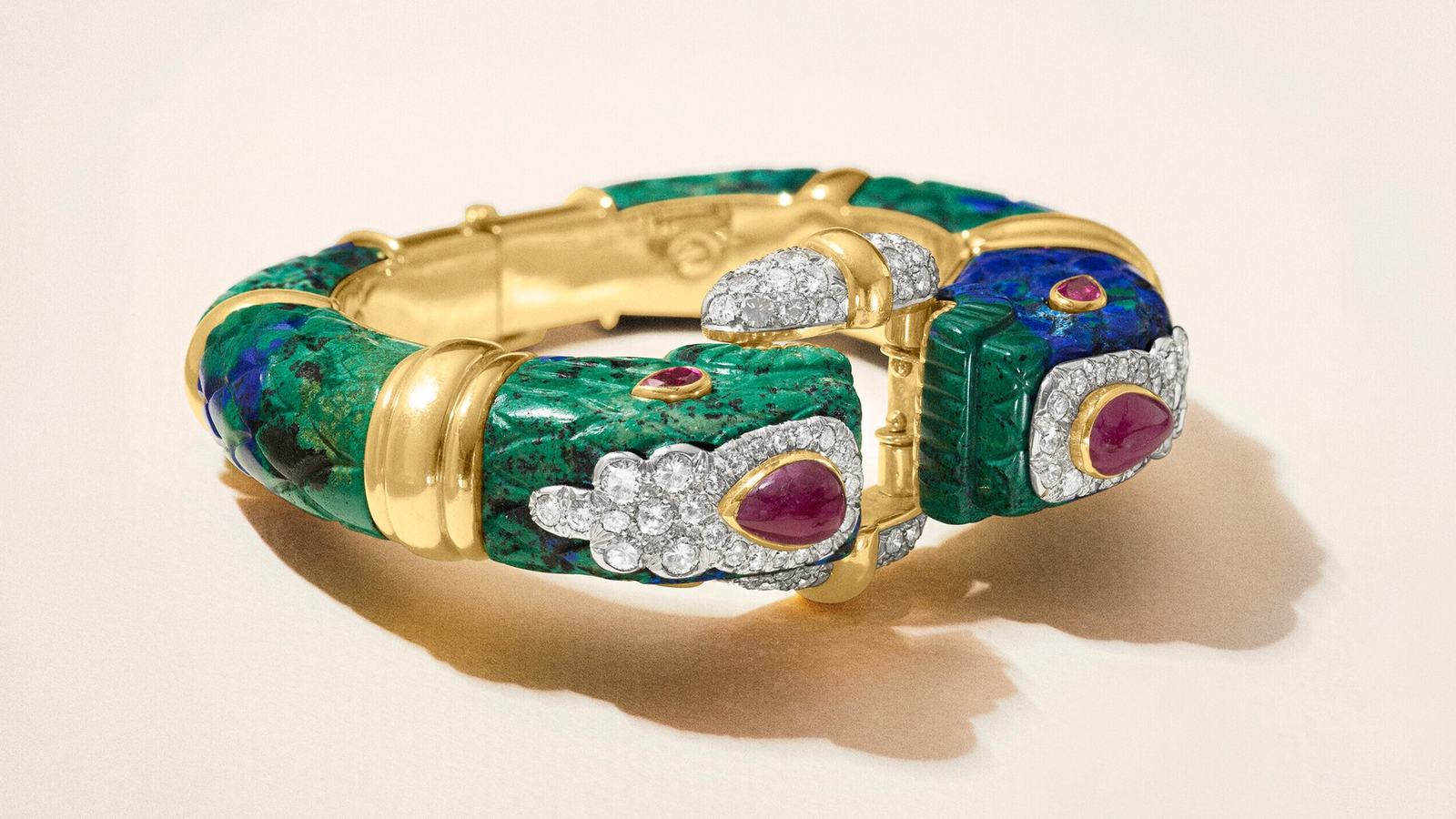
Christie’s updates its David Webb collecting guide during the October Jewels Online sale, tracing the American designer’s enamel animal jewellery, carved gold and distinctive gemstone colours.
David Webb jewels return to collectors’ attention
Christie’s has published an updated guide to the work of American jeweller David Webb as the auction house offers examples in its New York Jewels Online sale running from 6 to 15 October 2026. The editorial guide, dated 8 October, places the current lots in the context of a designer whose colourful animals, geometric enamel and richly worked gold established an unusually recognisable house style.
The timing matters for collectors because an online sale is still in progress, and some of the illustrated jewels are examples that bidders can examine in catalogue photographs before deciding whether to participate. The guide distinguishes between pieces currently being offered and earlier objects already sold, an important difference when comparing estimates with realised prices.
Webb’s reputation is attached to bold design rather than the discreet appearance of every piece. Animal bangles, strongly textured yellow gold, rock crystal and striking gemstone combinations help explain why collectors often recognise his work from across a room. That visual character also makes correct attribution and condition assessment particularly important.
From New York workshop to a jewellery house
Born in Asheville, North Carolina, in 1925, Webb learned elements of metalwork as an apprentice silversmith and moved to New York in pursuit of a design career. With support from socialite Antoinette Quilleret, he opened a business in 1945 and by 1948 had established David Webb Inc. in his own name.
His creations became popular during the 1950s and 1960s with figures including Elizabeth Taylor, Jacqueline Kennedy and fashion editor Diana Vreeland. Those associations are part of the house’s history, but they do not establish that any particular lot had a celebrity owner. Provenance must be documented for each piece rather than inferred from the famous people who once wore the brand.
Webb died in 1975, while the business and its design archive continued. Christie’s notes that more than 40,000 drawings and designs underpin the surviving archive, giving specialists a substantial body of reference material when considering shapes, settings and historic models. It also means collectors must distinguish an original period jewel from a later interpretation of a documented design.
Zebras, sculpted gold and coloured gemstones
The best-known David Webb animal motif is perhaps the zebra bangle, closely followed by frogs, cats and horses. Christie’s recalls that the designer’s first animal bracelet dates to 1957 and that his playful menagerie became an enduring part of the house’s identity. The same pieces that look exuberant can involve demanding metalwork and enamel techniques beneath the surface.
Textured eighteen-carat gold is another hallmark. Some pieces draw on ancient decorative traditions and use scroll forms, hammered surfaces or carefully modelled volumes to make the metal itself the focus. The new catalogue includes a diamond-and-gold necklace with a presale estimate of $20,000 to $30,000, demonstrating that collecting interest is not limited to the animal motifs.
Colourful gemstones extend the theme, with sapphires, emeralds, rubies and turquoise set against rich gold or enamel. Christie’s current guide shows Webb pieces at different estimate levels, such as a pair of diamond earrings guided at $12,000 to $18,000 and a leopard brooch carrying an $8,000 to $12,000 estimate. These are guide prices, not achieved sale figures or assurances of investment value.
What careful collectors should verify
Because Webb pieces can contain enamel, hardstone, elaborate articulations and varied gem settings, photographs alone are not enough to establish condition. A prospective buyer should review the auction house’s condition information and, where possible, examine a piece for chips, later repairs, replacement stones and excessive wear at hinges or closures.
Authenticity also calls for more than an attractive signature. A documented ownership history, relevant maker’s marks, construction quality and a specialist’s assessment should all contribute to a decision. For rare examples, comparison with archive designs may help, but even a close resemblance to a famous model does not prove date or originality.
On the collecting side, Webb demonstrates why design authorship can matter as much as gemstone size. A sculptural bracelet may be bought because its form is instantly identifiable, while a refined rock-crystal pair of earrings may appeal to someone seeking the same house in a quieter register. Both should be considered on their individual merits rather than on a claim that all vintage jewellery rises in price.
The current Christie’s material gives collectors an opportunity to compare the house’s historic development with the range of items being offered in October. Bidding remains subject to the published conditions of sale, buyer’s premium and other charges, and the final results will only be known when the online auction closes.