The 22nd Design Miami fair is scheduled for 1–6 December 2026, placing historical and contemporary furniture, lighting and objects under the curatorial theme Unveiling—an occasion with special relevance for owners commissioning yacht interiors.
A separate design fair in Miami Art Week
Design Miami will hold its 22nd edition from 1 to 6 December 2026 at Convention Center Drive and 19th Street in Miami Beach, according to its official fair information. This is a distinct event from Art Basel Miami Beach, with its own exhibitors, collecting disciplines, preview schedule and curatorial direction. Whereas a conventional fine-art fair may foreground painting and sculpture, Design Miami centres furniture, lighting and collectible objects that occupy the territory between functional design and cultural collecting. That difference makes the fair especially relevant to superyacht owners and designers who have to consider how an object will work within an inhabited interior.
The organisers have named Charlene Prempeh as the curatorial director and presented Unveiling as the 2026 theme. It proposes a focus on the stories, processes and cultural information embedded in designed objects. For a collector, that can lead to more interesting questions than simply whether a chair or lamp is fashionable. Who designed it, how was it made, how unusual is the form, what is its condition and what documentation accompanies it? Those same questions matter when a piece is proposed for a yacht, where presentation must coexist with security, maintenance, guest comfort and a highly controlled environment.
The official timetable makes room for several audiences
The first day, Tuesday 1 December, is scheduled for invited previews: a members' session from 11am to 1pm followed by a collectors' preview until 6pm. On Wednesday 2 December, an invitation-only VIP preview precedes public opening at 1pm. The organiser lists public hours on Wednesday until 7pm, Thursday through Saturday from 11am to 7pm and Sunday 6 December from 11am to 6pm. These are planned local-time hours and visitors should verify ticket access and any updates on the fair's official page before making reservations.
That structure matters for buyers who want to study a significant work without trying to make a fast decision in a crowded aisle. Preview access can provide a calmer first conversation with a gallery, while a later visit allows time to reassess proportions and materials. However, invitation status should not be confused with a guarantee that any particular object remains available. Collectible design can be sold, reserved or withdrawn, and special commissions may follow separate timelines. A disciplined buyer establishes the identity, availability and terms of a work directly with its seller before arranging transport or announcing a placement.
Historical furniture and new work require different questions
The fair's 2026 gallery information describes presentations of historic and contemporary design, including furniture, ceramics, lighting and other objects. It identifies, among others, Adrian Sassoon's display of ceramics and sculpture, and ESPASSO's presentation of works associated with Lina Bo Bardi and the SESC Pompeia project. These are examples from the official list, not a complete account of every exhibitor or a claim that individual pieces will remain for sale throughout the week. Their presence points to the range between decorative art, experimental contemporary work and design with a documented architectural context.
A historical piece may require provenance research, condition documentation and consideration of previous restoration. A newly commissioned work may instead involve questions about edition size, production capacity, artist involvement and installation tolerances. Both are legitimate forms of collecting, but the evidence supporting their value is not identical. For yacht owners, the distinction is heightened by the requirements of onboard life. A museum-quality chair may be unsuitable for everyday use at sea, while a robust bespoke interpretation may deliver the intended aesthetic without risking an irreplaceable original. The appropriate answer depends on the object and its intended role.
A yacht interior is not a conventional gallery
Collectible furniture can transform a yacht's main saloon, owner's study or private dining room, but onboard installation raises engineering and preservation questions. Vessel movement, vibration, humidity, sunlight and evacuation routes all affect what can be safely displayed. Even an object that fits a room may not satisfy fire or fastening requirements, and a glass or stone surface can have very different consequences when a ship heels. The designer, captain and shipyard or refit contractor must assess those issues before a purchase is treated as ready for installation. The fact that a work is admired at a design fair does not establish marine suitability.
There is a second, less obvious problem: objects are often selected from photographs without sufficient attention to human scale. A table may be wonderful from an exhibition viewpoint but obstruct passage on a deck; a sculptural lamp may have a fragile arm positioned where guests naturally walk. Measurements, weight, fixing methods and maintenance access should be obtained from the gallery. Where an installation is complex, full-size mock-ups and technical drawings may be justified. This approach protects both the artwork and the onboard experience, allowing a meaningful design statement to survive real use rather than becoming an expensive object that crew must continually work around.
Provenance and authenticity should accompany enthusiasm
The strongest design purchases are supported by more than an attractive label. Buyers should request the object's maker, date, material description, edition information if relevant, condition and restoration history. With historical furniture, documented provenance and a clear explanation of attributions may be especially important. For work by a living studio, the gallery may be able to supply certificates or production records. Such documents do not eliminate every uncertainty, but they make it easier to understand precisely what is being acquired. This matters for a yacht owner who may eventually transfer the work to another residence or offer it for resale.
Condition also influences handling. An object made from delicate veneers, unusual patinated metals or historically important textiles may require conservation treatment incompatible with routine yacht cleaning products. A gallery should be asked for written care guidance before the piece is placed on board. Owners may need to coordinate the work with specialist insurance and an inventory that records its condition on installation. A purchase that includes the necessary documentation can be enjoyed more confidently; one based only on atmosphere and an oral assurance leaves later custodians with avoidable uncertainty.
Craft and materials offer a more substantive luxury conversation
The Unveiling theme provides an opportunity to examine the labour and technique behind a finished object. At the luxury end of design, an unfamiliar material treatment can be more meaningful than overt rarity, especially when its making can be explained and documented. Yacht interiors frequently rely on specialised craft, from complex timber joinery to metalwork and upholstery. A collecting fair may therefore introduce owners to makers whose approach to material and proportion could influence future commissions. Such an encounter is a starting point for a proper design brief, rather than evidence that a displayed work can simply be enlarged and installed aboard a yacht.
Good commissioning also respects intellectual property and artist intent. A designer's style should not be copied into a yacht interior without permission merely because a work was seen publicly. Equally, scaling an object can alter structural behaviour, lighting quality and the character that made the original compelling. The right conversation involves the artist or authorised gallery, the yacht's interior design team and the yard's technical specialists. It may lead to an original commission, a carefully selected existing piece or the decision that the work belongs ashore. All three outcomes can be sensible for a serious collector.
Miami's broader cultural week should be planned deliberately
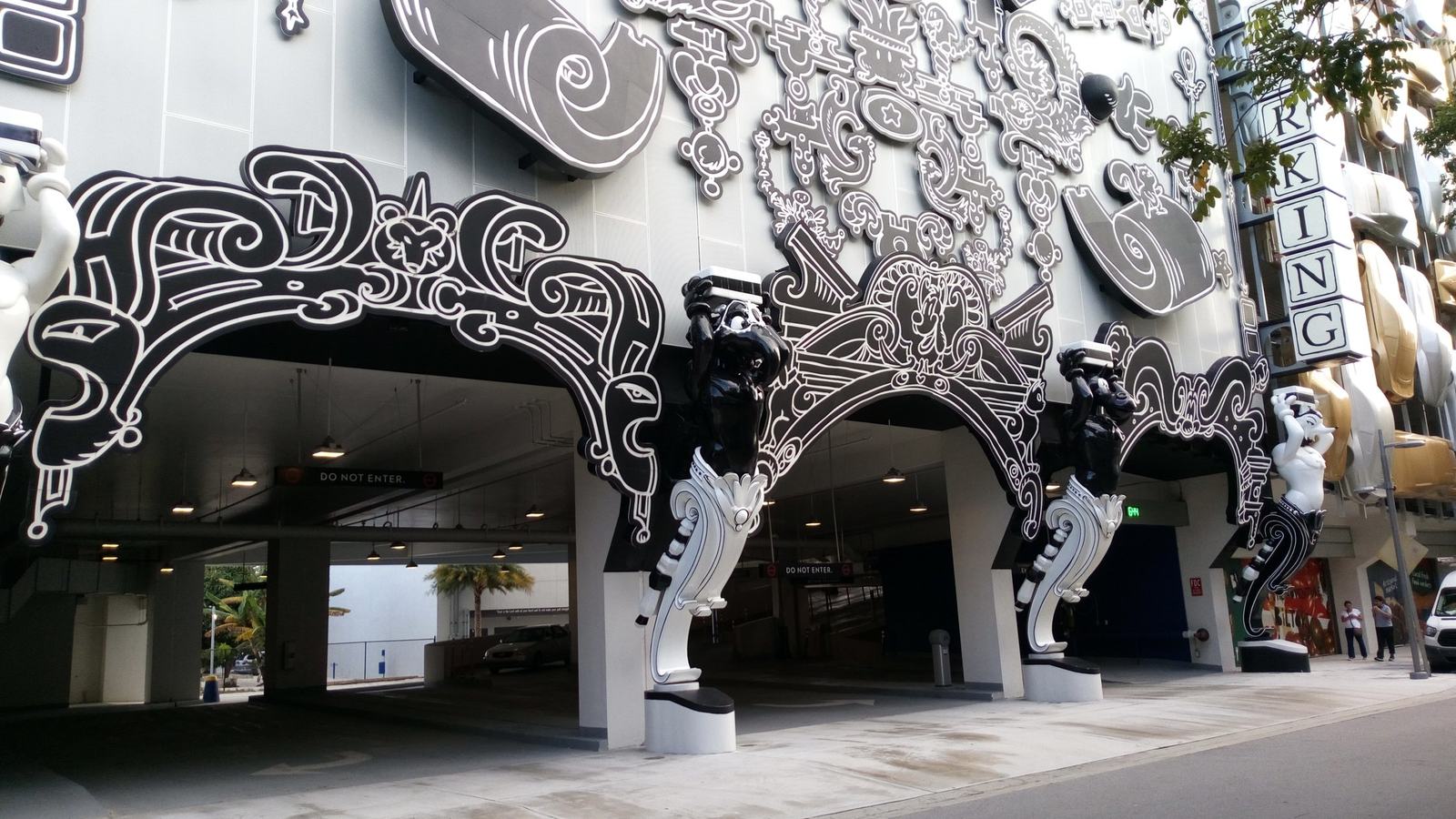
Design Miami takes place during an unusually busy period in Miami Beach and the surrounding city. Art, architecture and hospitality events can compete for the same guests' time, so it helps to distinguish the design fair's actual opening dates from those of other exhibitions. The official venue is listed at Convention Center Drive and 19th Street. The archival photograph accompanying this article shows the wider Miami Design District, not the fair venue or an installation from the 2026 edition; it is included only to illustrate the city's design context. Visiting collectors should not infer the location of the fair from that photograph.
For guests staying on a yacht, the visit also raises straightforward logistics: arrange a road transfer, allocate time for admission and schedule appointments with priority galleries. Moving through Miami during a major cultural week can be slower than mileage alone suggests. Owners who are genuinely considering a purchase should use a quiet second visit to examine condition and clarify terms, rather than trying to complete substantial acquisitions during a crowded social itinerary. Transporting an object from the fair to a berth is a separate undertaking requiring the seller's handling instructions and, if applicable, specialist shippers.
The best acquisition begins with a defined use
As of 7 November, the 2026 fair is still forthcoming. Its official website confirms the edition, theme, preview and public schedule, location and examples of participating galleries. Individual pieces may change before opening, and their availability, authenticity or valuation cannot be certified from an event announcement. The relevant next step for an owner is to decide whether the visit is principally about discovery, acquiring an established historical piece or developing a commission for a future yacht project. Each objective leads to different questions and different professional advice.
The appeal of Design Miami is that function and collecting are not neatly separated. A beautiful object may have daily use, or it may be preserved as a cultural work. On a superyacht, that distinction must be made consciously because the setting is both luxurious and mechanically demanding. The fair creates an opportunity to meet the makers and specialists who can explain those choices. The strongest result is rarely an impulse purchase. It is an informed decision in which aesthetic pleasure, history, craftsmanship, conservation and the reality of life at sea are considered together.
Primary documentation: Design Miami; additional first-party details: official programme or catalogue. Report dated 7 November 2026. Future event schedules, sale catalogues, berthing availability and advertised conditions may change. No future event outcome or auction sale result has been assumed.
Editorial illustration: File:Miami Design District, Miami, US (2).jpg — Miami Design District public artwork, 2021 — Jess Hawsor / Wikimedia Commons, CC BY-SA 4.0, resized; illustrative district scene, not the 2026 Design Miami fair. Original author and source credited under Creative Commons licence; cropped/resized for this article. This is a historical or locality photograph, not a depiction of the forthcoming event, current sales lots or event attendees. For share-alike images the adapted image remains under the original compatible CC BY-SA licence.

Source
Design Miami