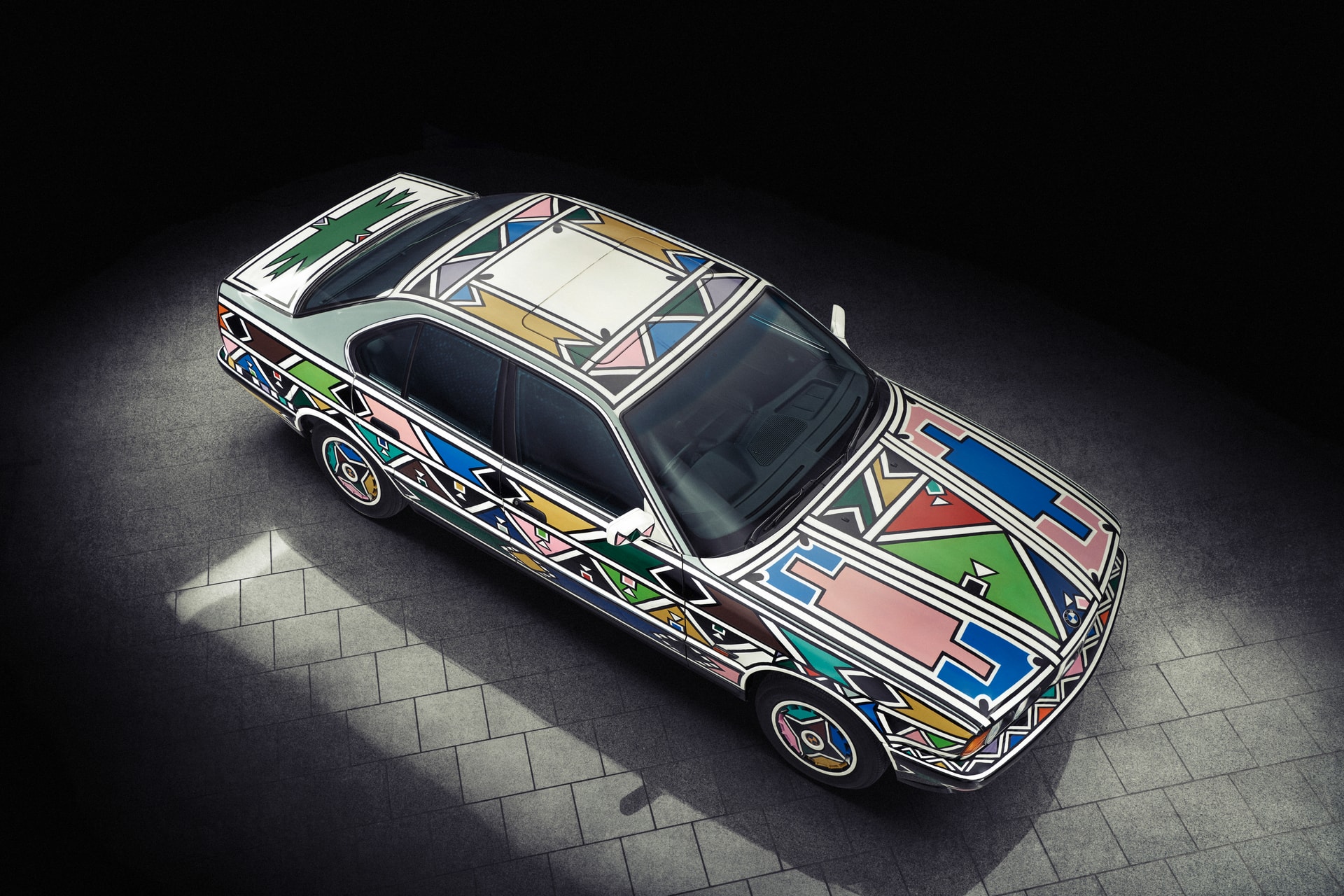
A new digital retrospective celebrates Esther Mahlangu's artistic career, including the 1991 BMW Art Car and subsequent luxury automotive collaborations.
A new online retrospective devoted to South African artist Esther Mahlangu opened on 11 November 2026, the occasion of her 91st birthday. Developed by Google Arts & Culture in cooperation with six cultural institutions, the project brings together more than 45 individual stories examining her work, personal history and artistic legacy. Among its subjects is the BMW 525i she painted in 1991, a significant commission in the history of BMW's Art Car collection. The manufacturer's official announcement describes newly accessible archival material, including photographs and accounts relating to the creation of that vehicle.
For collectors of contemporary art and important motor cars, the project offers a chance to consider an object that occupies both fields without belonging entirely to either. The car was created for exhibition and, according to BMW, has never been driven on a public road or in competition. Its significance is therefore fundamentally different from that of a racing vehicle whose provenance is established through its competition history.
The retrospective also explores the development of Mahlangu's practice beyond this single commission. Its digital format allows audiences to encounter aspects of the wider collection, examine images and learn about the circumstances in which her work developed without being physically present at an exhibition. The announcement does not concern the sale of the 525i or any change in ownership of the Art Car.
Painting a vehicle rather than enclosing a canvas
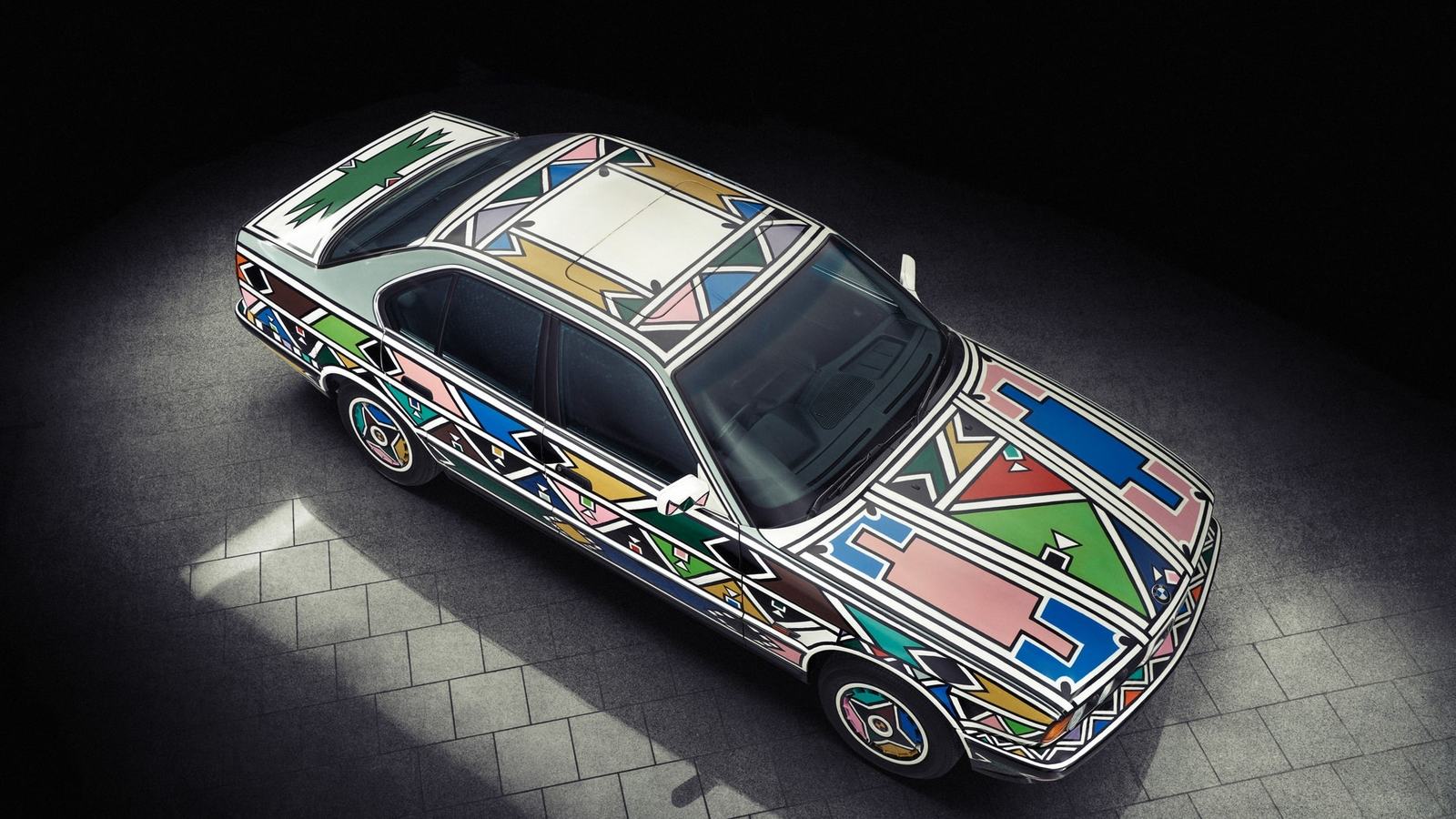
Mahlangu was the first woman and the first African artist to contribute to BMW's Art Car collection. In 1991 she brought the geometric vocabulary associated with Ndebele mural painting to the exterior of a BMW 525i, completing the commission within a week, according to the manufacturer's retrospective account.
The change of material and form is important. A painted wall provides a relatively continuous architectural surface. A car introduces windows, doors, wheel arches and complex changes of curvature. An artist working with such an object must consider the movement of the observer around it and the way a set of forms will be interrupted by functional elements of the vehicle. Patterns that appear continuous when viewed from one position may be read quite differently from another.
The car thus provides a particularly interesting example of an artist adapting an established practice to an unfamiliar physical medium. The vehicle's existing architecture becomes a component of the work rather than simply a support that disappears behind the painted surface.
The historical context of the Art Car collection
BMW's collection began in 1975 when racing driver and auctioneer Hervé Poulain sought a collaboration with Alexander Calder for a BMW 3.0 CSL associated with the 24 Hours of Le Mans. The programme subsequently attracted artists working in diverse disciplines. BMW identifies twenty vehicles in the collection, with contributors including Roy Lichtenstein, Andy Warhol and Julie Mehretu.
The collection is not a single automotive design series in the usual commercial sense. Individual cars reflect different artistic approaches, and some have a connection with racing while others were developed as exhibition objects. That distinction matters when examining Mahlangu's contribution. Her commission was not a decorative livery subsequently subjected to competition and repairs. Its role has been that of an artwork travelling between cultural settings.
For an audience familiar with the market for historic vehicles, the programme demonstrates how an automobile can acquire a cultural identity that is independent of its conventional specifications. Engine output, performance and production rarity do not adequately describe the importance of such an object. The circumstances of its commission, the artistic contribution and its subsequent exhibition history require separate consideration.
From the exterior to the private interior
Mahlangu's collaboration with BMW did not end with the 525i. In 2016 she painted wood trim for a BMW Individual 7 Series, a project presented at Frieze London and later auctioned for charity. The application involved a much smaller area and introduced the work into the space occupied by passengers.
The manufacturer's account also identifies the 2020 Rolls-Royce commission known as The Mahlangu Phantom. The artist created a work for the Phantom's Gallery, the display area incorporated into the dashboard. These projects show how the relationship between an artist and an automotive manufacturer can take different forms: exterior treatment, interior craft and an individual artwork placed within a purpose-built display space.
These distinctions are equally relevant to clients commissioning art for private residences or superyachts. Integrating a work into a finished interior is not the same as hanging an independently produced picture. The artist, designers and technical specialists may need to agree how the material will be supported, protected and maintained. Such requirements should be established for the actual commission rather than inferred from an example in a different environment.
A growing archive of cultural material
The new retrospective incorporates more than 700 archival images and over 100 high-resolution images of artworks, according to BMW's announcement. It also contains curated exhibition material and virtual visits, including access to aspects of the artist's 2024 exhibition at the Iziko South African National Gallery.
The breadth of the material makes the programme particularly useful to people who have previously encountered Mahlangu's work only through the Art Car. Photographs and exhibition records place individual objects within the development of an artistic career. They can also help an audience distinguish the artist's work from designs that merely resemble its visual vocabulary.
For collectors who are considering an acquisition, online archives can assist preliminary research into exhibition history, documented commissions and related works. They do not replace examination of an individual object's condition or proof of provenance. Similarity of appearance is not evidence of authorship. A prospective purchaser still needs to establish the identity, ownership history and documentation of the particular work through the appropriate gallery or independent specialist.
Reconstructing memories with new technologies
One unusual element of the digital retrospective concerns periods of Mahlangu's childhood before the surviving photographic archive. The collaborators used interviews and archival research to develop visual reconstructions, subsequently employing generative video technology to animate some of the images.
The resulting sequences should be understood as artistic and technological interpretations of remembered experiences. They are not surviving film recordings of the events they portray. The distinction is especially important where the generated images have the visual characteristics of documentary footage.
A digital exhibition can place these reconstructed scenes alongside authentic photographs, contemporary interviews and existing works. Each type of material contributes something different. Clear presentation of its origin helps visitors understand which elements are direct records, which represent recollection and which have been produced to communicate that recollection through a new medium.
For an archive intended to remain accessible over time, retaining those distinctions is as important as preserving the visual material itself. The value of the reconstruction lies in its capacity to introduce audiences to aspects of a personal history that were not otherwise photographed, not in creating the appearance of historical evidence that does not exist.
Technology and the changing surface
BMW describes further collaborations involving animated projections and electronic displays. In 2023 its Electric AI Canvas project employed generated animations based on Mahlangu's designs, while the 2024 BMW i5 NOSTOKANA used colour-changing electronic ink to present moving compositions across the surface of a vehicle.
The development introduces a different relationship between a design and its supporting object. A painted surface retains the physical arrangement determined at the time of its creation. A changing electronic surface allows multiple compositions to appear in succession. The artist's involvement, the systems controlling those changes and the circumstances of presentation all become part of the process.
It is therefore useful to distinguish a work created directly by an artist from a technical system that presents variations based on an artist's designs. The objects may be connected through the same collaboration while remaining different in their material characteristics and their documentation.
Visiting the exhibition from anywhere
The digital retrospective is available through Google Arts & Culture. Its online format offers an opportunity to examine the collections and interpretative material before visiting a museum, gallery or motoring exhibition in person. Visitors interested in the artist's primary work should also consult the participating cultural institutions and the gallery responsible for representing her work.
Looking ahead to the 2027 programme
BMW has indicated that further projects involving Mahlangu's 1991 Art Car are planned for 2027, without providing a complete calendar in the November announcement. Those future activities should therefore be distinguished from the retrospective that is already accessible.
The immediate significance of the November project is its ability to bring together artistic and automotive material that would otherwise be encountered in several different locations. It places the celebrated 525i in the context of Mahlangu's wider career and provides a sustained opportunity to consider how her work has moved between public architecture, vehicles, private interiors and digital media. For both art specialists and automotive collectors, that broader context is the principal attraction of the new exhibition.
Primary source: BMW Group official announcement, 11 November 2026.
Further official information: Google Arts & Culture Esther Mahlangu retrospective.
Photo: BMW Group, official press image of Esther Mahlangu's 1991 BMW Art Car accompanying the 11 November 2026 retrospective release. Official source.