Elemental Essence at Art Athina brings architecture, scent and film into an exhibition exploring the Athenian Riviera and Mykonos, on display 12–16 November 2026.
Two Greek coastlines become an art installation
Four Seasons Astir Palace Hotel Athens and Four Seasons Hotel Mykonos are participating in Art Athina 2026 with Elemental Essence, an exhibition designed to express the different landscapes and design histories of their properties. The installation is scheduled for November 12 to 16 at Onassis Ready in Athens. Rather than display photographs of hotel rooms, the project brings together sculpture, scent, moving images and archives. It is the Greek hotel collection’s first participation in the contemporary art fair.
For collectors and travellers who care about architecture, the intriguing proposition is to experience familiar destinations through unexpected media. A scent may recall a pine forest more immediately than a landscape photograph, while an archive can explain why a modern building takes its particular form. The exhibition’s success will depend on the work itself, however. Visitors should not mistake a promotional collaboration for an assessment of every artist’s practice or the fair’s wider programme.
Empedocles supplies a conceptual framework
Curator Claudia Paetzold has shaped the experience around earth, water, air and fire, the classical elements associated with the Greek philosopher Empedocles. Two adjoining areas interpret these themes through the contrasting settings of Vouliagmeni and Mykonos. The premise gives the exhibition a simple organising principle without requiring guests to know the history of philosophy before entering. Materials, scents and images are meant to communicate relationships between built spaces and the natural environments around them.
Ancient ideas are often borrowed by contemporary brands, but the interesting question is what an artist does with them. Here the four elements do not describe physical properties in a scientific sense; they create a vocabulary for atmosphere and memory. A viewer might connect earth to material and planting, or air to movement and sea breeze. Visitors should allow their own responses to develop instead of searching for one correct interpretation of each gallery space.
Sissel Tolaas makes smell part of the encounter
Norwegian artist and chemist Sissel Tolaas, internationally known for using smell as an artistic medium, undertook research visits to the two Greek properties. Four Seasons says she has created compositions intended to communicate their contrasting environmental character. This transforms scent from the incidental background of a hotel into a deliberate component of contemporary art. The audience may find that smell evokes memories and impressions that are more personal than those generated by a conventional visual display.
Scent-based work can be remarkably direct, but it also requires care. Some visitors may be sensitive to fragrance, while others perceive the same composition differently. A gallery should make access and information available to those who wish to avoid a strongly scented area. Collectors interested in the work should ask about editioning, preservation and the rights associated with any acquisition. The description of an installation does not establish that any particular work is for sale.
A modernist history on the Athenian Riviera
Astir Palace began its life in 1960 on a wooded peninsula at Vouliagmeni as Greek modernism reshaped ideas of leisure architecture. The current Four Seasons release names Emmanouil Vourekas, Periklis Sakellarios, Prokopis Vasileiadis and Konstantinos Dekavallas among figures connected with its development. Archival images and references to the buildings’ evolution form part of the Athens section. This is an unusually substantive way for a hospitality property to present its history without limiting the story to a list of present-day amenities.
The site’s architectural value lies in decisions about orientation, landscape, circulation and the relationship of interior rooms to the sea. These questions remain relevant to contemporary yacht owners commissioning waterfront property or evaluating design. Archival photographs should be read in their historical context rather than treated as proof that every earlier structure survives unchanged. A collector or researcher interested in the material may want to follow up with independent architectural archives.
Mykonos through film and translucent layers
The Mykonos component uses moving imagery by Australian cinematographer Matthew Thorne alongside suspended translucent fabrics and scent. The release credits Greek architect Nikos Valsamakis with the design approach for Four Seasons Hotel Mykonos, whose white forms follow the hillside above Kalo Livadi Bay. Landscape work by Helli Pangalou uses planting and pathways to mediate between architecture and island terrain. At the art fair, these elements are presented as ideas visitors can experience without leaving Athens.
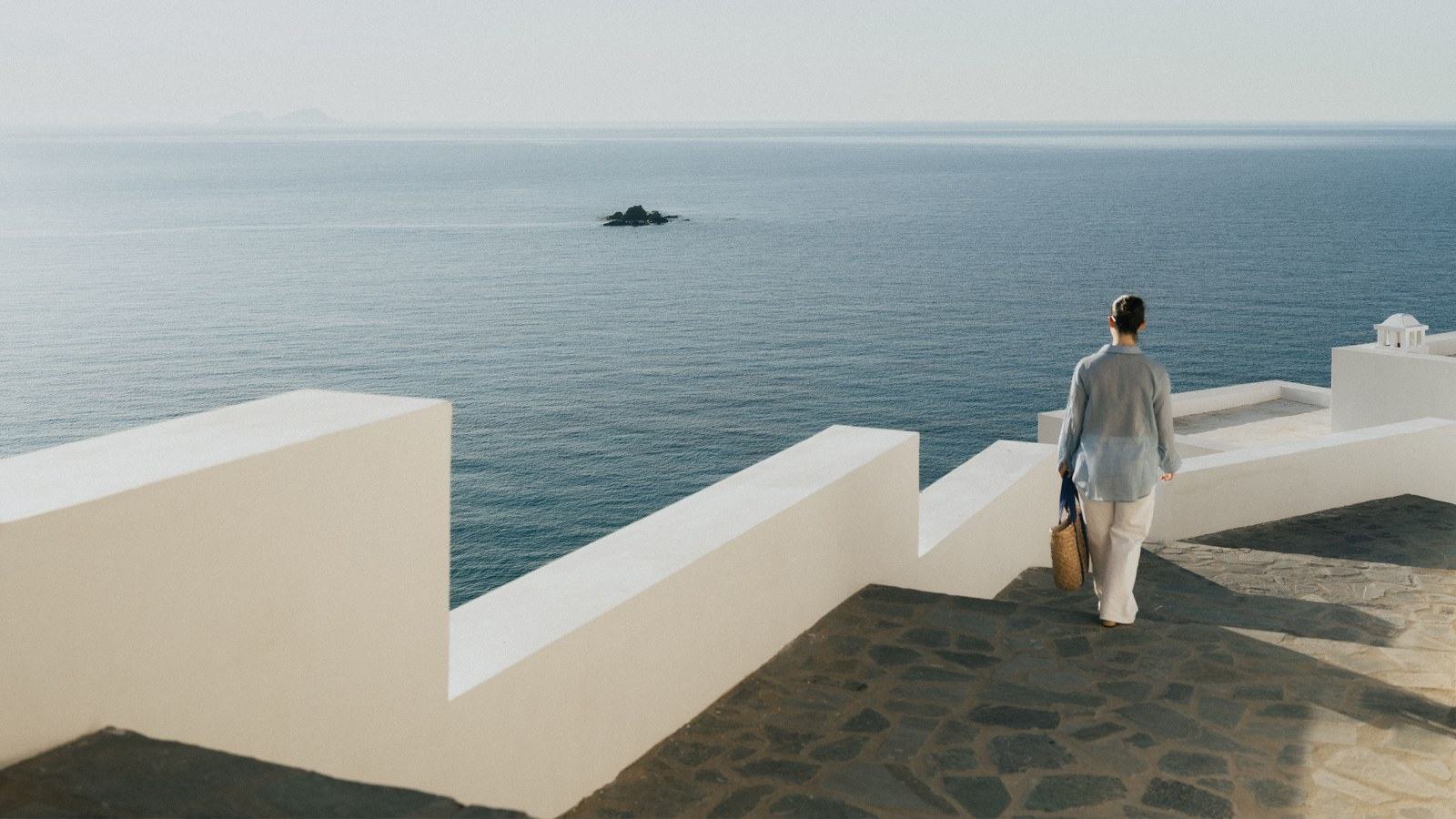
Film can reveal light and the passage of time in ways a still picture cannot, especially where architecture sits in a coastal environment. The challenge is to preserve the integrity of the artwork rather than turn it into a room advertisement. Visitors may wish to compare the installation with photographs and plans of the actual property, then consider what is gained or lost in translation. The accompanying photograph here depicts the resort, not the gallery installation.
A useful encounter for design-minded travellers
The exhibition is one part of Art Athina, a fair that has brought together galleries, collectors and cultural institutions since the early 1990s. Visitors may combine Elemental Essence with independent presentations across the event, giving the hotel collaboration a place within a broader creative programme. The organisers describe the venue as Onassis Ready. Before arranging a visit, guests should check the specific location, opening hours and whether exhibition access follows the main fair’s ticketing structure.
For a traveller choosing between a resort excursion and an art-focused city day, the Athens installation offers a compact window into the design narratives of two coastal locations. It may be especially valuable for people commissioning interiors or collecting moving-image work, although no purchase opportunity has been promised. A thoughtful itinerary should include time for nearby galleries or architecture beyond the commercial hospitality setting, allowing the city’s cultural life to remain central.
How architecture, nature and art meet
The Four Seasons initiative connects natural materials, scent, archival documentation and cinematic images within a single environment. Its stated ambition is to make the character of the Athenian Riviera and Mykonos perceptible in a different way. That approach highlights how luxury design can be more meaningful when it responds to a place rather than applying the same palette and furnishing language everywhere. There is an important distinction between a design claim and how a visitor actually experiences the finished space.
Visitors can test the project by asking which impressions remain after leaving the exhibition. Does the scent suggest pine, salt air or another association? Do the archives explain the original architects’ choices? Does the film provide an atmosphere impossible to capture in a brochure? These are useful questions for collectors as well as hotel guests, because they treat art as something to engage with rather than a decorative accessory.
Five days in November
The dates confirmed in the official announcement are November 12 to 16, 2026. The participating hotels are Four Seasons Astir Palace Hotel Athens and Four Seasons Hotel Mykonos, but the exhibition takes place in Athens. A stay at either property should not be assumed to include admission or transport. Travellers should verify the fair’s visitor arrangements and any available guided explanation directly with the organisers before purchasing flights or scheduling a private viewing.
Elemental Essence is notable for the named artists, defined curator and specific materials rather than a vague claim to cultural engagement. It will be most rewarding for visitors who also explore the rest of Art Athina and the architectural history from which the project draws. The hotel group’s release establishes the intended installation, not the long-term ownership of works or whether the presentation will tour. Those questions remain open until confirmed by the relevant galleries and artists.
Primary source: official operator release. Information reflects announcements reviewed 31 October 2026; check current terms directly.
Event calendar: Elemental Essence Exhibition at Art Athina 2026.