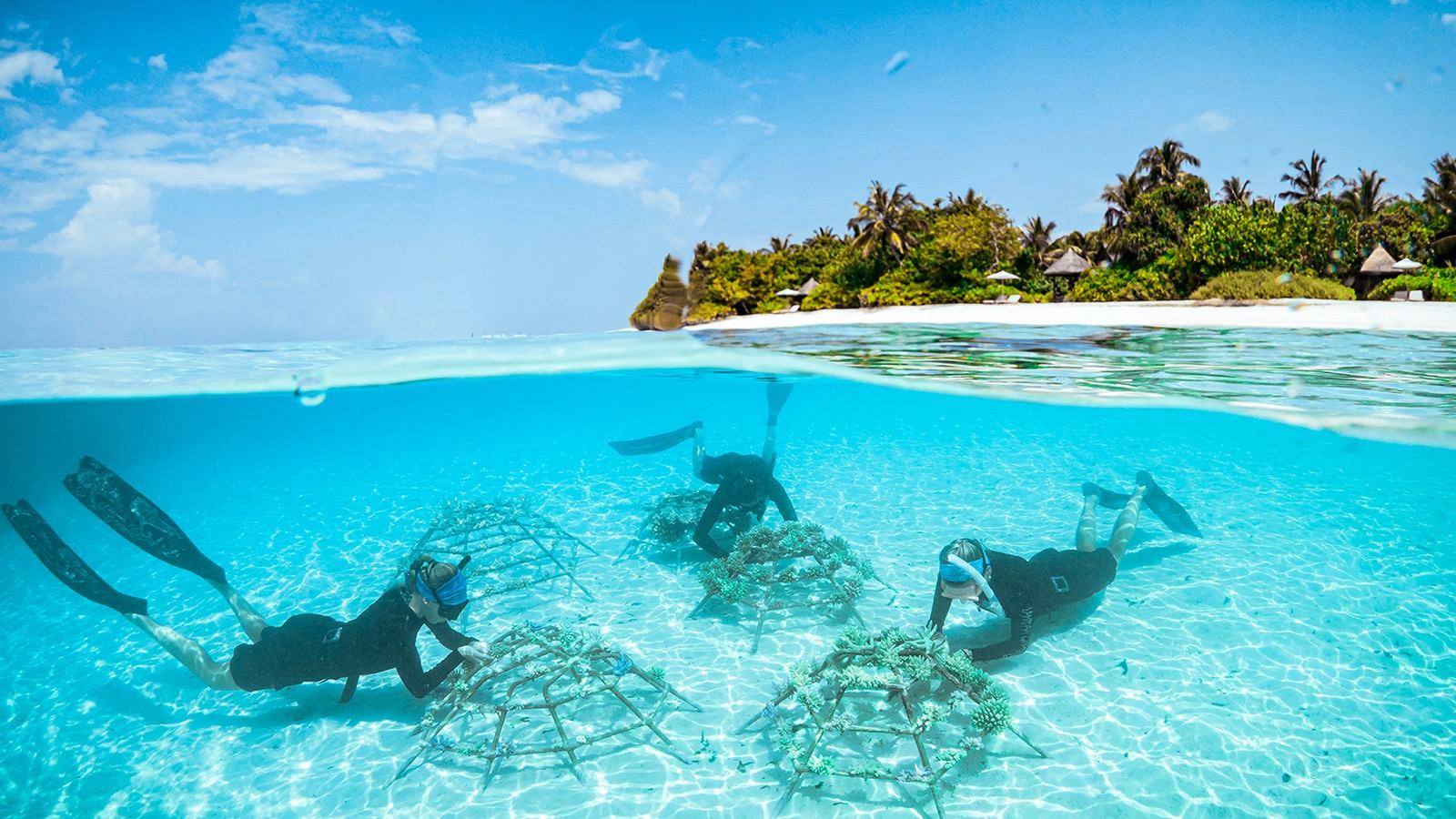
Four Seasons Resorts Maldives wins the HICAP 2026 biodiversity education award, recognising programmes in coral recovery, turtle rehabilitation and marine science.
Four Seasons Resorts Maldives has been recognised in the Biodiversity Action & Education category of the 2026 HICAP Sustainable Hotel Awards. The announcement on 13 October focuses on long-running conservation and training programmes at Kuda Huraa and Landaa Giraavaru, where marine science is combined with practical work for guests and local communities.
For superyacht owners visiting the Indian Ocean, the result provides a different perspective on a destination usually presented through private villas and luminous lagoons. Coral restoration, turtle rehabilitation and marine education involve sustained effort and measurement, rather than a brief excursion arranged for a visitor's entertainment.
Two resorts with a long scientific history
The award recognises conservation activity at Kuda Huraa, which opened in 1998, and Landaa Giraavaru, which opened in 2006. Four Seasons says that its marine programmes combine practical action with research and opportunities for Maldivian students to learn alongside specialists.
A conservation award means more when the underlying efforts persist beyond a single season. Continuous monitoring, the skills of the people involved and the ability to adapt methods after difficult environmental events are more useful indicators than the number of holiday visitors photographed beside a reef project.
The scale of coral restoration
The Reefscapers partnership began in 2001 and now encompasses more than 9,000 coral frames, according to the resorts. Monitoring and AI-assisted research help teams understand survival rates and choose restoration methods as environmental pressure on the reefs increases.
Frame numbers alone cannot establish that an ecosystem has fully recovered. Restored coral must survive warming events and disease, develop habitat functions and ideally reproduce, which is why the operator's observations of natural reproduction on mature frames are important to the story.
Responding to bleaching
Four Seasons reports that around 28,000 corals were relocated to deeper and cooler water during the 2024 bleaching event. That large intervention demonstrates the work required when restoration programmes face extreme environmental conditions instead of the idealised clear-water scenery visitors associate with tropical holidays.
The programme has also developed techniques involving reproductive material collected from wild corals, controlled fertilisation and larval settlement. The purpose is to help restore populations with greater diversity, although no single intervention can remove the wider stresses affecting reefs throughout the Indian Ocean.
Turtles affected by ghost fishing nets
Turtle Rehabilitation Centres at the two resorts have cared for more than 500 sea turtles and released more than 280, according to Four Seasons. Many animals arrive injured after becoming entangled in abandoned fishing gear carried by ocean currents, an issue that can originate far from the place where a turtle is found.
For yachts operating in tropical waters, the wider lesson concerns responsible waste handling and the effects of lost gear. Wildlife encounters should respect guidance from conservation teams, and visitors must not assume that a rescue centre is a venue for uncontrolled contact with animals undergoing treatment.
Research in Baa Atoll
At Landaa Giraavaru, scientists working with The Manta Trust study reef manta rays and the ecosystems on which they depend. Four Seasons links this scientific history with Baa Atoll's designation as a UNESCO World Biosphere Reserve in 2011, an important marker of the area's global ecological significance.
An itinerary involving manta encounters should be planned within local rules and established observation practices. The presence of a famous marine species does not justify approaching animals excessively closely, crowding them with tenders or entering sensitive sites without appropriate local guidance.
Education for young Maldivians
The Baa Atoll Marine Biology Internship Programme has offered a staged introduction to marine science since 2023. Four Seasons also reports that its government-accredited apprenticeship programme has produced more than a thousand Maldivian graduates since 2001 across fourteen pathways, including marine conservation.
A further four-year marine and environmental science apprenticeship, developed with Maldives National University, combines academic study with fieldwork at the resorts. Building local expertise can help conservation efforts endure by connecting research with professional opportunities for people who live among the islands year-round.
What guests can learn
The resorts operate Marine Discovery Centres where visitors can encounter information about reef restoration and wildlife work. Participation in practical activities depends on the programme available at the time, and a hotel booking should not be treated as automatic permission to assist on sensitive research sites.
For wealthy travellers, engaging responsibly can mean making time for a briefing, choosing qualified marine guides and understanding why some activities or locations are restricted. That approach can make an Indian Ocean cruise more rewarding without confusing access to a luxury resort with ownership of the surrounding natural environment.
The award and its limits
HICAP's Biodiversity Action & Education recognition considers conservation and learning activities capable of informing practice elsewhere. The Maldives result therefore represents work accumulated over many years, rather than a new project begun in October or a claim that all local environmental challenges are resolved.
Four Seasons announced the 2026 award on 13 October. Its published measurements provide substance for a report, but travellers should seek current programme information and follow local marine protection requirements when arranging resort visits, diving or yacht activities.