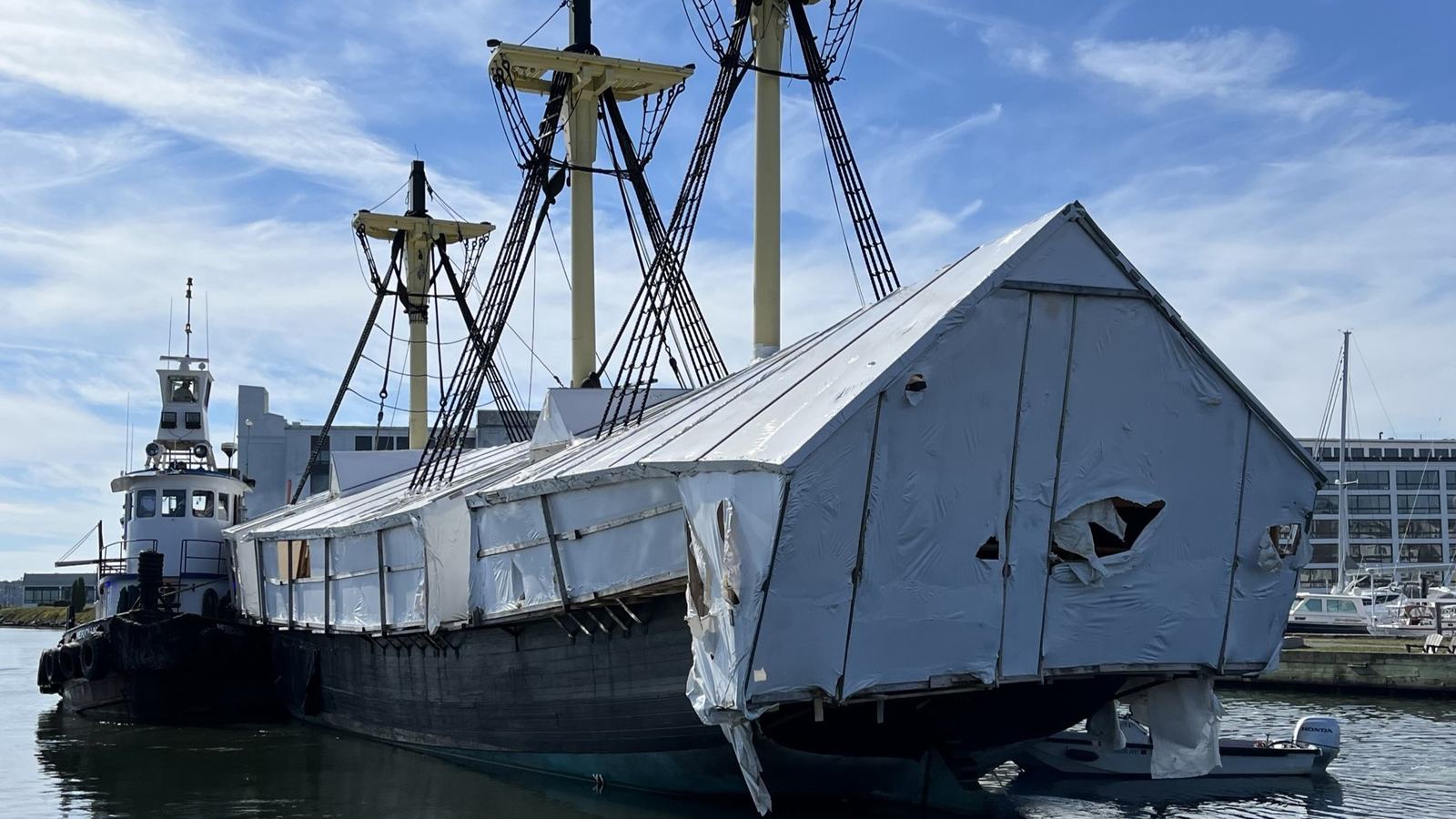
The return and ongoing restoration of Friendship of Salem offers superyacht visitors an unusually tangible introduction to merchant shipping, maritime engineering and the trading networks that shaped New England.
The Wharf as a Maritime Archive
Approaching Salem from the water gives an immediate explanation for the city’s place in American maritime history. Derby Wharf runs out into a harbour that once connected New England merchants with ports across the Atlantic and much farther east, and the tall-ship replica Friendship of Salem gives that global story a visible form. It is a particularly rewarding shore excursion for superyacht guests who are interested in shipbuilding, navigation, trading networks and the social history behind an attractive waterfront.
The vessel should not be mistaken for a surviving eighteenth-century ship. The National Park Service identifies it as a modern reconstruction of the Salem-built Friendship of 1797, created to interpret the design and working life of a merchantman while incorporating contemporary safety and accessibility measures. Seeing a carefully interpreted replica invites a different kind of appreciation from viewing a polished museum model: scale, deck layout and the demands of square-rigged seamanship become much easier to imagine.
Derby Wharf is itself part of the exhibit, rather than merely a place where the ship happens to berth. The surviving waterfront buildings and historic wharves place Friendship in the commercial setting that once sustained her predecessors. A visit can therefore begin with the harbour panorama and continue inland through the working landscape of customs, warehousing and merchants’ houses.
Why Friendship Matters Beyond Her Rig
The original Friendship was built in Salem in the closing years of the eighteenth century and launched in 1797. According to the park's historical account, the two-decked East Indiaman undertook fifteen voyages, calling at destinations including China, India, Indonesia, Russia and European ports. Its commercial itinerary shows how an Atlantic town could participate in a genuinely international exchange of goods, ideas and navigational knowledge long before container shipping.
The cargo lists illuminate the material culture of the period. Pepper, silk, coffee and sugar were among the commodities brought through Salem, alongside wine, tin and everyday provisions. They were not simply luxury curiosities: they passed through webs of merchants, dock workers, sailors, shipowners and consumers whose lives rarely appear together in conventional yacht histories.
Friendship’s final voyage ended under the pressures of the War of 1812, when the British intercepted the ship on its return from Archangel in Russia. The National Park Service records that the crew returned home but the vessel was sold in London. That ending complicates the romance of the square-rigger, reminding the visitor that international trade relied on fragile diplomacy, exposed shipping lanes and crews who could not always receive news of a declaration of war.
A Restoration That Reveals the Real Engineering
The modern ship is the subject of a substantial preservation programme, and the repair work is worth understanding even if a guest sees the exterior rather than joining an onboard programme. The National Park Service describes a multi-year project involving renewal of deck structures, the transom, bulwarks, framing and the bow. It is a rare public illustration of the difference between displaying a historic design and keeping a functioning vessel safe.
The park says Friendship returned to Derby Wharf in July 2025 after work at Gloucester Marine Railway, with the vessel protected during the tow. Its update described the subsequent installation of rigging as an ongoing undertaking ahead of major commemorations. That account establishes the documented repair timeline, but it should not be read as confirmation of any particular sailing date or today's access arrangements.
For a modern superyacht owner or technical manager, the underlying disciplines are familiar even though the structure and rig are utterly different. Surveying, staged repairs, preserving an intended design, controlling moisture, selecting materials and planning work around operational access all require difficult decisions. In this context the restored wooden ship offers a useful conversation about authenticity and engineering, without pretending that a timber merchantman and a contemporary yacht face identical technical problems.
Building a Thoughtful Salem Shore Day
The strongest itinerary is unhurried. Start at Salem Maritime National Historical Park and walk the waterfront before attempting to fit in a ship programme; the condition of the vessel and the availability of guided access should be checked with the park shortly before arrival. The broader landscape remains rewarding even when boarding is restricted, because the history is distributed across multiple historic structures.
Nearby, the Custom House and the collection of waterfront warehouses explain the administrative and practical side of a port economy. The Narbonne House and other preserved buildings provide a counterweight to stories focused entirely on wealthy merchants. A responsible interpretation of Salem should make room for working families, labour and the unequal distribution of opportunity as well as celebrated voyages.
The Peabody Essex Museum provides an especially appropriate extension for guests interested in maritime art and documentation. The park identifies the original Friendship's ship model and voyage records as important sources for the replica’s design, with related material interpreted at the museum. Check museum exhibitions and admission arrangements separately; a reference in the ship’s history is not a guarantee that every object is continuously on public display.
From Modern Yacht to Historic Harbour
For an arriving yacht, Salem deserves the same operational preparation as any unfamiliar North American port. Guest movement and berth arrangements should be coordinated with a suitable local marina or agent, while the captain uses current navigational information, harbour guidance, local weather and the vessel’s own draft limitations. Nothing about the existence of a historic wharf implies that a large private yacht may berth alongside it.
Guests can use the shore day to look closely at the difference between a working waterfront and a contemporary destination. The harbour’s maritime heritage is not a decorative backdrop; its long chronology explains the town’s streets, buildings and institutions. That makes Salem an intelligent addition to a New England yacht itinerary where Portsmouth, Boston and other ports could otherwise start to feel interchangeable.
The most compelling final view is of Friendship at Derby Wharf, framed by the ordinary harbour activity around it. Modern yachts, commercial vessels, public spaces and a restored merchant ship occupy a common seascape while representing different generations of maritime ambition. A visit succeeds when guests leave with a sharper understanding of how the ocean shaped both Salem’s prosperity and its people.
Visiting Responsibly and Verifying Details
Salem Maritime National Historical Park is the authoritative starting point for information on public access to Friendship, repair progress and events. The park’s published restoration account records the 2025 return to the wharf and the subsequent rigging work, but opening windows may change as conservation continues. Confirm current activities directly before setting out, particularly if boarding the ship is the primary purpose of the excursion.
The key historic and technical references for this feature are the National Park Service’s Friendship repair record, its vessel history and the Salem waterfront places guide. The image accompanying this article is an official NPS photograph of the vessel during a turnaround, not a generated reconstruction. As with any heritage visit, respect active conservation areas and follow staff instructions.