IAMWATCH’s George Daniels centenary exhibition brings together 22 watches, including both Space Traveller pocket watches, and examines his mechanical legacy.
An exceptional gathering of mechanical watches by the late British horologist George Daniels forms the historical centrepiece of IAMWATCH in Singapore this weekend. The Hour Glass and Phillips in Association with Bacs & Russo arranged the exhibition to mark the centenary of Daniels, who was born in 1926 and died in 2011. The exhibition, announced as a presentation of twenty-two of his watches, includes the two Space Traveller pocket watches together for the first time. For collectors of independent watchmaking, the significance of this assembly extends beyond the scarcity of the objects. It offers a rare opportunity to understand the development of a maker's ideas through individual watches that were conceived and executed over the course of an unusually personal career.
The scale of an unusually small body of work
According to the organiser, Daniels made twenty-four pocket watches and two wristwatches, mastering thirty-two of the thirty-four disciplines required to make a watch by hand. Individual pieces could require more than 2,500 hours of work. The presentation of twenty-two examples therefore represents a substantial proportion of the watches associated with his individual production. It differs fundamentally from an exhibition assembled to illustrate the successive commercial collections of a large manufacturer, where the examples selected may be representatives of references produced in considerable quantities.
A collector looking at the Daniels watches should distinguish the properties of each individual piece from a broader recognisable identity shared by his work. The technical characteristics of a particular movement, its documented circumstances of creation and its ownership history can each contribute to its significance. A physical exhibition of so many pieces provides a context in which similarities and variations can be examined. The historical insight available through considering them together would be difficult to reproduce by encountering single watches only when they appear in an auction catalogue. The organisers' achievement is thus as much a matter of assembling and interpreting objects as it is of demonstrating their rarity.
Making the entire watch rather than designing a single component
The exhibition's account of Daniels' approach emphasises the breadth of his practical knowledge. Mechanical watchmaking involves a series of interdependent operations, including the preparation of the movement's structure, the manufacture and finishing of components, the construction of the time display and the adjustment of the assembled mechanism. In many workshops these operations are divided between specialists, each of whom may have a very sophisticated understanding of a narrower part of the process.
Daniels' ambition was to understand and exercise an unusually large range of those skills within his own work. That approach permitted decisions about the appearance of a watch and the mechanical arrangement beneath it to develop in close relation to one another. It also required considerable time and patience, neither of which is easily reconciled with production at scale. The finished object consequently provides evidence of a particular maker's decisions across several different crafts. For owners accustomed to commissioning bespoke objects, such a relationship between the designer and the execution can be especially compelling.
The independent pursuit of an improved escapement
Among Daniels' contributions to the development of mechanical watchmaking, the co-axial escapement occupies a particular position. The organiser describes its underlying purpose as reducing the dependence of the mechanism on lubrication and improving performance over extended periods. The escapement regulates the release of energy from the power source to the oscillating regulating assembly. Its design determines, among other things, how the impulse required to sustain oscillation is delivered and how the movement's rate responds to the conditions under which the mechanism operates.
Most users of a finished watch have no reason to examine the interaction of these small components. For a designer of movements, however, the architecture of the escapement is an important subject of investigation. Changes to its geometry influence manufacturing tolerances, adjustment and servicing. Developing an alternative requires more than producing an arrangement that operates under favourable workshop conditions. It also requires the ability to maintain appropriate performance when the device is used and, if intended for series manufacture, to establish a repeatable industrial process. Daniels' work is particularly notable because his ideas eventually reached a much wider audience through Omega's adoption of the co-axial mechanism.
Why the Space Traveller watches belong together
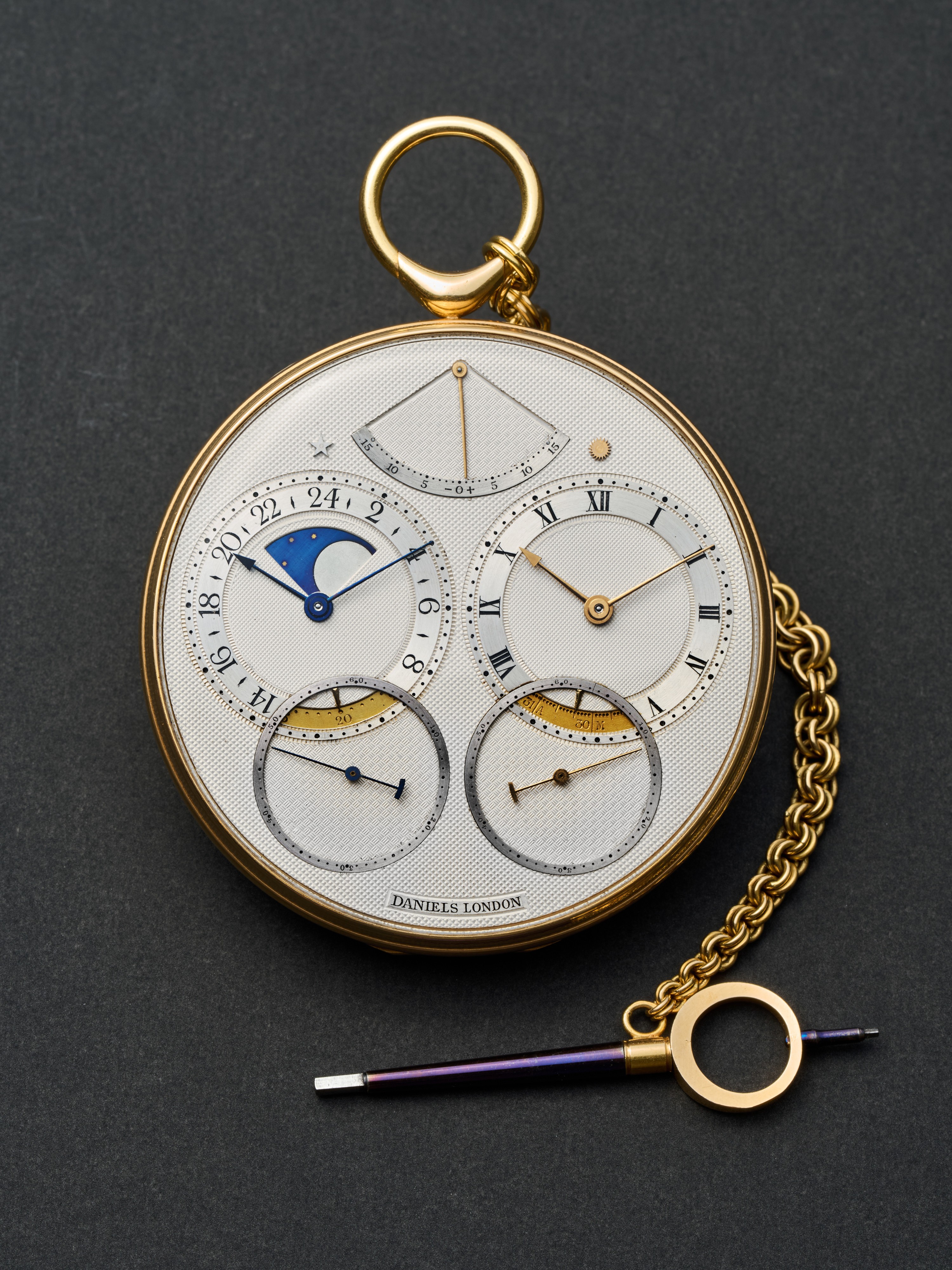
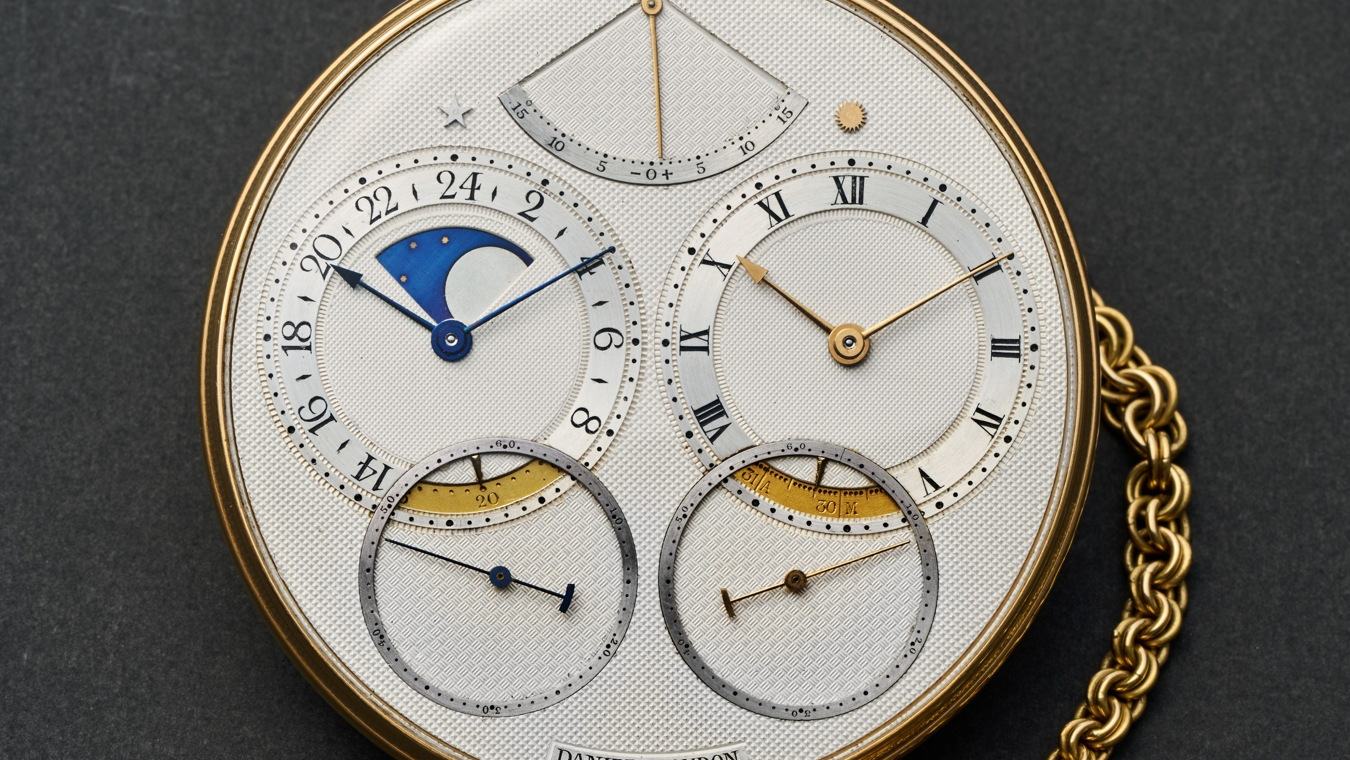
The two Space Traveller watches are among the most important objects identified in the exhibition announcement. The organisers date both to 1982 and describe the second as a response to Daniels' regret at parting with the first. Space Traveller II subsequently remained associated with his personal collection until his death. The presence of the two watches within one exhibition matters because each can be interpreted in relation to the same technical and intellectual interests without being regarded simply as a substitute for the other.
The indication of mean solar time and sidereal time introduces a particularly interesting subject. Ordinary civil time is organised around the solar day, while sidereal time refers to the rotation of the Earth relative to distant celestial reference points. The distinction can be represented mechanically by movements arranged to progress at slightly different rates. A purposeful construction must make the corresponding information comprehensible to the user while preserving the operation of the mechanism. In a pocket watch developed by an individual craftsman, the representation of these two measures of time gives the owner an opportunity to examine an astronomical relationship through the operation of the object itself.
A continuing conversation with Roger W. Smith
The Singapore programme places Daniels' work within the history of its transmission to subsequent generations of watchmakers. Roger W. Smith has contributed lectures concerning Daniels' life and the development of the co-axial escapement. He was also scheduled to take part in a discussion with Aurel Bacs, moderated by Su Jia Xian, on 14 November. A documentary commissioned by Phillips and its watch auction partners formed part of the same centenary programme. The organisers identify filming in the Isle of Man, England and Switzerland, together with archival material from The George Daniels Educational Trust.
Such a gathering provides a different kind of historical evidence from a presentation devoted exclusively to the completed objects. Testimony from people connected with the development and transmission of the craft can help explain why a maker selected particular technical arrangements, or why a seemingly small operation occupied considerable time. It can also clarify which parts of a process have changed as later makers have developed their own approaches. For a knowledgeable collector, those distinctions are valuable when evaluating contemporary watches that explicitly refer to Daniels or to techniques associated with his tradition.
The context of a period of technological change
Daniels developed much of his work in a period during which electronically regulated quartz watches were transforming timekeeping. An accurate portable indication could increasingly be obtained without the traditional mechanical architecture on which specialist craftsmen had depended. His pursuit of new mechanical solutions was therefore not simply an effort to continue a method of production unchanged in response to commercial demand. It involved treating the mechanical watch as a field of invention with intellectual and artistic interest independent of the availability of a less expensive means of telling the time.
That distinction remains relevant today. A collector can value a mechanical watch for its construction, historical relationship to other objects and visible evidence of craftsmanship while relying on contemporary electronic information for navigation or communications. On board a yacht, mechanical timepieces may offer personal pleasure and a connection to the long history of chronometry, but they do not substitute for approved navigational instruments and verified time references. The interest of the Space Traveller watches lies precisely in their distinctive mechanical representation of time rather than their ability to displace all other means of establishing it.
Documenting and caring for a significant private collection
A collector considering an exceptionally important handmade watch should understand that the integrity of the object and its documented history are closely related. Records of earlier service work, original correspondence and photographs of the actual movement may be particularly valuable. If a watch requires attention, the choice of specialist and the scope of the proposed intervention deserve careful consideration. Replacing a component merely because a newer equivalent is available may be inappropriate when the original component forms part of the evidence of how the maker worked.
The ability to consult experts and established institutions is particularly important for rare mechanical creations. Owners considering insurance, safe storage, public loans or the transport of objects across borders should obtain advice specific to the individual item. An exhibition such as the centenary presentation depends in part on arrangements that allow privately held watches to be examined responsibly outside their usual settings. A careful approach to ownership can therefore support scholarship and public understanding as well as protect the financial and personal interests of the collector.
A gathering that gives individual watches their historical context
IAMWATCH runs from 12 to 15 November at The Singapore EDITION, with three public days. The centenary exhibition has been organised within a programme that also includes lectures, film screenings and opportunities to meet contemporary makers. Its central achievement is the association of an unusually large number of Daniels' watches within a single setting and the opportunity to consider their relationship to later generations of mechanical watchmaking.
The exhibition is not an auction of the twenty-two watches, and their assembly should not be interpreted as an announcement that individual examples are available for purchase. Its importance for private collectors lies in the opportunity to deepen their understanding of objects whose technical identity cannot be separated from the maker's own approach. For an audience capable of acquiring the most ambitious contemporary watches, the Daniels centenary is a reminder that the lasting significance of a collection can derive from the quality of the questions it raises about invention, construction and the continuity of craft.
Primary source: The Hour Glass official IAMWATCH 2026 event programme and George Daniels 100 exhibition announcement, 30 October 2026.
The Hour Glass / IAMWATCH 2026 official exhibition photograph of George Daniels Space Traveller I. Official source.