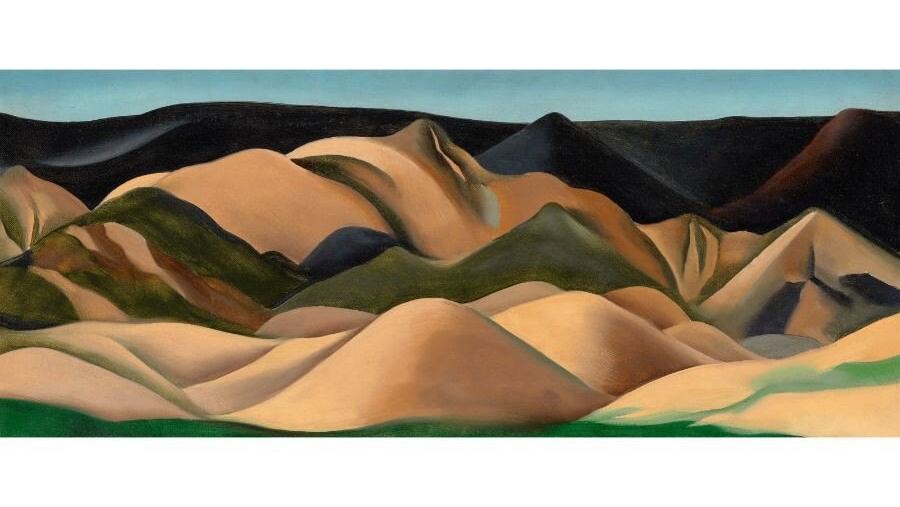
Christie's will offer Georgia O'Keeffe's 1930 Near Abiquiu, New Mexico I at its 17 November New York evening sale after the small landscape was rediscovered in an East Village closet.
Ultra-high-value art collecting, 12 November 2026. A Georgia O'Keeffe landscape long missing from public view has emerged from private storage and is headed to Christie's New York on 17 November, estimated in the region of $3 million. This is a presale estimate.
An extraordinary rediscovery in Manhattan Christie's has announced the rediscovery of a Georgia O'Keeffe landscape that had remained outside public view for decades, stored in a wooden box in the front closet of an East Village apartment. The painting, Near Abiquiu, New Mexico I, was made in 1930 and is expected to be offered at the auction house's 20th Century Evening Sale in New York on 17 November 2026. The presale estimate is in the region of $3 million. The circumstances are arresting, but they should not eclipse the importance of the work itself: a small painting connected with the period when New Mexico entered O'Keeffe's imagination and transformed the course of her art. The announcement is a preview, not a sale result. Its value remains subject to bidding and to the scrutiny of interested collectors. The auction house has also arranged a free public exhibition, permitting visitors to examine a picture that had long been known primarily through earlier documentation.
A graduation gift kept for generations The owner received the painting as a graduation gift in the 1960s. Christie’s says the woman's mother purchased it for $3,800 from the Downtown Gallery in Manhattan on 15 April 1963. That purchase history provides an unusually clear provenance anchor for a rediscovered modern painting. Rather than emerging with a vague claim of inherited ownership, the work is associated with a named dealer, a date and a known relationship between the purchaser and recipient. The owner's family has asked to remain anonymous, a decision that deserves respect in the coverage of a private collection. The press release offers an account of the owner's independent, accomplished life, including international travel and work, without making her identity a matter of public disclosure. The documentary history matters to collectors; speculative attempts to identify the family do not add anything to the understanding of the art.
The story behind the closet Christie’s recounts that a relative was helping the painting's owner examine her belongings when she mentioned that an O'Keeffe was in the closet. The relative found a wooden box hidden among coats, with the painting still in original gallery packing. It had once hung in the apartment, but the owner reportedly placed it in storage in the mid-1980s after becoming concerned about a visitor's unusual interest in it. This is a human story about privacy and possession, though it should not be exaggerated into a tale of theft or an insurance investigation: the announcement provides no such allegation. The circumstances illustrate how a major work can disappear from scholarly visibility without being physically lost. A collector's decision to avoid public attention may protect privacy, yet it can also leave important evidence inaccessible to later researchers. Documentation becomes particularly valuable when the next generation must identify and manage the object.
The painting is small but historically significant The work measures approximately ten by twenty-four inches, giving it a horizontal format unusually well suited to a broad New Mexico view. Christie’s describes it as a likely early version in a series of three paintings exploring Lobo Peak north of Taos Pueblo. Another version is in the Metropolitan Museum of Art, while a third is in a private collection and was previously associated with David and Peggy Rockefeller. Those relationships give scholars a way to study changes in composition and interpretation across the group. The painting was made shortly after O'Keeffe's first visit to New Mexico in 1929, when the region's open spaces and distinct landscape became central to her work. A small painting can have great historical importance when it illuminates a turning point in an artist's development. Market size and physical size are very different measures.
A known work that had been difficult to locate The existence of Near Abiquiu, New Mexico I was previously documented through a photograph made in 1931, and Christie’s says it appeared in an appendix of the artist's catalogue raisonné because the physical painting had not been accessible to modern scholars. Its rediscovery therefore changes the practical state of knowledge. Researchers can potentially examine the original surface, colours, materials and any evidence not visible in an old black-and-white record. A catalogue raisonné is a scholarly compilation of an artist's works, but its entries depend on the evidence available at the time of publication. The appearance of a previously inaccessible original can prompt a new understanding of attribution, chronology and relationships among related pictures. The important claim is that the actual painting has become available for expert assessment; the story should not suggest that experts were previously unaware of its existence.
The original backboard carries O'Keeffe's initials The auction house reports that the work bears an 'OK' signature on its original backboard. A signature or inscription can be useful evidence but should never be treated as sufficient authentication by itself. Professional attribution requires examining the object and considering documentation, technique, materials and its place within the artist's known work. The documented Downtown Gallery sale and early photograph provide additional elements of the provenance record. Prospective buyers should review the specialist catalogue and any condition information available. Small panels and works on paper may also have particular display and conservation requirements. The excitement of a rediscovery often concentrates public attention on the circumstances of finding it, but responsible purchasing depends on what is established when an object is fully examined.
A free exhibition gives the public unusual access Christie's has announced that the painting will be shown during its New York marquee-week exhibition at 20 Rockefeller Center from 7 to 17 November. This means the work can be seen by members of the public before the auction rather than remaining solely within private viewings for selected bidders. The decision is significant because the painting was absent from public display for at least three decades, according to the release. Museum-goers and art historians may find the chance to study it directly as interesting as the eventual price. The exhibition also places the rediscovered work among other material offered during a major auction week, but visitors should distinguish the scholarly and emotional value of seeing the picture from the commercial decision to bid. Attendance at a free preview creates no obligation to buy and is not evidence of market demand.
An estimate near $3m is not a realised value Christie's has placed the painting's estimate in the region of $3 million. That expression is intentionally different from a final transaction price. The outcome could vary with bidding, reserve conditions and the assessments of specialists and collectors. A rediscovery can attract attention, yet rarity alone is not a guarantee that a work will exceed its estimate. Comparisons with other O'Keeffe paintings require attention to size, date, subject, condition and provenance. An iconic flower painting and an early New Mexico landscape may appeal to different buyers. A market observer should resist the temptation to assign a single price per square inch or use one highly publicised sale to extrapolate values for all the artist's work. The appropriate record today is the announcement and estimate; the realised result belongs to a later verified report.
Private collections can carry overlooked scholarship The discovery demonstrates why systematic collection records matter even to families with no immediate intention to sell. An object kept privately for generations may have a strong provenance and significant artistic importance, but that information can be lost when owners die or household possessions are dispersed. Inventories should include photographs, acquisition documents, specialist evaluations and the location of each work. Insurance and estate planning may also be necessary where objects carry substantial value. The objective is not to publicise a private collection without consent, but to ensure that responsible family members can understand and preserve what exists. When a work is placed in long-term storage, periodic condition monitoring may be appropriate. A cupboard is not necessarily a suitable conservation environment, even when the object has survived there with its original protective packing.
New Mexico remains an essential part of O'Keeffe's story O'Keeffe's New Mexico subjects have become inseparable from her reputation, and Near Abiquiu, New Mexico I offers a view into an early stage of that relationship. Landscape painting can be intensely personal even when no figure appears. The framing of distant hills and open sky can express an artist's perception as distinctly as a portrait. Collectors drawn to such work may also care about its ties to place, but those ties should be explored through the artist's biography and reliable scholarship rather than a romanticised account of the American West. The comparison with the Metropolitan Museum's related picture may be especially illuminating. An original in private hands can enrich the public understanding of a major artist when its history is documented and the work is available for study or exhibition.
The next milestone is the auction itself The source confirms that Near Abiquiu, New Mexico I is a 1930 Georgia O'Keeffe landscape recently recovered from private storage and linked to a documented 1963 Downtown Gallery purchase. It will be exhibited in New York and offered during Christie's 17 November evening auction, with a presale estimate near $3 million. The family has not been publicly identified and the work has not yet been sold. The responsible collecting story centres on provenance, rediscovery and the opportunity to study an original previously known largely through an old photograph. Whatever the bidding outcome, its reappearance is an important development for scholars and admirers of O'Keeffe's early New Mexico paintings. For a serious buyer, the appeal of the discovery should be matched by careful evaluation of the artwork itself.
Primary source: Christie's, 5 November 2026, discovery of O'Keeffe Near Abiquiu, New Mexico I.