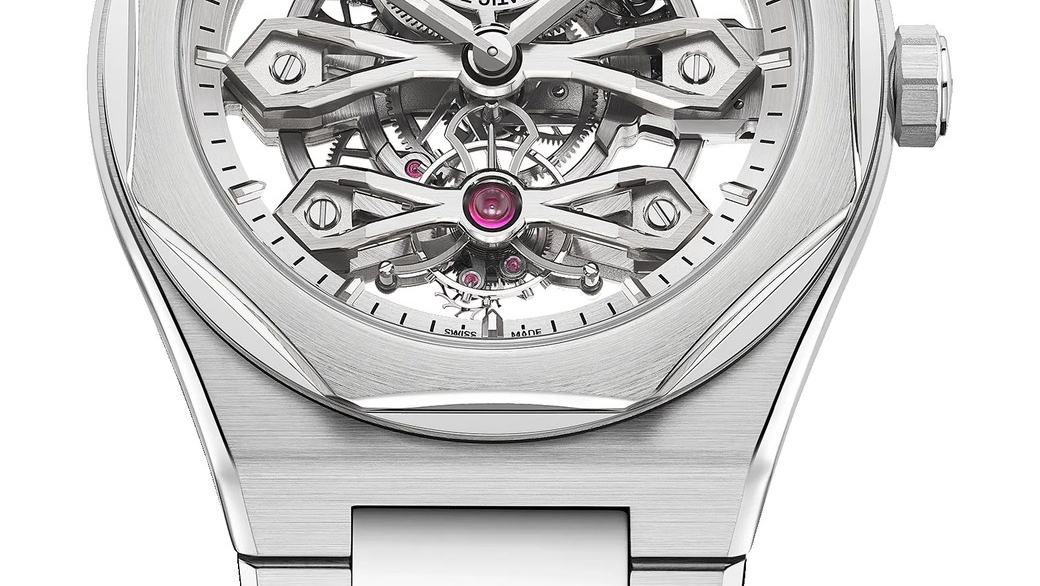
Girard-Perregaux fuses two historic design signatures in the 41mm Laureato Fifty Three Gold Bridges, a limited 50-piece tourbillon driven by calibre GP9620.
Two house signatures in one watch
Girard-Perregaux's new Laureato Fifty Three Gold Bridges brings together two strands of its history that were not originally designed to meet. The Three Bridges movement architecture dates to 1867, when visible bridges became an expression of mechanical design. The Laureato arrived in 1975 with the integrated bracelet and octagonal bezel that now define the sports-luxury collection. Their combination is more than a retrospective exercise: it asks whether the architecture of a complicated movement can become part of an everyday wearable shape.
The resulting reference 99112-58-3576-1CM is a 41mm watch, built around an automatic tourbillon movement and presented in an edition of 50. Its price on the manufacturer's UK site is £144,000, which places it firmly in the realm of specialist collecting. For a buyer, however, the most compelling comparison may not be with other costly integrated-bracelet watches. It is with the much larger, more formal pieces that have traditionally provided a showcase for three-bridge construction.
A familiar case made less familiar
At first glance the watch preserves the visual cues associated with the Laureato. There is a stainless-steel case and bracelet and an octagonal bezel, here fashioned from white gold. The outer facets of the bezel are newly worked with a polished bevel contrasting against circular satin finishing. Rather than cover the dial with a conventional display, Girard-Perregaux opens the centre to reveal the mechanism. The tension between the composed outer shell and the exposed movement supplies much of the watch's visual character.
The manufacturer gives a case diameter of 41mm and thickness of 10.85mm, unusually contained dimensions for an automatic tourbillon with such a prominent mechanical display. Those numbers do not, by themselves, guarantee comfort. Bracelet articulation, clasp adjustment and how the case sits against the wrist all matter. They do suggest that Girard-Perregaux has treated wearability as a central design requirement, rather than leaving it as a secondary consideration after the complication is complete.
The movement is the main event
The in-house GP9620 calibre is organised around three openworked white-gold bridges. The upper bridge secures the mainspring barrel, the centre bridge supports the gear train and motion works, and the lower bridge anchors the tourbillon. Barrel, gear train and tourbillon are aligned along a single axis. That structural order is practical, but it is also the reason the movement can be read visually. The machinery becomes an architectural composition, with a recognisable top, middle and base.
Girard-Perregaux lists 303 components and 33 jewels, with a frequency of 21,600 vibrations per hour, equivalent to 3Hz. The calibre winds automatically, although the usual centrally mounted rotor would obscure much of the display. Instead, a platinum micro-rotor sits beneath the barrel. This is a significant design decision. It allows the watch to retain the convenience of automatic winding while leaving the view of the bridges largely uninterrupted.
Why a tourbillon changes the view
The tourbillon is visible at the lower end of the mechanism. Its rotating carriage makes the regulator a moving focal point rather than a hidden technical feature. In a modern wristwatch, a tourbillon should not automatically be taken as proof of better practical accuracy. Its appeal here lies in mechanical execution, finishing and the way its motion animates the symmetrical layout. Prospective collectors should judge the quality of the whole movement, not treat the presence of a tourbillon as the complete story.
Openworked watchmaking also demands restraint. Without a conventional dial, surfaces, colours and the relationships between components need to keep the time readable. White-gold bridges against the darker mechanical background create an orderly frame, while the bracelet and bezel establish a more familiar context. The watch succeeds conceptually because the visible engineering and its case belong to the same design conversation, even though their historical origins lie more than a century apart.
What fifty pieces mean for a collector
Girard-Perregaux identifies this reference as a limited edition of 50, a small run that changes the purchase process as well as the likely pattern of ownership. A prospective client will need to confirm allocation, availability and the local price directly with the manufacturer or an authorised retailer. The stated £144,000 UK figure should not be converted into an assumed worldwide retail price; duties, exchange rates and regional pricing can differ. The company also offers another variation, so the precise reference should accompany any enquiry.
At this level, aftercare becomes as important as an attractive release photograph. A high-complication movement warrants discussion of servicing, insurance, bracelet sizing and the handling of specialist components. A collector might also compare the Three Gold Bridges with other Laureato models to decide whether the open movement delivers the pleasure expected from the higher commitment. Scarcity can increase interest, but it cannot substitute for the watch being personally convincing on the wrist.
Heritage without imitation
The strongest part of the proposition is the dialogue between 1867 and 1975. Girard-Perregaux has not simply placed an antique-looking movement inside a modern case. It has re-engineered the three-bridge concept into a compact automatic calibre and allowed the Laureato's geometry to supply the supporting frame. The historical references are legible without requiring the watch to dress as a museum object. That gives the design a clearer identity than a heritage edition based only on colours or typography.
For owners drawn to sophisticated mechanical watches but unwilling to reserve them only for formal occasions, the Laureato Fifty Three Gold Bridges offers an unusual answer. It pairs an integrated steel bracelet with a highly visible tourbillon, and a controlled case profile with a demanding movement architecture. Its limited production and significant price mean it is not an exercise in accessibility. It is, rather, a statement about how a manufacture's separate design traditions can meet in one carefully considered object.
Official source: Girard-Perregaux. Product details and availability should be confirmed with the manufacturer.
Source
Girard-Perregaux