St. Augustine’s Casa Monica introduces a renewed Grand Bohemian identity with Moroccan craftsmanship, commissioned paintings and a redesigned pool lounge.
The Kessler Collection announced on 10 November 2026 a renewed identity and interior programme for Casa Monica, the 137-room hotel at 95 Cordova Street in St. Augustine, Florida. The building, which dates to 1888, now operates as Grand Bohemian Casa Monica, St. Augustine, Autograph Collection. Rather than replace the hotel's historic Spanish and Moorish Revival character with a neutral contemporary scheme, its in-house design studio has worked with references to Moroccan decorative arts and the architecture of southern Spain. A group of fourteen original paintings commissioned from French-Canadian artist Jean-Claude Roy accompanies the refurbishment. The new Soltana Pool Lounge introduces another expression of the same design approach. For private owners who appreciate the combination of historic architecture and modern interiors, the transformation offers a useful comparison with the refit of a mature yacht: how can established character be preserved while facilities, colours and individual objects are reconsidered?
The changing fortunes of a nineteenth-century landmark
According to the Kessler Collection's account, Casa Monica opened in 1888 and was subsequently acquired by Henry Flagler, the industrialist whose investments helped transform Florida's hospitality and transport infrastructure. He renamed it the Cordova Hotel. The building later fell into disrepair and spent many years serving as a county courthouse. Its restoration by Richard C. Kessler in the 1990s brought the original hotel name back into use.
This history makes the current refurbishment different from the creation of a building intended to evoke an earlier architectural period. The building has undergone several substantial changes of function, and the existing spaces contain evidence of later decisions as well as the original design. Owners considering the acquisition or restoration of an historic property should become familiar with those layers before deciding which elements ought to be retained. Historic significance does not necessarily depend upon every component remaining as it was when first constructed. Subsequent interventions may have acquired a significance of their own, while some changes may be of little interest. The value of an informed restoration lies partly in establishing those distinctions and making contemporary changes without obscuring what gives a property its identity.
A palette drawn from Morocco and southern Spain
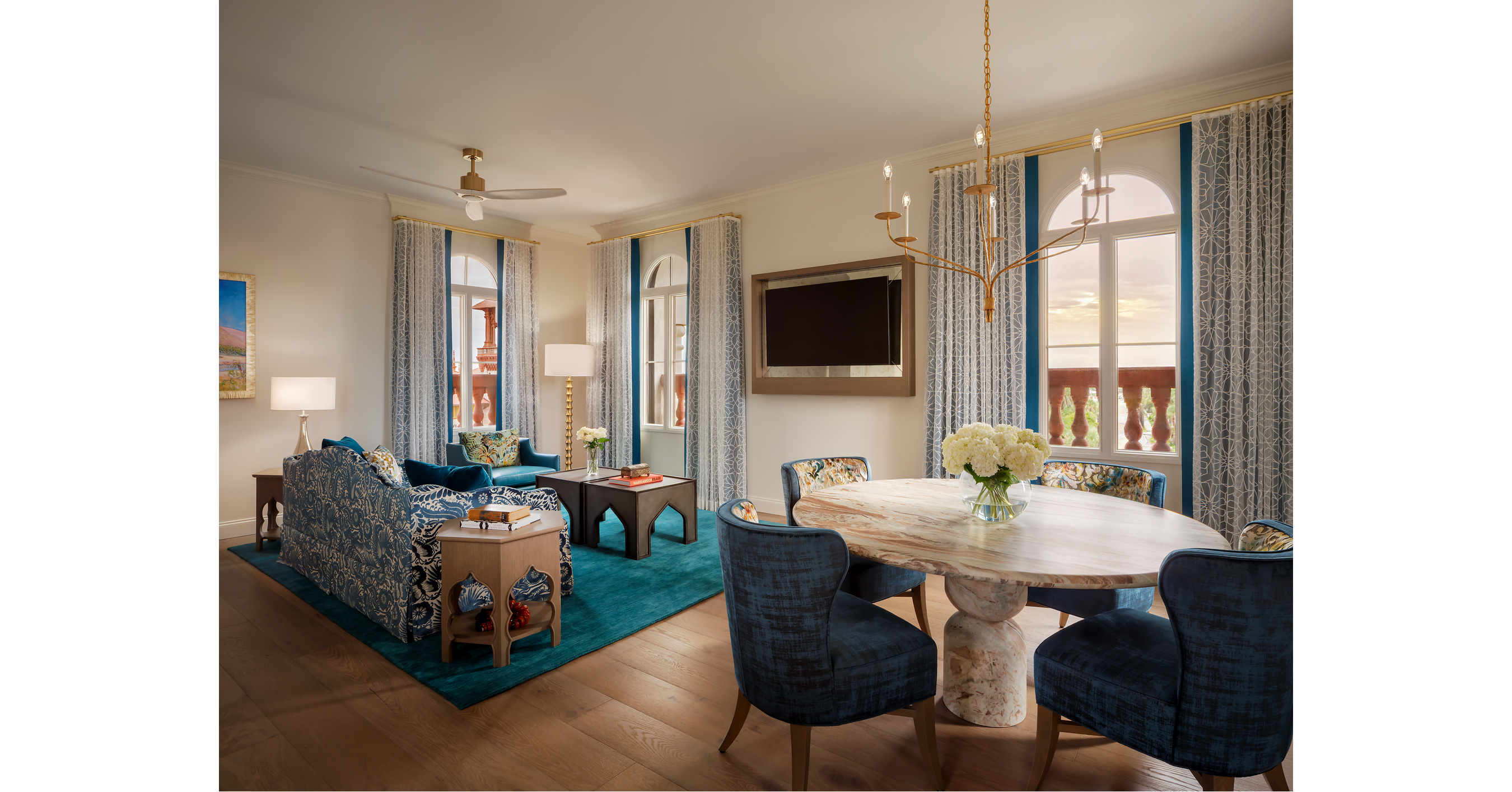
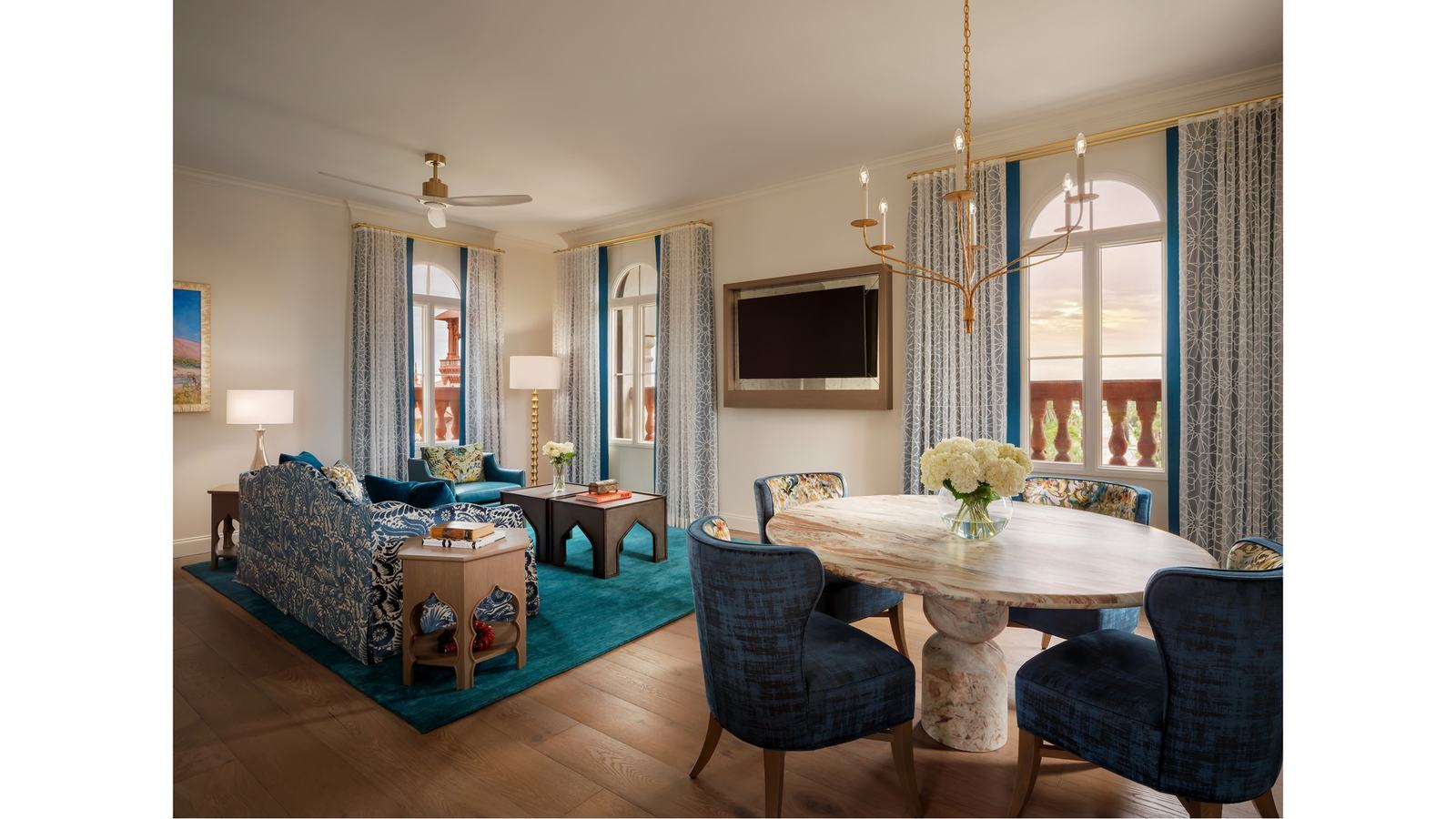
Diana Kessler and the group's in-house studio have used peacock blues, greens, warm wood and antique-brass finishes to develop the refreshed interiors. Embroidered curtains and specially designed carpets refer to architectural ornament and traditional Spanish tilework. The bedrooms incorporate sculptural headboards that reinterpret arched forms familiar from the building's wider decorative vocabulary.
The degree of abstraction in the new elements matters. A headboard may suggest the form of an architectural opening without attempting to reproduce the masonry of a particular historic building. A textile may derive its rhythm from traditional geometric decoration while remaining a material designed for a contemporary hospitality environment. By allowing selected forms to appear at different scales, the designer can establish connections across rooms without relying on the repetition of precisely the same motif. An owner choosing materials for a new yacht interior faces a similar opportunity. It may be more compelling to develop a consistent approach to proportion and pattern than to commission objects that reproduce historic details literally. The key is to retain enough understanding of the original forms that their reinterpretation has a discernible relationship with the tradition being invoked.
Handcrafted surfaces and the importance of individual makers
The recent work builds on changes to the hotel's public spaces, which introduced Moroccan tile, lighting and woodwork, alongside gold-leaf decoration by Sarah Pelfrey and Tina Davis. The identification of particular makers is useful because it helps visitors distinguish between a broad design reference and the people who actually prepared or installed the decorative work.
Zellige tiles, used in the new poolside bar, are particularly interesting in this context. Their appearance owes much to variation within individually produced pieces, as well as to the arrangement of the complete surface. A handmade finish should not necessarily be evaluated by the standards of a uniformly manufactured tile. Nevertheless, the practical installation of such a surface remains important. The way the pieces are selected, positioned and joined can determine the visual quality of the finished work and its suitability for repeated use. A client considering a similar installation aboard a yacht should establish the applicable technical requirements in advance, including the effect of movement, the weight of the materials and their maintenance. An appropriate marine installation may involve a different construction method from the one used in a historic building ashore.
Fourteen new paintings created for the rooms
The refurbishment continues the Kessler Collection's relationship with artist Jean-Claude Roy. Fourteen original paintings have been commissioned specifically for the guestrooms. According to the announcement, their subject matter and colour draw inspiration from Morocco, extending the design references of the rooms through individual works rather than treating the walls as spaces for generic decoration.
Commissioned art within a hotel offers an opportunity to consider how the disposition of works changes the experience of an interior. Visitors may encounter different objects across successive stays, and the work in an individual bedroom becomes part of a relatively private environment. A painting that would be seen for a short period within a public exhibition can instead be experienced across several days under changing light. The responsibility of the operator includes protecting those works within areas used continually by guests and staff. Private collectors considering a similar programme should involve the artist or an appropriate adviser in discussions about location, lighting and installation. A substantial artwork should not be treated simply as the final surface required to complete a decorative scheme. Its own character may significantly influence the arrangement of the room.
Soltana Pool Lounge as a contemporary interpretation
The reworked pool area is dominated by greens and warm terracotta tones. Its bar incorporates handcrafted emerald-coloured Moroccan tiles and brass lighting, while daybeds and other lounge furnishings introduce a combination of green and white. The adjacent pavilion is available for private events and celebrations. The pool lounge is intended to function throughout the day, rather than as a facility with a single narrowly prescribed period of use.
Outdoor hospitality spaces often have to accommodate activities that differ in character without making their furniture or organisation unnecessarily complicated. A quiet afternoon beside a swimming pool may call for a different relationship between music, lighting and circulation from an evening drinks reception. The design needs to account for both while ensuring that service personnel can work effectively. Owners of substantial yachts will recognise the importance of similar questions when arranging their exterior guest areas. A pool terrace can become an important gathering space even when guests have no intention of swimming. The most successful layouts provide distinct places to sit and converse without requiring every activity to take place around the same large group of furniture.
Mediterranean culinary references with a Florida identity
The new lounge menu draws on Mediterranean flavours while incorporating regional ingredients. Examples include a Moroccan-style hummus with roasted garlic and lemon, and Florida fish tacos served with mango and vegetables. The drinks programme refers to southern Spain and Morocco through combinations of mint, citrus and other flavours familiar from those regions.
The character of the menu should be considered in relation to the hospitality setting rather than judged as an attempt to reproduce a complete traditional Moroccan or Spanish dining programme. The hotel combines these culinary references with Florida ingredients and the practical requirements of a poolside service. That combination of influences mirrors the wider interior design approach, in which historical forms have informed the creation of contemporary objects. For a guest who wishes to explore more traditional regional food, time spent elsewhere in St. Augustine can complement the hotel's own programme. Menus and individual ingredients may vary, and dietary requirements should be discussed directly with the restaurant rather than assumed to be covered by a general description of the cuisine.
St. Augustine as a cultural shore destination
The hotel stands within easy walking distance of the Lightner Museum, Flagler College and the Castillo de San Marcos, together with the city's waterfront and specialist shops. A visitor can therefore use it as a base for exploring the relationship between the community's historic architecture and the ways earlier generations used the coast. For yacht owners visiting northeast Florida, the city offers a different experience from the much larger luxury districts farther south.
A stay ashore need not be organised entirely around the hotel's facilities. Visits to galleries, historic buildings and local specialists can provide a wider context for understanding the architectural references within Casa Monica. Anyone arriving aboard a yacht should separately establish the suitability and availability of marine facilities for the particular vessel. The hotel is located within the historic street network, not within a directly attached private marina. Local access, transport, security and the practical arrangements for guests leaving the vessel remain distinct from a reservation at the property. Taking those matters into account can make the shore-based experience more flexible without placing unrealistic demands upon the yacht's itinerary.
A renovation judged through its continuing use
The renewed hotel includes the Cordova Coastal Chophouse & Bar, its art gallery, spa facilities and extensive event spaces. The operator also identifies arrangements for beach concierge services and access to Palencia Golf Club. Prospective visitors should confirm individual service arrangements when booking, particularly if use of a particular facility forms a significant part of the proposed stay.
Casa Monica's transition into the Grand Bohemian identity demonstrates how an established hospitality building can develop a new interior direction without abandoning its recognisable architecture. The fourteen paintings, tilework, furniture and renewed pool terrace contribute individual points of interest within a much longer history. The hotel's transformation will be most meaningful when those elements enhance ordinary occupation rather than require visitors to encounter the property principally as a design exhibition. For those commissioning private interiors, the project provides a reminder that an existing place can establish a valuable framework for contemporary design. A well-considered update makes it possible to introduce new craftsmanship, materials and artworks while allowing the character of the original setting to remain visible.
Primary source: The Kessler Collection, official press announcement, 10 November 2026.
The Kessler Collection — official interior photograph supplied via PR Newswire for the Casa Monica transformation. Official source.