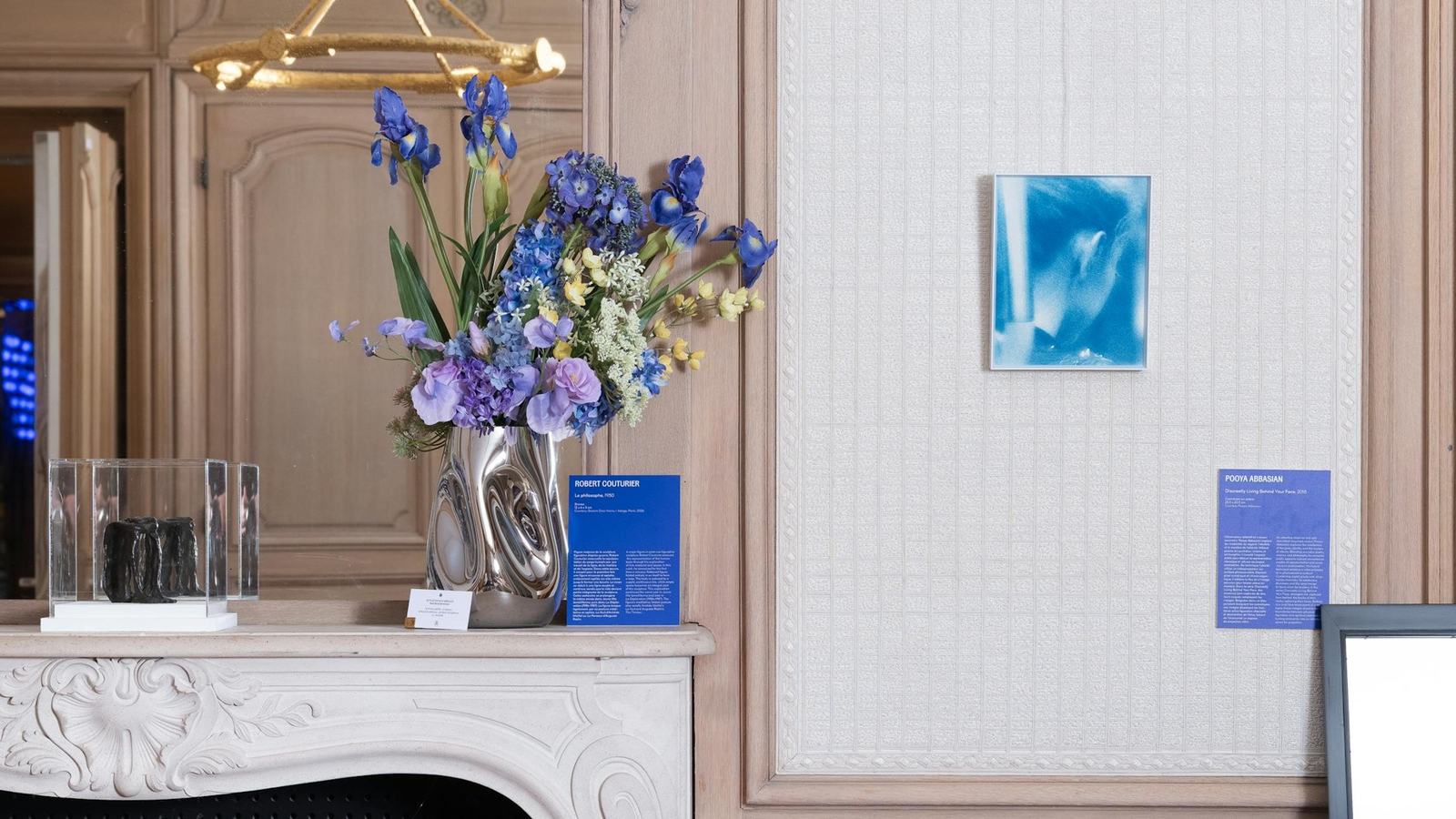
Guerlain's nineteenth annual contemporary art exhibition brings together photography, light and fragrance at its Champs-Élysées address until 15 November 2026.
Guerlain's nineteenth annual contemporary art exhibition is approaching its final weekend at La Maison Guerlain, 68 Avenue des Champs-Élysées, Paris. Entitled L’Heure des possibles, the presentation continues until 15 November 2026, according to an official announcement issued by LVMH on 27 October. Curated by Hervé Mikaeloff and Benoît Baume, the exhibition brings together around thirty international artists to investigate the ambiguous sensory territory between daylight and darkness. Its inspiration is the house's new L’Heure Bleue fragrance, and its approach extends beyond the conventional presentation of perfume to bring photographs, other artistic practices and specially composed olfactory experiences into conversation.
The participating artists identified in the announcement include Christian Boltanski, James Turrell, Rineke Dijkstra, Ugo Rondinone and Marguerite Bornhauser. Their inclusion places different generations and approaches to visual perception alongside one another, rather than framing twilight as a single picturesque subject. Alongside the exhibition, Guerlain has also announced the recipient of a separate art and environment prize, with an exhibition in Arles anticipated in summer 2027.
The changing perception of a familiar environment
The passage between daylight and darkness is notable because the physical environment does not necessarily change at the same rate as our perception of it. Edges and contrasts become less apparent as ambient illumination diminishes. Colours may be perceived differently, and the relationship between foreground and background can become uncertain. Familiar objects can seem strange without having altered their material form.
For a photographer or an artist working with light, these qualities provide opportunities that differ from those available under stable illumination. An image can describe the way objects become difficult to distinguish, or it can investigate the emotional associations of a particular hour. The exhibition's theme consequently lends itself to investigations of memory, atmosphere and the experience of uncertainty, as well as more literal representations of changing light. The official announcement identifies photography as central to the presentation, but does not imply that the artists approach the subject in the same way.
Photography beyond the description of visible objects
Photography is frequently encountered as a means of recording something present in front of a camera. Its artistic possibilities, however, extend to the interpretation of time, the organisation of a frame and the selective visibility of information. The choices made at exposure, printing and presentation can all influence how an image is experienced. The exhibition's emphasis on the boundary between the visible and invisible offers a useful framework for considering these choices.
An image may deliberately withhold details that a viewer expects to see. Rather than treating the resulting ambiguity as a fault, the artist can use it to establish an unfamiliar relationship between a subject and its surroundings. This approach is of particular interest to private collectors whose collections extend beyond conventional documentary photography. It invites an assessment of how a work changes with viewing distance, display conditions and the viewer's own attention. Specific conclusions about an individual work should nevertheless be based on seeing the work and consulting its documentation, rather than attributing a uniform aesthetic to everyone participating.
What fragrance introduces into an exhibition
Guerlain commissioned olfactory compositions by its perfumer Delphine Jelk to extend the experience beyond sight. This creates a distinctive relationship between two types of sensory encounter. A photographic print can generally be viewed repeatedly within its defined visual boundary. A scent disperses through air, develops over time and may be experienced differently depending on the person encountering it and the surrounding conditions.
The combination does not require the fragrance to provide a literal explanation of a visual artwork. It may instead encourage associations that are not established by visual information alone. A visitor can experience both an image and a scent while allowing their relationship to remain open to interpretation. For those interested in fragrance as part of artistic practice, this is a different proposition from judging a perfume principally as a personal accessory. It also provides an opportunity to consider the role of memory and individual experience in any encounter with an artwork.
An urban setting with a particular cultural context
The exhibition takes place within Guerlain's own address on the Champs-Élysées rather than in an independent museum. That arrangement is significant because it places a commercial luxury house in the role of cultural host. The company's identity and history form part of the context, particularly because the curatorial theme refers to one of its fragrances. Visitors should be aware of that relationship when interpreting the exhibition.
The participation of established artists and the use of curatorial expertise create a setting in which the artistic works can be considered independently of the product that inspired the theme. An interested collector might compare this kind of presentation with an institutional exhibition or a gallery programme, where different structures of funding, acquisition and interpretation apply. The exhibition complements the wider contemporary art activity in Paris associated with Art Basel. It is not a stand-alone description of all the art available in the city during the autumn season.
Building a private collection around perception
For collectors concerned with contemporary art, twilight offers a potentially productive subject because its meaning need not be expressed through a particular medium. Works selected for such a collection could examine memory, light, duration, the documentation of absence or the relationship between visual information and emotional response. The unifying principle may be conceptual rather than a similarity in colour or format.
Such a collection should still be supported by rigorous consideration of individual acquisitions. A work involving variable lighting or a time-based component can require more detailed installation instructions than a conventional framed photograph. The provenance, edition details where applicable, artistic intent and responsibilities for future maintenance should be understood before a commitment is made. The works appearing in L’Heure des possibles are not necessarily available for purchase, and the official exhibition announcement does not disclose prices or the ownership of each exhibited piece.
Art and the sensory environment of a superyacht
The relationship among ambient light, scent and perception can also be relevant for an owner developing an interior or selecting art for a private yacht. The quality of daylight entering a particular space may change dramatically with the yacht's orientation, latitude and time of day. Artificial light then becomes important not simply for illuminating objects but for shaping the experience of the interior.
An artwork chosen specifically for its interaction with light should be assessed under appropriate conditions before installation. Controls, material sensitivities, reflected glare, vibration and the availability of suitable mounting arrangements may affect the result. Scent also requires particular care in a confined environment where it can affect guests and crew who have different preferences or sensitivities. The exhibition provides inspiration for thinking about these sensory relationships, not a prescription for reproducing a cultural installation aboard a yacht.
Supporting environmental research through artistic practice
In parallel with the Paris exhibition, Guerlain has announced Livia Melzi as the recipient of the fourth Art & Environment Prize, organised with Lee Ufan Arles. The company says the artist was selected from more than 750 applications. Her proposed project, The Proxy Collection, focuses on ancient remains submerged in the Rhône. The award is to support a residency and an exhibition in Arles during summer 2027.
There is a distinction between supporting research through an artist's practice and underwriting an environmental remediation programme. A cultural project can draw attention to questions involving heritage, material traces, water or the relationship between nature and human activity without itself delivering a particular ecological outcome. Patrons considering support for similar work should understand the artist's research objectives and the nature of the resulting presentation. The prize announcement establishes Melzi's selection and intended project; it does not establish that the works have been completed or that the future exhibition has already opened.
The closing weekend and what follows
The official LVMH announcement identifies 15 November 2026 as the final date of L’Heure des possibles. Anyone intending to visit La Maison Guerlain this weekend should check opening arrangements directly with the venue. The information available in the announcement does not establish whether capacity restrictions, special closing arrangements or changes to the programme apply. Its separate announcement concerning Livia Melzi concerns a future residency and exhibition in Arles, rather than a continuation of the same Paris show.
Taken together, these activities illustrate the different ways in which a luxury house may participate in contemporary artistic culture: presenting work by established and emerging practitioners, commissioning experiences in its own creative medium and supporting research by an artist selected through a prize. The interest for collectors lies in considering each of those activities on its own merits. The Paris presentation offers a final opportunity this weekend to examine the curators' interpretation of twilight, while the planned Arles exhibition gives those following the prize a distinct development to watch in 2027.
Primary source: LVMH official announcement, 27 October 2026.
L’Heure des possibles exhibition at La Maison Guerlain — official press photograph. Official source.
