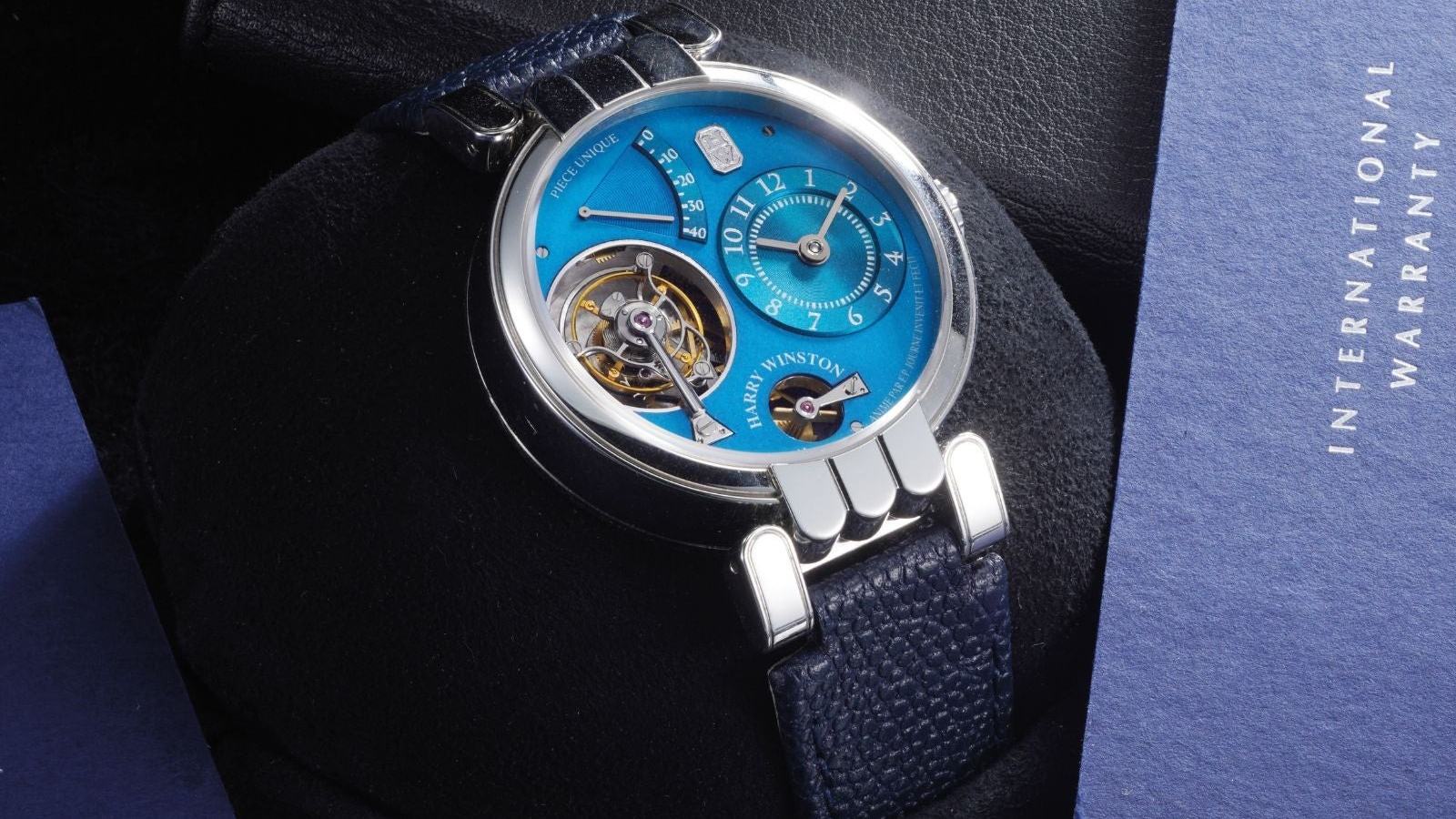
A platinum Harry Winston Opus One tourbillon developed with F.P. Journe comes to Phillips Geneva with a CHF 400,000–800,000 estimate, recalling a pivotal watchmaking collaboration.
A watch at the start of a remarkable collaboration
Phillips is preparing to offer a platinum Harry Winston Opus One Tourbillon made with François-Paul Journe at its Geneva Watch Auction XXIV in November 2026. The model connects a major jewellery house with one of the most respected names in independent horology, and its appearance offers collectors an opportunity to examine an early chapter of that relationship.
The auction house identifies the 2001 watch as lot 107, a platinum reference 200/MTFPJ38P with a turquoise dial. Its published estimate is CHF 400,000 to CHF 800,000, a guide for bidding rather than any guarantee of the final hammer price or total amount paid.
The specific watch is significant not only for its complication and precious-metal case but also for the way its makers were recognised. In a field where specialist movement designers have often remained largely invisible, the Opus collection placed the independent watchmaker alongside the commissioning brand.
How the Opus idea took shape
Max Büsser joined Harry Winston’s watch operation in 1998 and sought to change the relationship between luxury branding and independent mechanical innovation. The first Opus appeared in 2001, introducing a format in which an established name could give a specialist creator the opportunity to present an exceptionally ambitious design.
Journe’s contribution formed the starting point for a sequence of five pioneering commissions, followed by work involving Antoine Preziuso, Vianney Halter, Christophe Claret and Felix Baumgartner. The series embraced mechanisms that extended beyond traditional displays, from hidden calendars and reversible minute repeaters to unusual rotating indications.
For the collector, understanding the individual creator and the history of the project is as important as recognising the brand engraved on the case. The Opus programme helped establish a broader culture of visible collaboration in which mechanical authorship could become an essential part of a watch’s identity.
Mechanics, rarity and condition
A tourbillon is a rotating regulator assembly developed to address certain positional influences on timekeeping, and its mechanical interest comes from the precise engineering involved. A complex watch of this age must be judged on the state of its mechanism, restoration history and availability of specialist servicing rather than on complication alone.
An early-series timepiece can be particularly sensitive to alterations because replacement parts, refinishing or an incorrect dial may change how collectors assess its originality. Bidders should examine case markings, movement signatures, period documentation and the auction house’s detailed condition report before placing a binding offer.
The turquoise presentation gives this example a distinctive visual character, but appearances in online catalogues cannot fully reveal surface wear, mechanical health or previous repairs. A physical preview and independent horological guidance are useful for a purchase of this importance.
Why the November sale matters to collectors
The Geneva Watch Auction XXIV is scheduled for 7 and 8 November at the Hotel President, with more than 220 timepieces from established manufacturers and independent watchmakers. The Opus One therefore appears in a broader context that can highlight how tastes have shifted from conventional complications towards more experimental pieces.
Büsser subsequently established MB&F, taking forward an approach to openly credited, collaborative creation that many collectors associate with the Opus years. A watch from the original project can consequently appeal to people studying both the early careers of notable makers and the development of modern independent watchmaking.
For an owner or enthusiast considering the November auction, the most meaningful comparison is with documented examples of the same watch or closely related editions. Provenance, quality and condition should guide the decision, while the estimated price remains just the starting framework for a competitive sale.