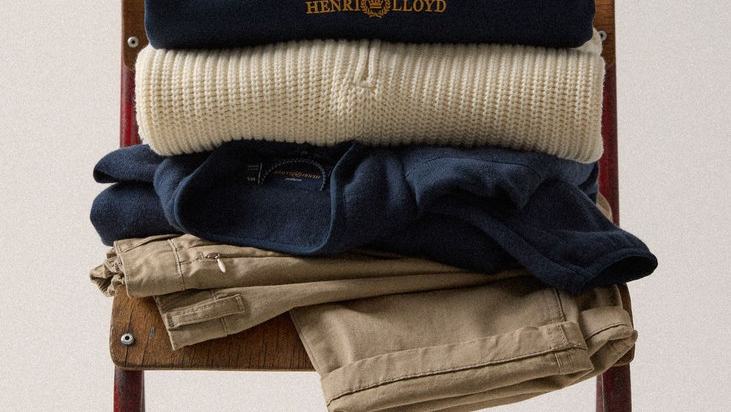
Henri-Lloyd has outlined its 2026 holiday collection of maritime clothing and accessories, from £12 keyrings to technical jackets and waterproof travel bags for life around the water.
Luxury maritime lifestyle and seasonal shopping preview, 12 November 2026. These are advertised UK prices and products from Henri-Lloyd's 10 November press announcement, not personally tested recommendations or a claim that every garment is certified for offshore professional use.
Gifts shaped by travel and time on the water Henri-Lloyd has introduced its 2026 Christmas gift selection, combining nautical accessories, travel bags, merino knitwear and sailing-inspired outerwear across several price ranges. The brand's November 10 announcement, published through British Marine, presents a mixture of items intended for active boat users and pieces designed primarily for everyday winter wear. For superyacht owners, guests and crew, the most useful way to read the collection is through the practical demands of a particular itinerary. A waterproof travel bag serves a different purpose from a knitted jumper, while a casual jacket may be suitable for a shore visit without meeting the safety requirements for a winter passage. Product choice should be guided by fit, storage, durability and likely use rather than the assumption that every item carrying a maritime label is equally suitable aboard. The published prices are in British pounds and may vary with market, retailer, exchange rates or later promotions.
Small accessories can be the most useful part of a kit Henri-Lloyd begins its lower-priced gift ideas with a Storm Keyring advertised at £12, a Watch Beanie at £20 and a Storm Wash Bag at £35. These are modest products compared with a technical jacket, yet they may have a daily function during travel. A wash bag can keep toiletries organised inside larger luggage or hold small everyday items during a short shore stay. The company's release describes the Storm Wash Bag as waterproof with useful interior storage, but the degree of protection afforded in actual conditions must be checked against the product specification. Waterproof can refer to material, construction or a particular closure arrangement, and it should not be understood as permission to immerse a bag containing electronics. The simple practice of separating wet and dry items can make a crowded cabin easier to manage. Crew packing for a yacht handover may have different priorities from a guest arranging a weekend voyage.
Duffle sizes allow buyers to match the duration of travel The company's Storm collection includes a backpack advertised at £90 and three duffle bags: a 50-litre model at £129, a 70-litre model at £139 and a 90-litre model at £149. The range gives travellers a choice of capacity, but volume is not the only criterion. A bag carried across a tender, stored in a crew cabin or loaded into an aircraft may need to satisfy very different limitations. A large duffle is not automatically more convenient if it cannot be stowed efficiently or becomes cumbersome when full. Padded straps, handles, closure design and the possibility of compression all influence actual utility. The announced figures should be confirmed at the point of purchase, together with the current dimensions and any airline restrictions. Water resistance can be valuable around a marina, but even a bag described as waterproof should be inspected for how its closures perform in spray or accidental immersion. Important documents and sensitive electronics may still require additional protection.
Gloves and socks are practical rather than showy gifts The brand includes merino wool and cotton socks alongside sailing gloves, with short- and long-fingered gloves advertised from £40. This part of the selection is particularly relevant to people who actually work with lines, tenders or equipment. Correctly fitted gloves can help protect hands during suitable tasks, but they are not a universal answer for every deck hazard. Certain machinery operations may require different procedures or no loose gloves at all, depending on the risk of entanglement. Crew should follow the yacht's safety guidance rather than substitute retail packaging for a risk assessment. Socks and base layers are similarly dependent on fit, climate and personal comfort. Merino may appeal for its feel and layering properties, while cotton can suit less demanding circumstances. A gift can be appreciated because it is useful, but a sizing chart, return policy and knowledge of the recipient's preferences may matter more than a catalogue photograph.
Merino layers are designed for a winter wardrobe Henri-Lloyd offers Merino Core 160 short- and long-sleeved tops from £65, and a men's Airwool Merino Hoody at £160. The press information presents these garments as versatile options for layering during cooler weather. Layering is a familiar principle in marine clothing: the wearer can adjust insulation as activities and conditions change, rather than rely on a single heavy garment. Yet performance depends on the complete clothing system, including wind and weather protection. A merino base layer should not be mistaken for waterproof outerwear, and no thermal garment can compensate for unsafe exposure during severe conditions. For yacht guests travelling between Mediterranean ports in the shoulder season, a comfortable base layer may have more everyday value than a highly specialised racing item. For crew working on deck, it needs to be assessed within the prescribed clothing and protective-equipment requirements. The official collection is a retail preview, not a marine safety certification.
Classic knitwear brings a different kind of maritime style The announcement lists the Golant Ribbed Crew at £150 and Golant Quarter Zip Ribbed Knit at £175. It also offers the Voyager Rugby Shirt at £90. These are aimed at people who want a recognisably nautical influence without necessarily wearing technical equipment every day. A knitted crew neck may be comfortable for cooler evenings ashore, while a quarter-zip can make temperature adjustment easier in a more casual environment. Owners and guests may value pieces that move naturally from a yacht to a restaurant or hotel. However, yacht crew dress codes, safety rules and uniform arrangements are specific to the vessel and employer. A casual knit should not automatically be described as suitable workwear for every crew role. The quality of a garment will be judged through actual wear, care and longevity rather than by its festive positioning. Buyers should ask how the material is to be washed and dried, especially during extended travel where specialist laundry facilities may not be available.
The Breeze and Bergen jackets move towards outerwear Henri-Lloyd identifies the Breeze jacket as an important part of its collection, with new colours and variations providing different warmth and protection levels. The advertised starting price is £165. The Bergen Hooded Jacket, at £195, is presented as a practical choice for cooler and unsettled conditions. The crucial difference between fashionable nautical styling and real weather protection lies in the garment's stated construction and intended use. A crew member planning a watch in exposed seas needs to examine the actual waterproof rating, breathability, seams, hood design and compatibility with personal flotation or safety equipment. A guest walking between marina buildings may have a much less demanding requirement. The company's broad description of protection levels is useful as an introduction but does not replace the technical details for each version. Even jackets from the same model family may differ in lining, warmth and suitability for different activities.
Originals connects the brand's history with current fashion The late-2026 Originals line revisits pieces associated with Henri-Lloyd's longer design history. The release names a Jib Jacket at £265 and a Consort RWR at £395 among its premium gifting ideas. The company presents the range as reinterpreting familiar styles for today's market while retaining an association with maritime performance. Heritage design can appeal to owners and guests who like clothing with a recognisable story, but a historic name does not prove that a new garment is identical to an older technical version. Modern fabrics, manufacturing arrangements and target customers can all differ. A buyer interested in function should examine the current specification rather than infer performance from the jacket's history. Someone shopping for style may reasonably make a different choice. Both types of use can be valid, provided the distinction is clear. Nostalgia is part of the collection's commercial appeal, not a substitute for describing how a garment is constructed today.
Selecting gifts for yacht crews requires particular sensitivity A yacht's guests may enjoy receiving nautical clothing, but gifts for crew deserve careful thought. Working uniforms and personal protective equipment are often supplied or specified by the employer; a casual clothing gift should not be presented as a replacement. Crew may also have limited cabin storage, international luggage restrictions and practical preferences shaped by their jobs. A compact accessory or an item that can be used ashore may be more welcome than a bulky garment chosen without consulting the recipient. In some operations, gifts may intersect with company policies or professional boundaries, particularly when they come from suppliers. The appropriate approach is to respect the individual's preferences and the yacht's management arrangements. Henri-Lloyd's range creates options at several price levels, but a good choice is one that suits the person rather than the sender's idea of what a sailor should wear.
Seasonal prices should be compared with actual needs The collection is promoted online with gift groupings below £50, below £150 and above £150, providing a convenient entry point for different budgets. Such categories can simplify browsing, yet the best value depends on whether the item will be used. A £35 bag that becomes part of a routine may prove more useful than an expensive jacket that does not fit the recipient or the conditions. The stated prices are not evidence of independent quality rankings or long-term durability. Buyers should consider the return period, sizing, care instructions, actual stock and shipping arrangements. Ordering for international delivery introduces potential customs duties, taxes and timing issues that are separate from the UK list price. Anyone planning gifts for a yacht party moving between ports should also establish where the goods will be delivered and who is authorised to receive them, rather than assume a courier can reach a vessel at short notice.
Practicality remains the defining marine test Henri-Lloyd's 2026 festive selection ranges from small accessories to larger bags, knitwear and technical-styled jackets. The source announcement identifies prices, product families and a holiday shopping emphasis but does not provide independent long-term testing across the collection. For Superyacht Guide's readership, the useful approach is to assess the products through actual marine and travel requirements while recognising that many pieces are intended chiefly for comfortable life ashore. A well-chosen garment may make a cold evening more pleasant; a sturdy bag may help protect possessions during a transfer; a pair of gloves may be useful for specific, authorised tasks. None of those benefits requires treating a promotional catalogue as a safety manual. The seasonal range offers a reminder that maritime style and functional equipment can sit beside each other, but their intended uses need not be confused. Buyers should confirm current specifications and prices directly with the retailer.
Primary source: British Marine and Henri-Lloyd, 10 November 2026, Nautical-Inspired Christmas Gift Collection.